For modulating service, electric actuators require gear-backlash control inside roughly 1-2 degrees of output-shaft angular play to keep positioning error and deadband within typical process-control budgets, whereas pneumatic rack-and-pinion and scotch-yoke designs routinely tolerate several degrees of backlash because their output is defined by end-stop air pressure rather than absolute shaft position [S1][S2].
This is the practical hinge spec: if the downstream control loop needs 1-3% throttling accuracy, the actuator's backlash is the dominant mechanical error source, and the choice between an electric actuator and a pneumatic valve actuator shifts from "power source preference" to a gear-mesh and signal-interface question. The same applies inside electric ball valve packages, where factory-assembled ball-screw or worm-gear trains carry their own backlash budget.
What "Gear Backlash" Means at the Actuator Output
Backlash in a valve actuator is the angular free travel at the output drive when input command reverses, before the gear train re-engages and the valve stem actually moves. In a multi-turn worm-gear electric actuator, backlash stacks across the worm/wheel pair plus any intermediate spur or planetary stage, and OEM data sheets for the Valen Tech VTEM series list output torque from 100 N·m to 3000 N·m with output speeds of 18-144 rpm, the worm-gear geometry that delivers that range being the same geometry that defines its backlash figure [S1].
Two engineering points frame the spec: (1) backlash is mostly felt as deadband on small input changes near the setpoint, and (2) in spring-return pneumatic actuators, the spring force biases the rack against one pinion face, which mechanically takes up slack on the driving side but leaves measurable play on the opposing coast side. For a pneumatic actuator sized for a class 150-300 ball or butterfly valve, this play shows up as 1-3% stroke uncertainty at the positioner, not as a hard fault.
Decision Criteria: Electric vs Pneumatic on Backlash Sensitivity
Five criteria separate the two architectures on backlash-driven performance: positioning accuracy, fail-safe behaviour, cycle life, environment, and integration cost. Electric actuators win on accuracy and signal resolution because their gear train drives a position-controlled motor with encoder feedback, and backlash is corrected in software. Pneumatic actuators win on fail-safe and overload tolerance because stored spring energy drives the valve to a safe position on air-loss regardless of gear state. [S1]
On cycle life, pneumatic rack-and-pinion units typically rate in the 500,000-1,000,000 cycle band for on-off duty, while electric actuators with brushless motors and properly greased worm gears match or exceed that figure in throttling service where partial stroking is the norm. The catch is environment: electric actuators with IP67/IP68 enclosures and ATEX/IECEx certification handle Zone 1 areas but cost more than a comparable pneumatic package, especially when instrument air is already available on site. AUTORUN markets both families across petroleum, chemical, light-industrial, metallurgy, HVAC, medical, fire-protection, and water-treatment sectors, reflecting the fact that the right choice is duty-driven rather than brand-driven [S2].
Typical Spec Ranges from Current OEM Catalogs
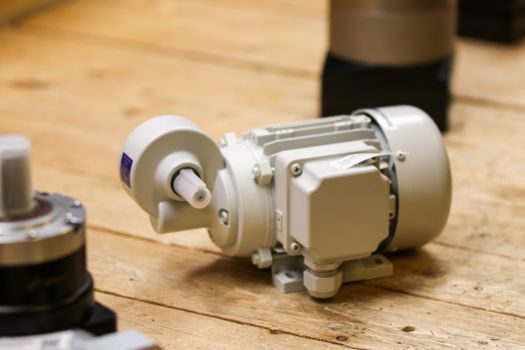
The Made-in-China sourcing index lists 483 manufacturers offering 1,449 electric-actuator-for-gate-valve product lines, with 24V/110V DC and 110V/220V/380V AC supply, 4-20 mA current-loop or 0-10 V DC voltage command inputs, and integral positioner/limit-switch options as the baseline configuration seen across the AUTORUN ODL series [S2][S5]. Torque output scales in bands (small: 50-300 N·m for 1/2"-2" ball valves; mid: 300-1500 N·m for 2"-6" butterfly valves; large: 1500-3000 N·m for 8"+ valves) and the Valen Tech VTEM series covers 100-3000 N·m at 18-144 rpm output speed [S1].
Pneumatic actuator packages show a similar torque stack but add air-supply pressure as a working variable: most double-acting and spring-return rack-and-pinion units are rated for 4-8 bar instrument air (standard plant air), and torque output rises with supply pressure, which is why the same physical actuator can drive a larger valve at 6 bar than at 4 bar. Scotch-yoke variants trade a more compact envelope for higher breakaway torque at the same supply pressure, which matters on resilient-seated butterfly valves where seating torque spikes at the closed position. The Hearken, GWALL, and valves-actuator.com catalogs all position scotch-yoke and rack-and-pison pneumatic products alongside electric units, confirming that integrators routinely mix the two on the same skid [S3][S6][S7].
Backlash in Throttling vs On-Off Service
For on-off (isolation) duty, backlash is a non-issue: the actuator drives the valve from one end-stop to the other, the gear train slams into the seat, and any angular play is absorbed in the seat contact. The Valen Tech VTEM at 18-144 rpm output speed can stroke a 2" ball valve fully open to fully closed in well under a second at the top of that range, and backlash contributes nothing to that operation [S1].
For throttling (modulating) duty, backlash becomes the dominant mechanical error: with a 4-20 mA setpoint commanding 50% opening, a 2-degree output backlash translates to roughly 0.5% of stroke that the input must traverse before the stem actually moves, which appears in the control loop as deadband and, in cascade loops, as limit-cycle hunting around setpoint. Electric actuators with servo-closed-loop control can be backslash-compensated in firmware, and high-end units specify <0.5% hysteresis, while pneumatic positioners typically quote 1-2% hysteresis, with the gear-train contribution being one of several error sources alongside packing friction and supply-pressure variation.
Selection Matrix by Application
Choose pneumatic (rack-and-pinion or scotch-yoke) when the service is on-off or open-close, the plant has reliable instrument air, the ambient area classification demands a simple pneumatic I/P interface, and a 1-2% hysteresis is acceptable; typical examples are block-valve isolation on pipelines, ESD (emergency shutdown) valves where stored spring force must move the valve on air loss, and tank-farm butterfly valves where cycle time is set by stroking speed rather than positioning accuracy. [S1]
Choose electric when the duty is modulating, the loop requires 0.5-1% positioning accuracy, instrument air is unavailable or expensive to run, and the operator wants remote setpoint, HART or Fieldbus diagnostics, and no air leaks to manage. Gate valves in clean power-plant cycling service and chemical-plant dosing loops are classic electric fits, especially when the gear train is enclosed, lubricated for life, and rated for the ambient temperature window. As a process engineer looking at a pneumatic conveyor cell or a pneumatic valve actuator manifold, the same logic applies: pneumatic for high-cycle on-off, electric for accurate modulation. For related decision logic on adjacent components, see this pneumatic tubing selection guide for conveyor cells and this solenoid vs diaphragm valve actuation speed map.
Failure Modes and Limits to Watch
For electric actuators, the gear-train failure modes are wear-induced backlash growth, lubricant depletion at high cycle counts, and motor stalling on a jammed valve stem, which trips the torque limit and forces a fault rather than a hard failure. Pneumatic failure modes are O-ring and seal wear on the rack-pinion interface, spring-set degradation in spring-return units, and positioner drift from supply-pressure fluctuation, which can mimic backlash in the control loop. [S1]
On hazardous-area installations, both families ship with ATEX/IECEx-certified enclosures, but the certification scope differs: electric units certify the motor and terminal enclosures as a unit, while pneumatic units certify the actuator body and the solenoid/positioner separately, and the integrator is responsible for the interface. On hygienic or washdown service, pneumatic stainless actuators are easier to clean because there is no motor housing, while electric units need IP67/IP68 ratings plus a sealed cable entry to survive the same washdown. These constraints push selection toward pneumatic in food/beverage and toward electric in dry, electrically clean plant areas such as power and water-treatment DCS rooms.
Trackable signals for the next 6-12 months: new ATEX/IECEx dual-certified electric actuator SKUs from Chinese OEMs such as AUTORUN and Hearken pairing 4-20 mA + HART with brushless servo drives; expanded 24V DC electric-actuator catalogs targeting solar-powered remote manifolds where instrument air is unavailable; and continued pneumatic price compression on commodity rack-and-pinion units, with Made-in-China listings showing mass-market double-acting stainless ball-valve assemblies at the lower end of the price band [S2][S4][S5][S7].