
In a single-instrument QA bench the deciding line is whether the rest of the cell also needs IP services: a serial device server does one job — encapsulate RS-232/RS-485 from a surface roughness tester onto TCP/UDP — whereas an industrial router adds firewalling, VPN, NAT, and often 4G/Wi-Fi as well, for roughly 2–5× the unit price.
Use a serial device server when the tester is the only networked asset at the workstation and a fixed LAN drop is available; reach for an industrial router the moment the cell needs PLC/HMI traffic, remote vendor access, or a cellular failover for an unattended surface-measurement station.
Decision criteria: port count, protocol, isolation, environment
Serial device servers typically expose 1, 2, 4, 8 or 16 asynchronous serial ports (RS-232, RS-422, RS-485, often selectable per port), with surge protection on the line side and a 10/100 Mbps Ethernet uplink [S2]. Industrial routers replace that single function with 2–5 switched Ethernet ports, a serial port or two for legacy gear, and a WAN interface that may be fibre, DSL, LTE/4G, or 5G depending on model [S2].
For a surface roughness tester on a shop floor the practical differences are: serial servers are usually rated 0–60 °C, DIN-rail or wall-mount, 9–48 VDC, while industrial routers add −40 to +75 °C operating ranges, conformal coating, and IP30–IP41 metal housings that survive switchgear cabinets and outdoor enclosures. Where Ra/Rz data has to cross a hazardous-area boundary, neither replaces an Ex-certified gateway; the decision is still router vs server inside the safe-side cabinet.
Surface-measurement data flow: what each device actually does
A serial device server listens on a TCP port (commonly RFC 2217 for COM-port redirection or raw TCP) and forwards bytes between the profilometer's UART and the SCADA/MES client, leaving protocol parsing to the application [S3]. Latency is sub-5 ms on a 100 Mbps LAN, and most units sustain 921.6 kbps per port, which is well above the 9.6–115.2 kbps a Ra stylus probe or optical roughness sensor typically streams.
An industrial router carries that same serial traffic plus full L3 routing, stateful firewall, IPSec/OpenVPN, and usually a 4G/5G modem. The trade-off is configurability overhead: VPN bring-up, SIM/APN provisioning, NAT rules, and routing tables must be maintained, which is overkill if the surface roughness tester is the only device on the cell. For multi-vendor cells mixing roughness testers, industrial borescopes, and industrial adhesive dispensers, the router consolidates uplink duties and centralises security policy.
Comparison matrix: serial server vs industrial router for a roughness cell
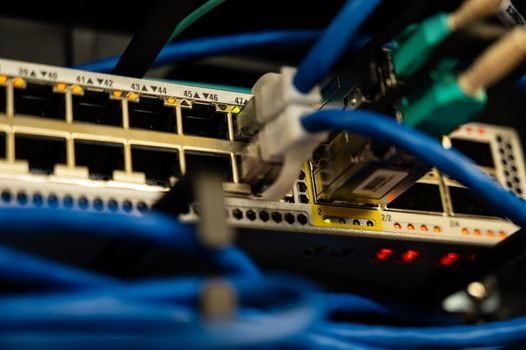
Decision criteria side-by-side: <strong>Cost</strong> — serial server USD 60–250 per port, industrial router USD 300–900 single unit. <strong>Serial port density</strong> — serial server wins, 1–16 ports in 1U/DIN; industrial router usually caps at 1–2. <strong>Ethernet / WAN richness</strong> — industrial router wins, with 2–5 LAN ports plus LTE/5G/SFP WAN; serial server offers a single 10/100 uplink. <strong>Security</strong> — industrial router provides stateful firewall + IPSec/OpenVPN; serial server provides only ACL on IP/port. <strong>Environmental hardening</strong> — industrial router typically −40 to +75 °C, IP30 metal, conformal coat; serial server commonly 0–60 °C, plastic or basic metal. <strong>Configuration effort</strong> — serial server is plug-and-serial-to-IP; industrial router needs VPN, firewall, routing, possibly APN setup. <strong>Power</strong> — both accept 9–48 VDC; industrial routers add redundant input on premium units.
For a bench-top Ra tester in a temperature-controlled metrology room the serial server is the lower-effort, lower-cost fit. For a cell on a CNC shop floor where the industrial buzzer alarms, the roughness tester, and a dispensing station all need to ride the same uplink to a remote QA database, the industrial router is the justified spend.
Where the serial server is the wrong tool
If the surface roughness tester needs to be reachable from a remote engineer over a public network, a raw serial server exposed to the internet is unsafe — most units ship with no built-in firewall, only IP-based access lists, and have no VPN client. Routing that device through an industrial router with IPSec/OpenVPN and a stateful firewall is the correct architecture; pair that with a managed SIM for cellular redundancy where wired LAN is unavailable.
Conversely, deploying an industrial router to serve a single profilometer in a clean lab wastes 60–80 % of the unit's capability and adds a configuration surface that has to be patched. Use a serial device server, and only the serial device server, when the only payload leaving the cell is the metrology stream.
Integration with plant standards and SQC workflows
Both device classes commonly support MQTT, OPC UA, and Modbus TCP bridging on top of raw serial, which matters because Statistical Process Control (SPC) packages expect push or pull on a defined topic or register map rather than a serial port. A serial server in this role acts as a thin protocol converter; an industrial router can run an on-board container or Lua/Python script to do local aggregation before publishing, useful when the surface roughness tester reports every 200 ms and bandwidth is metered over LTE.
For full cell selection criteria across QA instrumentation see the metering-pump spec-driven decision map and the paint-booth Ex-lighting spec map; for the upstream mechanical side of the cell the vacuum die-casting machine spec map and V-ribbed belt selection for servo axes are the practical references. None of these four articles replaces the cell-level network decision, but together they cover the surrounding BOM.
Limits, failure modes, and what to verify before purchase
Serial server failure modes: dropped TCP sessions on long idle runs (mitigate with keep-alive timers 5–30 s), RS-485 termination/ biasing mistakes on multi-drop lines, and proprietary Windows utilities that lock the device to one vendor's COM-port driver. Industrial router failure modes: VPN tunnel flapping on flaky cellular RSSI, NAT hairpinning when the SCADA server and the cell are on the same subnet behind the router, and licensing tiers that gate IPSec or 5G features behind a paid key.
Verify before specifying: the exact RS-232/422/485 mode the surface roughness tester requires (asynchronous, 7/8 data bits, parity, flow control); the operating temperature envelope of the cabinet (industrial router if > 60 °C or < 0 °C); whether the cell needs remote vendor access (industrial router with VPN); and whether the SCADA host expects raw TCP, RFC 2217, or Modbus TCP — most modern profilometers default to ASCII over RS-232 at 9600–115200 bps, which both device classes can carry without protocol conversion.
Bottom line for procurement: the serial device server is the right box when the roughness tester is the only networked device in the cell and the LAN is trusted; the industrial router is the right box the moment the cell needs VPN, cellular, firewalling, or multi-Ethernet aggregation. Most surface-finish cells start with a serial server and migrate to an industrial router when the second networked instrument arrives — that migration is the signal to spec the router up front, not after the second retrofit.