
Global server hardware supply in mid-2026 still routes through three identifiable procurement tiers — Tier-1 branded OEM (Dell PowerEdge, HPE ProLiant, Lenovo ThinkSystem, Inspur), Tier-2 white-box ODM (Quanta, Wiwynn, Foxconn), and Tier-3 industrial-China assemblers listed on B2B directories such as made-in-china.com — and the boundary between Tier-2 ODM and Tier-3 integrator is where most sourcing engineers now look for cost relief [S1].
China's export-oriented server listings on made-in-china.com run to thousands of active manufacturer profiles covering 1U/2U/4U rack chassis, GPU servers, storage JBODs, and tower workstations, with the typical supplier band offering OEM/ODM services, 100–1000 W single-PSU configurations and 80 Plus rated power supplies [S1]. For a process-engineer audience this matters because industrial plants, edge data rooms and SCADA cabinets now consume the same x86 and ARM server SKUs that hyperscalers deploy, just in smaller lot sizes and harsher environmental envelopes.
Tier-1 Branded OEM: Dell, HPE, Lenovo, Inspur Spec Anchors
Dell's Server Hardware Manager (SHM) utility — version 1.7 for Storage and JBOD Arrays — illustrates the integration depth Tier-1 OEM customers expect: a Windows Installer package that inventories backplanes, EMMs, BBUs, and PSU firmware revisions across MD-series dense enclosures and SC-series JBODs [S2]. SHM 1.7 is a Recommended (not Optional) driver on Dell's support matrix, and ships in tandem with the per-array firmware bundles rather than as a standalone agent [S2].
For Oracle RAC deployments, the reference spec floor sits at a 2-node cluster minimum with at least 1.6 GHz CPU, 8 GB RAM, 1 Gbps private interconnect, and on the OS side Linux x86-64 or Oracle Solaris SPARC — these are the values that Tier-1 OEM reference architectures are quoted against [S3]. Microsoft hardware guidance adds the power dimension: x86 server platforms now routinely plan for 80 Plus Platinum/Titanium PSUs and per-rack PDU budgets in the 7–15 kW range, driven by higher TDP processors and GPU accelerators [S4]. Process engineers translating this to plant-IT rooms should budget 4–6 kW per rack for 1U dual-socket general-purpose servers, 8–12 kW per rack for GPU/AI edge nodes.
Tier-2 White-Box ODM: Quanta, Wiwynn, Foxconn Hyperscaler Supply
Hyperscaler demand in 2026 is still served predominantly by ODM direct — Quanta Computer, Wiwynn (a Quanta spin-off), Foxconn (Hon Hai), Inventec, Wistron — all of whom design motherboards and chassis to a customer spec and ship in container-load volumes at the lowest cost per U. The defining spec levers at this tier are: 1U/2U density, NVMe-only backplanes, OCP 3.0 NIC slots, and liquid-cooling-ready cold-plate interfaces for TDP 250–350 W CPUs. Buyers who can absorb 5,000+ unit annual volume get these at materially lower unit cost than Tier-1, but lose the integrated management layer (iLO/iDRAC/OpenBMC equivalents) and the global spares pool. [S1]
Edge-of-network and industrial buyers rarely reach Tier-2 ODM minimum order quantities, so the practical procurement path for plant-IT and SCADA-adjacent server rooms remains Tier-1 OEM or Tier-3 integrator. The Wikipedia-stable architecture anchors (CPU socket maps, PCIe lane counts, BMC chip selection) are identical between Tier-1 and Tier-2; what differs is the management software stack and the warranty/SLA envelope. Buyers who want a hybrid — Tier-2 motherboard with Tier-1-style management firmware — increasingly specify OpenBMC plus Redfish-compliant APIs, which both Inspur and Lenovo now support on their volume SKUs.
Tier-3 China Industrial Assemblers: Made-in-China.com SKU Bands

The made-in-china.com server vertical (the S1 listing) indexes several thousand manufacturer profiles, of which the surfaced active subset typically offers: 1U/2U/4U rack-mount general-purpose servers, GPU servers (4–8× PCIe slots), storage servers with 12/24/36-bay backplanes, and tower workstations, with OEM/ODM service flags and a self-reported R&D capacity line [S1]. Pricing on this channel is typically quoted FOB Shenzhen/Ningbo per unit, with MOQ bands of 1–5 units for stock SKUs and 20–100 units for custom configurations.
Spec discipline matters more than price on this tier: insist on 80 Plus rated PSUs, named BMC chip (Aspeed AST2500/AST2600 or equivalent), a real warranty statement, and a published MTBF figure. Two procurement red flags on Tier-3 are (1) unnamed CPU SKUs ("Xeon-compatible" without a model number) and (2) a single-PSU configuration in a chassis physically able to hold two — these usually mean a refurbished or bin-sorted unit. For a working spec list the safe defaults are: dual hot-swap PSU bay populated with two 80 Plus Platinum units, IPMI 2.0 / Redfish BMC, ECC RDIMM slots at DDR4-3200 or DDR5-4800, and at least one PCIe 4.0 x16 riser.
Selection Criteria: TCO, SLA, Form Factor and Cert Scope
For industrial buyers, the four real decision criteria between the three tiers are: (1) 5-year TCO including spares and management tooling, (2) SLA response time and on-site coverage geography, (3) form-factor match to the existing rack (depth, rail kit, airflow direction), and (4) certification scope for the deployment environment. A typical comparison: Tier-1 OEM quotes 5-year TCO at roughly 1.8–2.2× the bare-box cost once ProSupport/iLO licenses are layered in, Tier-2 ODM at 1.2–1.4×, and Tier-3 industrial at 1.0–1.3× — but Tier-3 typically carries a 1–3 year warranty versus 5-year on Tier-1, so the TCO gap narrows by year three. [S2]
Cert scope is where Tier-1 still wins for regulated plants: NEBS Level 3 conformance for telecom-edge rooms, UL 60950-1 / IEC 62368-1 for IT safety, and Energy Star 4.0 for federal/enterprise procurement are pre-attested on PowerEdge/ProLiant SKUs. Tier-3 listings on made-in-china.com may carry CE/FCC marks but rarely NEBS, and CE/FCC paperwork should be requested as a PDF rather than relied on from a flag [S1]. For plants in ATEX/IECEx-zoned areas the server itself almost never sits inside the hazardous area, but the routing, cable glands, and fiber interfaces into Zone 1 boxes must be specced separately — a problem shared with broader industrial hardware sourcing profiles such as those catalogued on the architectural hardware spec page.
Use Cases: Edge, SCADA, Plant-IT and AI Inference
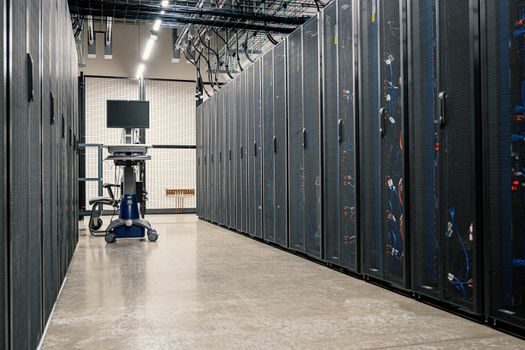
The four dominant plant-IT use cases for 2026 server procurement are: (a) edge aggregation nodes at 1–3 kW per rack for SCADA historians (PI, Wonderware, Ignition), (b) on-prem AI inference racks for vision-based quality inspection (4–8 GPU, 8–15 kW per rack), (c) MES/ERP application servers at 4–6 kW per rack, and (d) storage-only JBOD arrays at 2–4 kW per rack with 60–100 bay high-density shelves. Dell's SHM 1.7 tool is explicitly built for case (d) — it inventories and updates the EMM/PSU/BBU firmware on Storage Center and MD-series JBODs as a unit, which is the same operational pattern industrial MES teams use for SAN-attached historian disks [S2].
For Oracle RAC on industrial deployments the published hardware floor is 1.6 GHz, 8 GB RAM, 1 Gbps private interconnect with the same OS support matrix as enterprise RAC [S3]. That floor is generous enough that any Tier-1 or Tier-2 dual-socket server built in the last five years will clear it; the binding constraint in plant-IT is almost always storage I/O and interconnect redundancy, not CPU. For the power budget side, the Microsoft hardware guidance is the cleanest open reference: plan rack PDU headroom at 1.3–1.5× the nameplate server draw to absorb inrush, redundancy switching, and peak GPU load [S4].
Constraints, Failure Modes and Sourcing Risk
The two highest-probability failure modes in industrial server procurement are (1) thermal derating inside a sealed plant-IT cabinet versus a data-center cold-aisle, and (2) firmware lock-in that prevents a Tier-3 box from receiving security patches. Thermal: a 1U server rated for 35 °C inlet in a data hall will throttle at 25 °C inlet inside a 19-inch cabinet with no front-door ventilation — spec the chassis with front-to-back (not side-to-side) airflow and verify the cabinet's net inlet temperature. Firmware: Tier-1 OEMs publish CVEs and patches on a regular cadence; Tier-3 China integrators typically do not, so any box not backed by a public advisory feed is a security liability for plant-IT that touches OT networks. [S3]
Two related comparison axes worth flagging: network-attached industrial sensors and instrumentation (catalogued on the pressure transmitter spec page and the pressure sensor spec page) increasingly need a server-side gateway with serial-server or Ethernet-APL termination — the same BOM exercise applies, just at the gateway tier rather than the rack tier. Spec discipline that prevents scope drift: keep the server procurement decision on TCO, SLA, form factor and cert scope, and let the gateway/sensor procurement follow its own spec list rather than bundling both into one vendor agreement.
Trackable next nodes for plant-IT server procurement: (1) the August 2026 refresh of Energy Star for servers (4.0→4.1 expected, but pin to the official spec page once published); (2) Hyperscaler ODM leakage of PCIe 5.0 / DDR5 white-box units into the Tier-3 channel as the platform generation rolls over; (3) the published SHM successor to v1.7 — Dell's support catalog is the canonical feed to watch for industrial JBOD owners [S2].
For related coverage, see Zinc Die Casting Machine Suppliers 2026: China OEM Map, Tonnage Bands and Sourcing Reality.