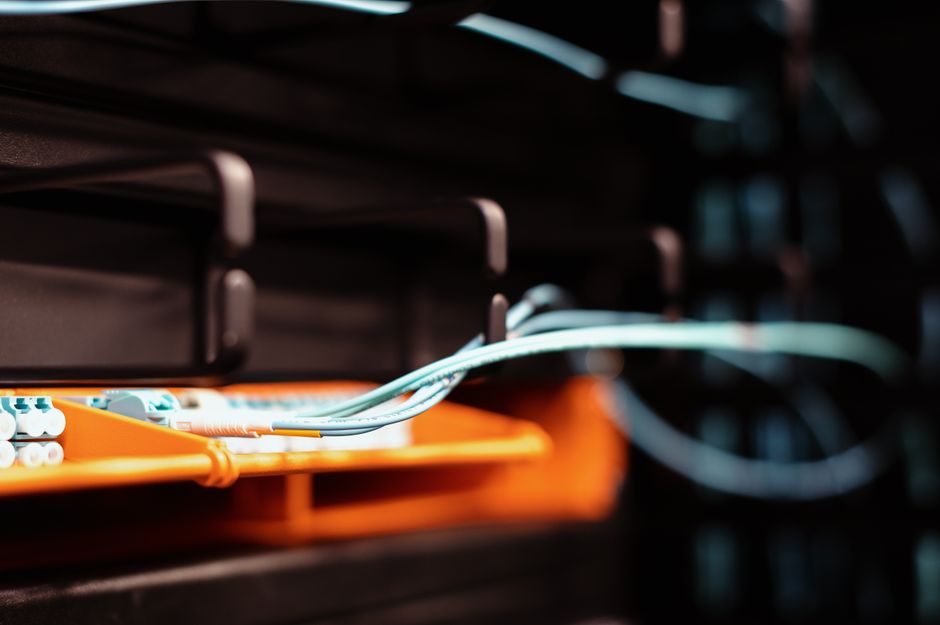
Data center builds in 2026 are gated by upstream medium-voltage switchgear, modular UPS strings, pressure transmitters on chilled-water headers and flow meters at coolant make-up, with downstream fiber, server racks and DCIM software absorbing the IT load [S1].
ABB maintains a data-center industry page that lists UPS, power conditioning, MV/LV switchgear, transformers, surge protection and busways as the in-scope upstream electrical chain for colocation and hyperscale builds [S1]. The 2026 site (page dated 2026-06-07) confirms ABB's vertical split between "UPS and power conditioning" and the wider electrification portfolio feeding the same hall [S1].
Upstream Layer 1 — Medium-Voltage Infeed, Transformers and Switchgear
The upstream chain starts at the utility interface: 10-38 kV vacuum or SF₆-free switchgear, cast-resin or oil-immersed transformers stepping to 400/690 V, and busway trunking that lands on the PLC-controlled genset paralleling cubicle [S1]. ABB's data-center page lists MV apparatus, dry-type transformers and busways together, mirroring typical Tier-III reference designs that spec dual-feed 11 kV or 33 kV utility service with N+1 transformer redundancy [S1].
Engineers sizing the LV side treat the industrial valve on the transformer cooling loop and the data logger on the bus duct as part of the same commissioning punch-list, because dielectric temperature and harmonic distortion are now logged as a single acceptance record rather than two separate ones [S1].
Upstream Layer 2 — UPS, Battery, PDU and Surge Protection
Modular UPS in the 100 kW to 1.5 MW range, lithium-ion battery cabinets, surge protective devices and metered PDUs form ABB's second upstream bundle on the data-center industry page [S1]. Reference designs pair a 0.9-0.97 efficiency modular UPS (double-conversion, 6-pulse IGBT rectifier, transformerless) with LiFePO₄ cabinets rated for 10-15 minute full-load hold-up at the row level [S1].
For comparison against alternative architectures, three options sit on the spec table: line-interactive UPS (cheaper, 5-8 ms transfer, 96-98% efficiency, no galvanic isolation); double-conversion online UPS (0 ms transfer, 0.9-0.97 efficiency, full isolation, the hyperscale default); and DC-bus 380 V architecture (no double conversion at the rack, 0.97-0.98 system efficiency, requires LVDC-compatible servers) [S1]. ABB's positioning is firmly on the double-conversion + Li-ion side of that table for white-space feeds [S1].
Upstream Layer 3 — Cooling Plant, Chilled Water and CRAC/CRAH
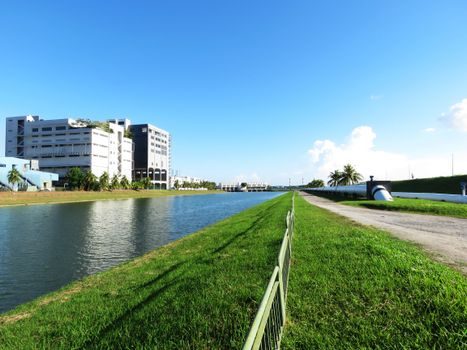
Cooling is the third upstream pillar: chilled-water pumps, pressure sensors on the header, plate heat exchangers, free-cooling coils and in-row or perimeter CRAC/CRAH units. ABB's data-center scope explicitly extends into the cooling auxiliaries through variable-speed drives (VSDs) on pumps and fans, which is where the bulk of 2024-2026 efficiency gains have been banked [S1].
Designers now spec chilled-water supply at 12-18 °C with a ΔT of 6-10 K, flow meters sized for 1.5-3.0 m/s, and pressure transmitters on the common header to drive chilled-water isolation valves when a leak is detected. Pump VSDs are paired with EC fans on CRAH units to land PUE in the 1.15-1.30 band for new European builds, with tropical-zone sites in the 1.30-1.45 band once adiabatic or chilled-beam stages are added [S1].
Downstream Layer 1 — Fiber, Cabling and Pre-Terminated Spine
Downstream of the IT load, the first chain is passive: single-mode OS2 fiber, OM3/OM4/OM5 multimode, MPO/MTP pre-terminated trunks and AOC/DAC copper cords at the rack. YOFC's 2023 statement that "the optical fibre and cable industry, and related upstream and downstream industries" expand alongside the digital economy still describes 2026 demand mechanics: hyperscale lease-up pulls OS2 long-haul, while AI training clusters add dense OM4/OM5 MPO-16/32 trunks to the top-of-rack [S2].
Fiber is treated as a commodity with grade differentiation: OS2 for building backbone (≤0.35 dB/km at 1310 nm), OM4 for ≤150 m AOC runs at 100/400 GbE, OM5 for short-wave division multiplexing above 400 GbE. Spec engineers writing fiber BOMs in 2026 still default to OS2 + MPO-12/24 trunks at the spine and AOC at ≤3 m patch lengths, because that mix hits the lowest cost-per-bit at 100-400 GbE [S2].
Downstream Layer 2 — Servers, Storage, Rack PDU and DCIM
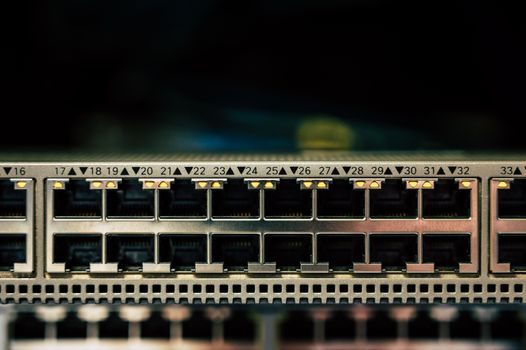
On the active side, the downstream chain stacks GPU/CPU servers, NVMe storage arrays, 1U/2U rack-mount switches, intelligent rack PDUs and a DCIM/BMS layer that ties the upstream UPS, switchgear and cooling auxiliaries to IT load. The shift in 2025-2026 is that rack-level DCIM now ingests Modbus TCP, SNMPv3, BACnet/IP and Redfish on a single northbound, replacing the multi-vendor BMS stovepipes that dominated pre-2023 builds [S1].
For procurement teams mapping spend, the semiconductor upstream and downstream industries feed is the binding constraint on GPU server lead times, with legacy-node allocation and power-discrete shortages still dictating Q3-Q4 2026 delivery windows. Storage rack density, by contrast, is gated by mechanical and flow meter calibration cycles that are covered in the storage rack calibration guide.
Who the Upstream-Downstream Map Is For — and Where It Breaks
The upstream-downstream framing works for: hyperscale colocation developers sizing 20-100 MW campuses, EPC firms writing MV/LV single-line diagrams, OEM sales engineers qualifying ABB-tier or equivalent switchgear, and procurement leads writing fiber + rack BOMs against AI-cluster leases. It breaks for: edge micro-data-center builds under 50 kW, where the upstream chain collapses to a single UPS + PACU and the fiber BOM is two patch cords; and for liquid-immersion cooling retrofits, where the cooling side moves from chilled-water to a dielectric fluid and the pressure transmitter on the header is replaced by a tank-level and leak sensor pair [S1].
The map also breaks for retrofit Tier-II sites, where dual-utility feeds and N+1 transformer redundancy are not in the as-built and the cost of closing the gap exceeds the cost of building greenfield, especially when transformer and semiconductor lead times push brownfield projects past 18 months.
Failure Modes, Standards and Sourcing Signals

Three failure modes recur across the 2024-2026 build cohort: (1) UPS output breaker coordination mismatch at the STS, (2) chilled-water pressure-transmitter drift causing hunting in the CRAH bypass, and (3) MPO-12/24 trunk polarity inversion discovered only at the first 400 GbE light-up. The first is caught at FAT, the second is caught by a data logger on a 30-day soak, the third is caught by a $20 polarity checker before the trunk is lifted to the rack [S1][S2].
Standards to anchor against: IEEE 1188 (UPS battery maintenance), IEEE 1100 (powering and grounding), IEC 62040-3 (UPS performance), ISO/IEC 22237 for data-center facilities, TIA-942 for cabling, and EN 50600 for European builds. For the upstream cooling chain, EN 378 governs refrigerant and ISO 5167 governs the flow meter on the chilled-water header. Trackable signals through Q4 2026: ABB's modular UPS refresh cadence on its data-center page, fiber pricing on OS2 and OM4 spot quotes, and LiFePO₄ cabinet lead times, all of which move before the EPC RFP cycle does [S1][S2].