Industrial servo drive prices on the open market span from about US$85 for a low-power hobby/RC-grade unit (50–200 W) to US$300+ for a 0.4–7.5 kW bus-controlled unit supporting Profinet or EtherCAT [S6]. The total landed cost of a servo motor + drive pair is governed by six hard levers: continuous power rating, feedback resolution, bus protocol, encoder type, MOQ band, and certification scope — not by brand premium alone.
For a 1.5 kW EtherCAT drive with 17/23-bit absolute encoder, Made-in-China listings cluster around US$140–168 per piece at 1-piece MOQ under the SVC300-series commercial class [S6]. The same physical rating from a US/EU specialist (e.g. ADVANCED Motion Controls, with 35+ years of manufacturing and a 14,000+ model catalogue) typically prices higher and is configured as a panel-mount module rather than a packaged unit [S2]. The price gap is paid for firmware maturity, support, and the breadth of analog/digital command interfaces.
Power Rating as the Primary Cost Lever
Continuous output power is the single strongest cost driver. Festo's product taxonomy groups servo drives from fractional-kW (50 W, 100 W, 200 W) up to 7.5 kW, with the 380 V three-phase class commonly used for machine-tool axes and packaging lines [S5]. At the low end, single-/three-phase 50–200 W units (200 V / 240 V) sit in the US$99–300 range per piece MOQ=1; at 7.5 kW the same bus-controlled architecture steps up in the same family [S6].
The rule of thumb process engineers use: cost scales roughly with the square root of power for the drive stage alone, and nearly linearly for the matched servo motor (because copper, magnets, and lamination mass scale with torque). A 0.4 kW drive is rarely the cheapest path to a 0.4 kW axis once the motor is added — this is why some builders consolidate to a higher-power drive and de-rate it.
Bus Protocol and Feedback Resolution Add 20–60%
Command interface is the second lever. Pulse/direction + analog command drives sit at the low end of the cost band. Stepping up to CANopen, Modbus, or basic RS-485 adds modest cost (typically 10–20% in the same physical power class). Profinet, EtherCAT, and EtherNet/IP — the protocols that dominate modern multi-axis machine builders — push cost higher again because the drive must integrate a dedicated ASIC and meet real-time jitter budgets [S5][S6].
Encoder feedback resolution is the third lever and is often underestimated. A 17-bit absolute encoder is now the de-facto baseline for industrial servo drives in the 0.4–7.5 kW class; 23-bit encoders (e.g. Ctsd-A6s-B1525-M100, 1.5 kW class) appear on higher-tier models and add incremental cost per axis [S6].
Analog, Panel-Mount and Module-Class Architecture
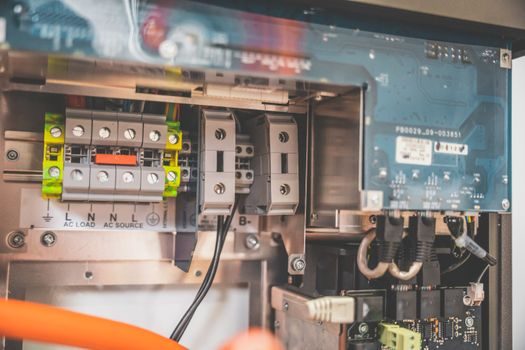
DirectIndustry's industrial manufacturer index for "analog servo drive" returns 24 manufacturers offering 125 products, with ADVANCED Motion Controls holding 63 of the 125 SKUs and Beijer Electronics, Copley Controls, and Cambridge Technology covering much of the remaining specialist space [S1]. This skews the long tail: most catalogued analog drives are PCB-style panel-mount modules intended to be integrated by an OEM, not boxed consumer units.
ADVANCED Motion Controls' product page frames itself as a global motion-control specialist with 35+ years in manufacturing and 14,000+ part numbers — a footprint consistent with a catalog that serves integrators across PCB-mount, panel-mount, and packaged form factors [S2]. For buyers, the practical consequence is that a fair price comparison is impossible without fixing the form factor and the command interface first.
Reference Designs and Open-Source Drive Builds
Texas Instruments' TIDM-SERVODRIVE reference design and the atopile spin-servo-drive open-source hardware project both sit in the public domain as of mid-2026, lowering the entry barrier for custom drive-stage development [S3][S4]. These designs typically expose a TI C2000-class DSP/MCU core with the gate drivers, current sense, and resolver/encoder interface fully mapped, but they are not turnkey products — the buyer still sources the bus protocol stack, certification, and enclosure.
The honest framing for a 2026 buyer: open-source and reference designs make sense when the drive is part of a differentiated product (custom motor, custom safety, or unusual form factor) and volume justifies the certification cost. For a one-off axis or a retrofit, a packaged industrial servo drive from an established catalog is almost always cheaper once labor and certification are counted [S3][S4].
Side-by-Side Cost Comparison: Three Common 1.5 kW Drive Classes

At 1.5 kW (a workhorse rating for packaging, small CNC, and pick-and-place axes), three classes compete on the open market: [S1]
1. Pulse/analog command, 17-bit encoder, single-phase 220 V: entry of the cost band, often US$99–140 per piece at MOQ=1; lowest integration cost when paired with a PLC or motion controller that already speaks pulse/direction [S6].
2. CANopen / Modbus command, 17-bit or 23-bit absolute encoder, 3-phase 220/380 V: mid-band, typically US$140–170 per piece MOQ=1 in the SVC300 class and similar; recommended for small multi-axis builds where real-time jitter under 1 ms is acceptable [S6].
3. Profinet / EtherCAT command, 23-bit absolute encoder, 3-phase 380 V: top of the open-market band, US$200–300+ per piece MOQ=1, with deeper discounts above MOQ=50; required for high-end packaging lines and CNC where sub-100 µs cycle times are mandated [S6].
The same three classes also exist in panel-mount / PCB-mount form factors from specialists, where the visible "drive" price is lower but integration labor, firmware, and certification push the total system cost above the packaged equivalent at low volumes [S1][S2].
What a Servo Drive is — and What it is Not
A servo drive (also called a servo amplifier) is the electronics unit that closes the position/velocity/torque loop around a servo motor, taking command setpoints from a PLC, motion controller, or analog source and producing the PWM'd three-phase (or single-phase for low-power) output that drives the motor [S5]. It is distinct from a stepper drive — servo drives close a feedback loop at the drive stage and are sized for continuous torque, while stepper drives operate open-loop and lose torque at speed.
It is also distinct from a variable-frequency drive (VFD). A VFD is built for induction-motor speed control in fans, pumps, and simple conveyors and rarely supports the high-bandwidth current loop or encoder feedback expected of a servo drive. Buyers who try to substitute a VFD for a servo drive on a position-controlled axis typically see poor dynamic response and no holding torque at zero speed. The same logic applies to a servo drive being asked to drive a linear-stage linear guide carriage or a crossed roller guide table — the drive is correct, but the mechanical loop still has to be sized for the desired stiffness and repeatability.
MOQ, Lead Time and Sourcing Risk
MOQ is the fourth hidden lever. Most open-market listings on Made-in-China-style B2B platforms default to MOQ=1 piece for industrial servo drives, with unit prices quoted in a band (e.g. US$140.00–168.00 for the SVC300 380 V 17A class) [S6]. At MOQ=50 and above, discounts of 10–25% are common on the same SKU, and the negotiation moves from a sales call to a quote thread with engineering support attached.
Lead time and sourcing risk are not visible in the unit price but dominate the total cost. Single-phase 50–200 W units and the 0.4 kW three-phase class tend to ship from stock; 7.5 kW Profinet/EtherCAT units often carry 4–8 week lead times when sourced outside the major European and Japanese OEM channels [S5][S6]. For plants standardising on a single drive family, this is the strongest argument for locking a frame agreement rather than spot-buying.
Certification Scope and Hidden Cost
CE is the baseline for industrial cabinets in Europe; UL / cUL is required for North American panel builders; ATEX/IECEx enters the picture for drives mounted in hazardous-area enclosures. None of the open-market listings cited here explicitly disclose multi-cert pricing, but the 14,000+ model catalog breadth of an established supplier [S2] is itself a signal that certification is treated as a product variant rather than a custom build.
A 2026 buyer's gate: before comparing two drives on price, fix the certifications, the bus protocol, the encoder interface, and the form factor. Only then does the price band quoted on a B2B platform become comparable across vendors [S1][S2][S6]. Skipping this gate is the single most common reason a "cheap" drive ends up costing more than a "premium" one once a real bill of materials is built.
Trackable signals for the rest of 2026: (1) any new EtherCAT or Profinet ASIC reference design published on TI's TIDM family, which tends to push mid-band prices down by 8–15% on the next product cycle [S4]; (2) updates to the atopile spin-servo-drive open-hardware project, which is a leading indicator of where hobby/low-end industrial pricing is heading 12–18 months out [S3]; (3) any stock-side shift in the 380 V 7.5 kW class, where current lead times of 4–8 weeks are the most likely point of supply-chain friction for late-2026 panel builds [S5][S6].
For related coverage, see Cold Box Core Shooter 2026 Buying Guide: Spec, Layout and Binder Drive Cost.