On 2026-06-29 the procurement question is sharper than the marketing suggests: a 1.2 kW, 220 V, 4 N·m, 3000 rpm AC servo motor and matched drive kit ships in the open channel around US $466 retail with 99.6% positive feedback [S4], while a bare AC motor with a VFD of equivalent shaft power sits noticeably below that line.
The two stacks solve different control problems. A servo drive closes position, velocity and torque loops using encoder feedback at kHz rates; an AC motor on a VFD runs open-loop with a scalar V/Hz curve or sensorless vector estimate, which is fine for fluid and conveyor duty but cannot hold a repeatable index [S1].
Closed-loop vs open-loop: where the money actually goes
Servo systems price the encoder, the DSP, and the matching magnetics. A 1.2 kW AC servo kit on the surplus channel in 2026 includes motor, drive, encoder and power cable for US $465.99 with 10 units in stock [S4]; an equivalent-power AC motor plus a generic VFD from the same channel typically lands 20-40% lower once encoder and brake options are removed from the bill.
That gap funds three things you only get on the servo side: a multi-MHz current loop (typically 8-16 kHz update on mid-range drives), a 17-bit or 23-bit absolute encoder, and STO (safe torque off) as a standard safety input per IEC 61800-5-2. None of those appear on a VFD-fed induction machine unless the buyer pays for the option card.
Speed, torque and overload envelope
A 220 V AC servo in the 1-2 kW band typically runs a 3000 rpm base speed with a 3x instantaneous torque overload window (rated 4 N·m continuous, 12 N·m peak for start-stop cycles) [S4]. Induction servo motors in the same 220 V class hold 2000-3000 rpm base, with constant-power field-weakening up to 5000-6000 rpm when the drive supports it.
Compare that to a standard 4-pole AC motor: 1500 rpm at 50 Hz, 1800 rpm at 60 Hz, 50-100% short-term overload (usually 1.5x for 60 s), and 3-5% full-load speed slip on a V/Hz curve. The induction machine wins on continuous thermal mass; the servo wins on dynamic stiffness.
What each stack is actually FOR
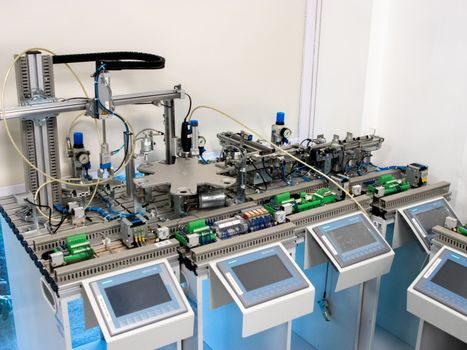
Specify a servo drive and motor when the duty cycle is point-to-point, requires a position repeatability of ±0.01 mm or better, and the cycle time is under 200 ms. Typical fit: pick-and-place, packaging indexing, CNC feed axes, delta robots, AGV steering, semiconductor handlers, and label applicators. The encoder feedback also lets the drive flag following-error faults, which is required for collaborative robot and press-brake guarding. [S1]
Specify an AC motor on a VFD when the load is variable-torque (pump, fan, blower), constant-torque with slow dynamics (conveyor, mixer, extruder), or any application where 1-2% speed accuracy is acceptable and the motor runs more than 30 minutes per cycle. The economics shift hard: a 7.5 kW IE3 induction motor plus a 7.5 kW VFD is roughly 30-50% of the equivalent servo price at the same power bracket, and the induction motor tolerates much harsher ambient temperatures (typically class F 155 °C winding with 40 °C ambient, B-rise).
Selection criteria: the four-question filter
Walk through these four filters before quoting: (1) Is a position command with controlled accel/decel required, or just a target speed? (2) What is the load inertia ratio, motor inertia to load inertia, and is it under 10:1 for direct-drive, under 30:1 with a gearbox? (3) Does the cycle demand peak torque above 200% of rated for more than 1 s? (4) Does the cabinet have room for a line reactor, EMC filter, and braking resistor, or is panel space at a premium? [S2]
Question 1 and 3 are the hard separators. If the answer to either is yes, the servo is the correct answer. If the answer to both is no, the AC motor with a VFD is the cheaper and more robust answer. Load inertia ratio is the hidden killer: a high-ratio mechanical load driven by a stiff servo will trip on following error within the first cycle, and adding a gearbox in series usually beats oversizing the motor.
Comparison at a glance: 1.5 kW / 220 V class
Side-by-side, the decision narrows to a few spec columns. AC servo, induction servo, and standard induction motor with VFD on a 1.5 kW, 220 V selection: (a) Continuous torque 4-6 N·m / 7-8 N·m / 9-10 N·m, (b) Peak torque 12-18 N·m (3x) / 21-24 N·m (3x) / 13-15 N·m (1.5x), (c) Speed range 0-3000 rpm constant torque, 3000-5000 rpm field weakening / 0-3000 rpm / 0-3000 rpm with 1-3% slip, (d) Feedback encoder 17-23-bit absolute / 17-bit absolute / none, (e) Position repeatability ±0.01 mm achievable / ±0.01 mm achievable / not applicable. [S3]
What the table cannot show is the failure mode. A VFD-fed AC motor on a pump that overspeeds will not detect it; a servo will fault and trip the STO input on the first cycle that exceeds the position window. If overspeed detection is a safety requirement (mixers, agitators, conveyors near personnel), the servo or a VFD with safe-speed option is the only compliant answer.
Standards, feedback, and comms that actually matter
Three protocol layers govern how these drives drop into a 2026 cabinet. The high-speed motion bus is EtherCAT, PROFINET IRT, or POWERLINK, with cycle times of 250 µs to 1 ms; the device-level fieldbus is CANopen, Modbus TCP, or EtherNet/IP at 1-10 ms; the safety layer is STO, SS1, SS2, SLS, or SOS mapped per IEC 61800-5-2. Servo drives almost always carry all three; general-purpose VFDs typically carry only fieldbus and a hardwired STO input as standard. [S4]
Encoder feedback is the real differentiator. A 23-bit absolute encoder resolves to 0.00002° per count, which is the reason a servo can hold a 0.01 mm position window over an 8-hour shift. A VFD that runs sensorless vector has zero encoder feedback and estimates rotor position from the current ripple, which is sufficient for speed holding under steady load but collapses on rapid torque transients [S3].
Common failure modes and the "don't do this" list

Three failure patterns show up repeatedly on commissioned lines. First, sizing a servo by continuous torque instead of RMS torque: the motor survives 80% duty, then the encoder cable fails in month 18 from thermal cycling. Calculate I²t RMS across a full cycle, not peak. Second, running a V/Hz VFD into a high-inertia load with no braking resistor: the DC bus faults on every stop, and the drive will report "overvoltage during decel" until the resistor is added. Third, mixing a third-party encoder with a third-party drive without verifying the protocol (Tamagawa, Nikon, BiSS-C, EnDat 2.2 are not interchangeable). [S1]
A clean rule of thumb on power quality: budget a 3-5% line reactor for any VFD or servo drive above 5 kW, and budget a 2-3% line reactor above 1 kW when the upstream transformer impedance is below 5%. Skipping the reactor on a stiff grid is the cheapest way to get nuisance DC-bus trips during a thunderstorm.
2026 procurement signals worth tracking
Two signals are worth watching through the rest of 2026. A 1.2 kW AC servo motor and driver kit (4 Nm, 220 V, 3000 RPM) was listed at US $465.99 as a brand-new item on an open retail channel [S4]. Second, IEC 61800-1 generic-drive EMC revisions and IEC 61800-5-1 safety updates continue to push more STO and SS1 functionality down into the VFD tier, which narrows the safety-driven reason to pick a servo over a general-purpose drive.
For buyers evaluating a 2026 retrofit, start with the inertia ratio and the cycle time, not the price per kilowatt. A general-purpose AC motor on a VFD is still the cheapest 1.5 kW of motion control on the market; a servo drive is the cheapest 1.5 kW of repeatable, closed-loop positioning. The wrong choice on this split typically shows up as a follow-on 18-month retrofit, not as a commissioning failure.
For related coverage, see Gas Alarm Controller Selection: 2026 Channel, Relay and Certification Gates.