Two-piece split clamp-type shaft collars in 303/304 stainless or zinc-plated carbon steel, with bore sizes from 1/2" through 3", are the dominant specification for cement-plant rotating equipment, because they combine high holding force with full-field serviceability [S2][S3].
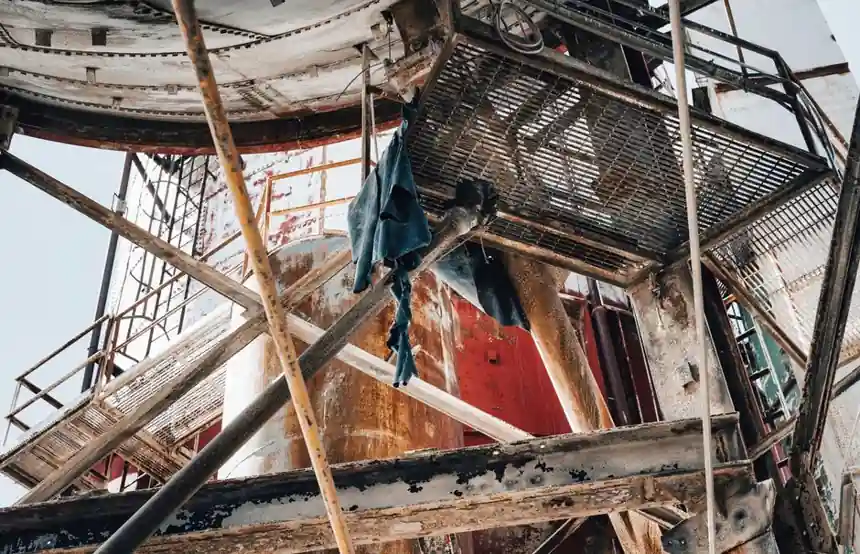
Cement plants are abrasive, hot, and dust-laden, with airborne clinker and gypsum particles wearing sliding surfaces and alkaline moisture attacking unprotected carbon steel. Process areas range from the raw-material crushing yard (ambient, wet, muddy) through the kiln/preheater (radiant heat to 200 °C, alkaline dust) to the finish-mill and packer (fine cement dust, lower temperature). Each zone drives a different shaft-collar spec [S3][S5].
Set-Screw vs Clamp-Style: Holding Mechanism Drives the Decision
Set-screw collars create point contact against the shaft; clamp-style collars distribute compressive force around the full bore circumference, and properly torqued clamp collars deliver roughly twice the axial holding strength of comparable set-screw designs [S3].
For a cement plant, that ratio matters: kiln-drive and cooler fans transmit sustained axial loads, and any slip on a case-hardened or chrome-plated shaft can mean unplanned downtime. Most OEM drive shafts in cement service run 1143 to 4140 alloy steel, often case-hardened to 55-60 HRC; a set-screw tip simply cannot bite into a surface harder than the screw itself, so the holding force collapses [S3]. Clamp-style collars bypass the hardness issue entirely, which is why they are the default on most kiln, ball-mill, and bucket-elevator rebuilds [S2][S4].
Material Selection by Plant Zone
303 stainless is the default for general-purpose cement-plant service because its sulfur content gives free-machining behaviour while still resisting the alkaline-dust corrosion seen in preheater and finish-mill areas [S2][S3].
For the wet end (raw mill, slurry pumps, wash-down zones), 304 stainless upgrades corrosion resistance at a modest cost premium. For the kiln and clinker-cooler zones, where radiant heat pushes skin temperatures past 150 °C, 316 stainless is specified where chloride-bearing fuels or alternative-fuel residues are present. For low-temperature, non-corrosive interior service such as packer conveyors, zinc-plated carbon steel remains cost-effective; for any collar mounted outdoors or in unconditioned walkways, hot-dip galvanize or black-oxide-plus-sealant is required [S2][S4]. Avoid aluminum collars in cement dust environments, because alkaline fines attack aluminum alloys aggressively [S3].
Bore Size, Tolerance, and Shaft Hardness
Verify shaft diameter and tolerance before selecting bore size; most cement-plant drive shafts are held to ISO h6/h7 tolerance, and matching the collar bore to the actual measured shaft (not the nominal nameplate) is essential to holding specified torque [S3][S4].
For shafts above 3", use flange-style or remachinable collars to keep the bore concentricity within 0.001"–0.002" TIR (total indicator reading). When the shaft is case-hardened above 50 HRC, drill-rod or soft-tip set screws will simply deform; specify hardened (grade 8 or 12.9) cap screws with a flat-face clamp design, and torque to the manufacturer-stated value (typically 80-120 in-lb on a 1/2" collar) using a calibrated wrench [S3][S4].
One-Piece vs Two-Piece Split: Serviceability Trade-off
One-piece clamp collars are lower cost and stiffer, but require axial access to the mounting position; two-piece split collars clamp around an already-installed shaft without disturbing bearings or couplings, which is the dominant configuration on cement-plant drives [S2][S6].
For kiln drives, baghouse fans, and bucket elevators, where pulling the shaft for maintenance is a multi-day task, two-piece split collars are the standard pick. One-piece collars are reserved for OEM assembly on conveyors, gear-motor output shafts, and small-diameter accessory drives where the shaft is short and accessible. For high-speed fans above 1800 rpm, balanced two-piece split collars are specified to keep residual imbalance below ISO 1940 G6.3, and to avoid vibration-induced fretting between the collar face and the bearing [S2][S6].
Comparison of the Main Collar Options for Cement Plants

Set-screw one-piece collars are the cheapest option at roughly 30-50% of clamp-collar cost, but they offer the lowest holding force and are unsuitable for case-hardened shafts [S3]. One-piece clamp collars provide higher holding power at moderate cost and suit OEM assembly of conveyors and gear motors on accessible shafts. Two-piece split clamp collars are the workhorse for cement plants, balancing full holding force, field serviceability, and balanced high-speed capability. Stainless (303/304/316) is the most corrosion-resistant but at 2-4x the cost of zinc-plated carbon steel; zinc-plated carbon steel suits dry, indoor service only [S2][S3][S4].
Selection rule of thumb: if the shaft is above 50 HRC, if the application exceeds 1500 rpm, or if maintenance access requires in-place service, choose two-piece split clamp-type in 303 stainless. For a deeper dive on the related topic of torque transfer, see the shaft key selection spec map; for rigid-shaft companion components, the shaft coupling and shaft collar reference pages cover bore, keyway, and material trade-offs in detail. Cement plant crews in adjacent heavy industries can also compare note in the mining clutch and brake selection spec map, which shares the same dust, vibration, and shock-loading profile.
Failure Modes Specific to Cement Service
The three most common in-service failures are shaft scoring from over-torqued set screws, bore elongation from repeated repositioning of one-piece clamp collars, and crevice corrosion between mated split-collar faces in wet zones [S3][S4].
To prevent scoring, use hardened cap screws with a flat-face clamp, and apply thread-locking compound rated for the local temperature. To prevent bore elongation, switch from one-piece to two-piece split designs whenever the collar will be repositioned more than three times across its service life. To prevent crevice corrosion, select 316 stainless in wash-down or outdoor areas, or apply a thin film of marine-grade anti-seize to the split-clamp interface at every re-assembly [S3][S6]. For cement and concrete equipment exposed to chloride-bearing alternative fuels, the 316 upgrade is non-negotiable.
Trackable next signals: the next quarterly rebuild cycle on the kiln drive and finish-mill baghouse fans, where any move from set-screw to two-piece split clamp collars will show up in the maintenance BOM; and any shift to higher-clinker alternative fuels, which raises chloride load and usually forces a spec upgrade from 304 to 316 stainless in the preheater zone [S3][S4][S5].