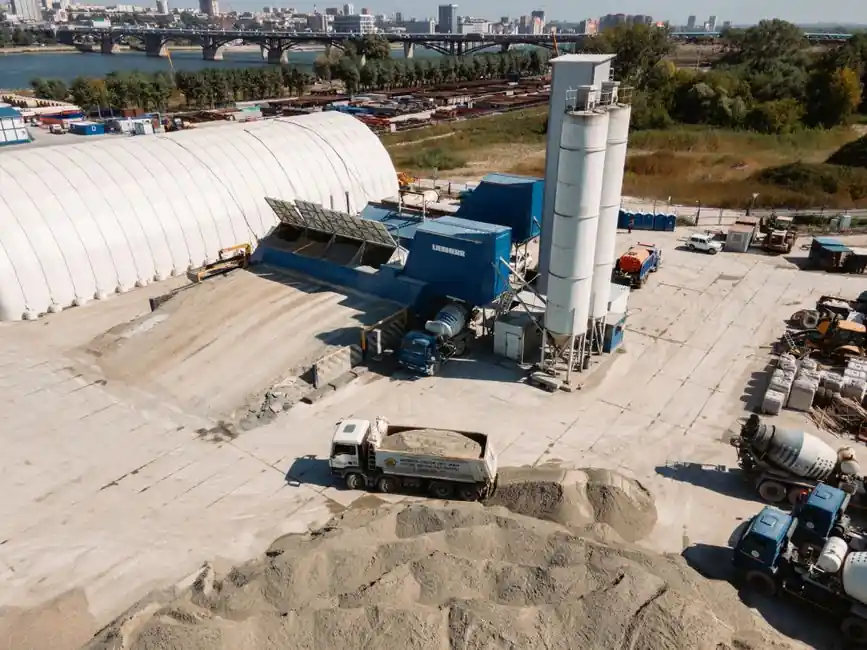
Cement plant couplings must transmit torque across crushers, kilns, ball mills, and conveyors that run continuously in dust-laden, thermally aggressive environments, with published torque envelopes for the dominant product families spanning roughly 3,900 Nm to 2,900,000 Nm [S1][S2].
Selection turns on four engineering inputs, including torque plus service factor, shaft diameter and keyway fit, expected angular and parallel misalignment, and operating RPM, before material and maintenance strategy are even considered [S3][S4].
Torque Envelope and Service Factor by Drive Point
Cement plant drives are not interchangeable, and the catalog torque ranges published for each coupling family reflect that. The SGFlex-LC elastomer coupling is rated 3,900 Nm to 44,200 Nm at 3,400 rpm to 4,100 rpm, which lines up with mid-range fans and conveyors, while the gear coupling LX family reaches 2,060 Nm to 2,900,000 Nm with a published misalignment of up to ±0.75° per half coupling, fitting heavy crusher and kiln drive service [S1].
A crusher or high-power conveyor is typically specified with a service factor multiplier well above 1.0 because shock loading and start-stop cycles dominate the load profile, whereas a centrifugal fan or screw conveyor can be evaluated closer to nameplate torque [S3][S4]. Engineers should never select a coupling purely on the existing coupling rating, because the existing unit is frequently oversized and the new torque basis will often be lower than the nameplate number stamped on the original hardware [S3].
Misalignment Classes: Angular, Parallel, Axial
All rotating cement equipment experiences some combination of angular, parallel, and axial misalignment, arising from thermal growth on kiln shells, frame deflection under load, and mounting tolerances on fabricated bases [S3][S4]. A coupling is acceptable only when its rated misalignment per axis meets or exceeds the worst-case installed value, not the average.
For a long kiln drive or a string-shaft conveyor with a defined shaft-center distance, the practical fix is a spacer or floating-shaft coupling, which lets the two halves live on separate pedestals and tolerate larger parallel offset than a close-coupled design [S3]. When the misaligned shafts are confirmed parallel but laterally offset, an Oldham coupling is the textbook answer, but it is not a general-purpose cement plant part because its torque density is low relative to gear and grid designs [S6].
Comparing Gear, Grid, Disc, and Elastomeric Options

Published cement-industry selection guidance treats gear, grid, flexible elastomeric, and disc pack couplings as the four families engineers should evaluate head-to-head [S2][S5]. On a 4-criterion comparison, the picture is clear:
1. Torque capacity: gear couplings win, with published maxima above 2,900,000 Nm in the LX series, followed by grid and disc pack in the mid-to-high range, and elastomeric units topping out near 44,200 Nm in current product lines [S1].
2. Misalignment tolerance: grid couplings are the shock-absorbing heavy lifter, disc pack couplings are specified for combined angular, radial, and axial compensation, and elastomeric couplings handle moderate misalignment with vibration damping that the all-metal designs cannot match [S1][S2][S5].
3. Speed: jaw and disc designs reach the highest catalog RPMs (jaw couplings up to 19,000 rpm in one product line, flexible disc shafts at 4,100 rpm to 12,000 rpm), while large gear couplings are usually constrained to lower-speed, high-torque service [S1].
4. Maintenance and environment: elastomeric couplings need minimal maintenance and dampen vibration, disc and gear couplings offer the corrosion and temperature resistance needed near kilns and clinker coolers, and grid couplings are favored where impact loads from crushers and grinders would fatigue a purely elastomeric element [S2][S5].
For a high-power conveyor or ball mill, gear or grid is the default; for a precision kiln drive or high-speed blower, disc pack is the specified choice; for a fan, filter, or general conveyor, elastomeric is the most cost-effective match [S2][S5].
Material, Dust, and Temperature Constraints
Cement plant couplings operate in dust, abrasion, and ambient temperatures that climb sharply near kiln and clinker cooler zones, so the elastomer compound, the steel grade of the disc pack, and the lubrication regime of the gear coupling are all real selection variables, not afterthoughts [S5]. Steel and alloy housings carry the high-torque and rugged-condition ratings, while polymer or elastomeric elements trade ultimate torque capacity for vibration and noise reduction [S4].
Disc pack couplings are explicitly described in current supplier guidance as corrosion-resistant and able to maintain performance in extreme temperatures, which is why they are specified for kiln drives, high-speed compressors, and blowers rather than elastomeric or grid designs [S5]. For a primer on the broader mechanical link category, the shaft coupling reference page lays out the rigid-vs-flexible taxonomy that drives this section.
Shaft Size, Keying, and Hub Selection

Bore diameter, keyway fit, and whether the hub is a standard or heavy-duty pattern are the second-order constraints that decide between two otherwise equivalent couplings. Oversized shafts frequently require a larger or HD style hub, and longer shaft spacing is the trigger to move from a close-coupled design to a spacer or floating-shaft coupling [S3].
Connection method matters as much as bore size, because a keyed, clamped, or tapered-bore interface changes the slip and fretting behavior under cyclic cement plant loads, and a mismatched interface is one of the documented paths to premature mechanical failure [S4]. When the coupling also sits on a shaft shoulder, the shaft collar and shaft fastening choices upstream of the hub determine axial location, and the shaft key geometry must match the keyseat in both the shaft and the hub bore.
Failure Modes and Maintenance Windows
The dominant failure modes that drive coupling replacement in cement plants are bearing wear from coupling-induced load, seal degradation caused by parallel misalignment beyond the coupling rating, and accelerated elastomer or grid element fatigue when shock loads were not factored into the original service factor [S3]. Each of these modes shortens the maintenance interval that plant schedulers plan against.
Specifying a coupling that is intentionally oversized is a documented mistake, because an unnecessarily stiff or massive coupling can transmit overload events straight into the driven equipment rather than protecting it, and it also adds rotating mass that itself becomes a balance problem at high RPM [S3]. For the cement-specific case, a parallel reference on mining drives is useful because the load and dust profiles overlap, and the shaft coupling selection map for mining article lines up torque and misalignment criteria in the same shape. Where the process side calls for an all-metal coupling, the gear coupling spec map for textile mill drives gives a second worked example of how torque, misalignment, and lubrication interact in continuous-duty industrial service.
Standards, Sourcing, and Selection Process
No single ISO or API standard dictates cement plant coupling selection, so engineers default to API 671 for general-purpose and high-speed couplings on rotating equipment, AGMA 9006 for flexible coupling ratings, and manufacturer service-factor tables for the final torque call, while keeping the ambient, dust, and temperature data sheet attached to the requisition [S3][S4]. For buyers also tasked with the process side, the cement and concrete and special cement reference pages cover the materials the coupling is driving.
Trackable signals for a current selection: confirm the catalog torque and RPM rating against the drive list, verify that the chosen elastomer or disc pack compound is rated for the kiln-side ambient temperature, and require the supplier to publish a service factor table that matches the crusher, conveyor, or fan class rather than a generic 1.0 multiplier [S2][S3][S4].