The practical definition of a correctly installed shaft key is narrow: the key must sit in the keyway with its bottom face fully supported by the shaft seat, its top face carrying the torque load against the hub keyway, and its side working clearance matched to the standard's prescribed fit class [S1]. When any of those three conditions drift, the failure mode is predictable — key rocking, hub-side keyway fretting, or shear at the key root — and the fix is almost always a rework, not a lubrication or torque adjustment.
For a working engineer, the installation question breaks into four measurable gates: key selection against Shaft Key Types and Classifications: A Spec-by-Spec Selection Guide, keyseat machining tolerance, interference between key and seat, and the dressing of the keyway before press-in. Skip any gate and the assembly will not hold its rated torque capacity.
Acceptance Criteria Before the Key Leaves the Bench
A parallel key must satisfy three measurable checks before it goes anywhere near the shaft: width tolerance, height tolerance, and squareness of the ends. The accepted working tolerance for a standard parallel key is h9 on width and h11 on height for the key itself, with the shaft keyseat cut to N9 and the hub keyway cut to JS9 or P9 depending on whether the application is a loose (sliding) fit or a tight (press) fit [S1]. A quick field check is to drop the key into a clean keyseat — the key should sit flat, not rock on a corner, and the side clearance should be visible but not loose. The key seating is governed by the shaft-key interface geometry, which is the most-cited tolerance stack in a gearbox or motor-driven assembly.
For tapered keys, the additional check is the slope — 1:100 is the standard, and the key must be a sliding fit on the shaft before the hub is pulled on. A taper key installed dry on a dirty seat will score the keyway inside ten duty cycles; an anti-scuff paste or a light oil film is acceptable, but never a dry press-fit on a tapered key.
Press-In Force, Direction, and Tooling Choice
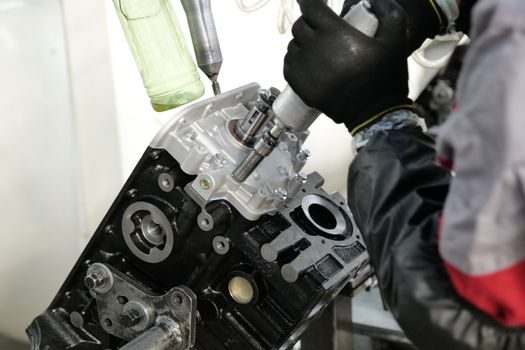
Pressing direction is not optional. A parallel key must be driven into the keyseat from the accessible end of the shaft, with the key squarely aligned to the seat, never at an angle. A dedicated shaft-key pressing tool with a guided sleeve and observation gap — as documented in gear-shaft assembly tooling patents — is the right answer for production runs, because the tool controls the alignment and the impact force [S1]. Hand-hammering with a drift is acceptable only for one-off maintenance work and only when the key is a light-duty square or flat key with no gib-head.
The press force itself is governed by the interference between the key width and the keyseat width. For a standard N9 / h9 fit, the interference is measured in micrometres and the press force is low enough that a 1-ton arbor press is normally sufficient for shafts up to 100 mm diameter. For larger shafts or for tight-fit (P9 / h9) hubs, the press force scales with the contact area, and a hydraulic press with a calibrated gauge is required. Field rule: if the key needs more than a hand-press to seat, the key or the seat is out of tolerance — stop and re-measure, do not increase the force.
Common Failure Modes and Their Root Causes
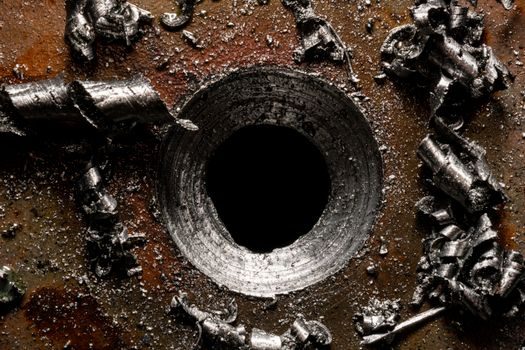
Key rocking under load is the most common field failure. The root cause is almost always a keyseat that was cut oversize or a key that was filed down to fit — both of which destroy the h9 / N9 fit and allow the key to lift under reversing torque. The corrective action is a replacement key of the correct standard size, not a shim. A second common failure is hub-side keyway fretting, which is a symptom of side-clearance that is too loose; the corrective action is to specify a tighter fit (JS9 instead of N9) or to switch to a tapered key if the application allows axial movement. [S1]
Shear at the key root is the catastrophic failure mode and it is almost always traceable to one of three things: a key that is too short for the torque load, a keyseat that does not run the full length of the hub engagement, or a material-grade mismatch (a mild-steel key in a high-torque drive). For a properly designed assembly, the key length is matched to the hub length with a 5-10 mm end gap to allow for assembly clearance, and the key material is the same grade or one grade harder than the shaft. A shaft-coupling sitting next to a failed keyway is a secondary inspection target — the coupling hub bore often shows the same fretting pattern if the misalignment was contributing to the load.
Installation vs Replacement: When to Stop Repairing
There is a clear line between a key that can be re-installed and a shaft that needs to be reworked. A key is reusable if the keyseat shows no measurable deformation, the key shows no burrs or peening on the loaded faces, and the fit class still measures within h9 / N9. A shaft keyseat is reusable if the width is still within tolerance, the bottom face is still flat to a feeler gauge, and the ends are not radiused. If the keyseat has been peened over by impact, the shaft must be re-cut or replaced; a peened keyseat will never hold a key to tolerance. The same goes for a hub keyway that has been hammered open — the hub must be re-bored and the keyway re-cut, not dressed over. [S1]
The economic line is around three re-installs. If the same shaft-key-hub assembly has been re-keyed three times, the likelihood of a fatigue failure at the keyway corner goes up sharply, and the right call is a shaft and hub replacement, not a fourth key. This is the same logic used in Retaining Ring Installation: Tooling, Groove Fit, and Failure-Mode Guide — repeated rework of a small groove is a fatigue-risk multiplier, not a maintenance saving.
Lubrication, Anti-Seize, and Surface Finish
For a press-fit key, lubrication at installation is a controlled choice. A light machine oil on the key sides reduces the press force and prevents scoring of the keyseat during assembly; a dry press is acceptable only when the key is a sliding-fit parallel key that will be removed for maintenance. Anti-seize (copper- or nickel-based) is the wrong choice for a key-seat interface — it changes the friction coefficient and can mask an undersized interference fit, leading to axial movement of the key under load. For tapered keys, a moly-based anti-scuff paste is the standard choice, applied thinly to the contact faces. [S1]
Surface finish matters more than most installation guides admit. The keyseat bottom face should be machined to Ra 1.6 µm or better; any tool marks deeper than that will create a stress concentration under cyclic torque and will be the initiation site for a key-seat fatigue crack. The key itself should be supplied to a surface finish of Ra 0.8 µm on the loaded faces, which is the standard for commercial parallel keys.
Sourcing and Standards Reference
Standard parallel keys are governed by ISO 773 (dimensions and tolerances), ISO R773 (older revision still cited in some maintenance manuals), and DIN 6885 for the German-equivalent specification. Tapered keys are covered by ISO 774 and DIN 6887. Woodruff keys — a different geometry entirely — are covered by ISO 3912 and are not interchangeable with parallel or tapered keys. Sourcing keys to a recognised standard is the single most effective way to avoid a fit-class mismatch, because the standard fixes both the key and the keyseat tolerance in a single document.
For sourcing, the practical rule is to buy keys to a standard and to buy the keyseat cutter to the same standard. A non-standard key — even one that measures correctly — is a field-failure risk because the replacement inventory will not match. Track the next signal on this topic: any revision of ISO 773 or DIN 6885 that tightens the h9 / N9 envelope, and any OEM move to a press-fit (P9) keyseat as a default for servo-driven assemblies. Either of those shifts will change the field-installation math.
Spec-level background on the components involved: linear guide.