
This guide covers the four key families that show up in paper-machine dryer drives, refiner shafts, reel drums, calender rolls, and converting-line gearboxes: parallel (square and rectangular), Woodruff, taper (plain and gib-head), and feather. Selection is driven by shaft diameter range, torque direction, hub axial movement, moisture, and temperature, and the same selection rules documented for general industrial shaft key service apply.
Operating envelope of a pulp and paper mill
Paper-machine dryer sections, refiner drives, and reel drums run continuously, with torque direction held constant for weeks at a time and ambient temperatures between 60 and 95 °C on the dryer frame; the bearing housings, steam joints, and felt run are exposed to water spray, carryover, and condensate, so corrosion and wash-down cleaning are part of the duty cycle. [S5]
Refiner motors and pulp mill primary drives commonly transmit 200–6000 kW at 200–1800 rpm through gearboxes coupling to shafts in the 60–400 mm diameter range, while the dryer section itself is largely a chain and gear train with shaft sizes commonly between 40 and 200 mm. Most couplings and pulleys in this envelope are still keyed; the choice of shaft coupling upstream of the key is what determines whether the hub needs to slide axially for alignment, and that single fact usually picks the key family.
Parallel square and rectangular keys: the paper-mill default
Parallel keys with a constant cross-section are the most common key type in industrial use, are standardised globally, and accept a pulley, gear, or coupling from one manufacturer on a shaft from another when both conform to the same width and height [S5].
Square parallel keys are typically specified for shafts in the 6–25 mm (0.25–1.0 in.) diameter range, while rectangular parallel keys dominate the 25–500 mm (1–20 in.) band that covers almost every refiner, dryer-drive, and calender shaft in a paper mill [S2]. Rectangular geometry (wider than tall) lets the key transmit more torque without deepening the shaft keyway, which is the single most important constraint when the shaft has already been turned down for a bearing seat.
Material choice in pulp and paper service generally tracks the shaft: key stock is specified to match the shaft's strength and hardness to prevent the key from becoming the weak link, with 1045 medium-carbon steel, 4140 alloy steel, or 316 stainless selected by environment rather than by load [S1]. For wash-down wet-end drives, 316 stainless keys are common, accepting a roughly 20–25% derating versus a carbon-steel key of the same section to account for the lower shear strength.
Woodruff keys: only for small shafts and tapered seats

Woodruff keys (semicircular in cross-section) are self-aligning because the curved base automatically centres in the circular pocket milled in the shaft, and they are widely used on small engine crankshafts and machine tool spindles, but in industrial applications they are less common than parallel keys because the deep shaft pocket weakens the shaft more than a parallel keyway [S5].
Woodruff keys are also relatively short and cannot carry the same load as a longer parallel key, which is why they are restricted to light-duty work and to mounting taper-bored components onto tapered shaft ends, and are explicitly unsuitable for high-torque applications such as wide-faced gears or multi-groove V-belt pulleys [S2]. Standard Woodruff sizes cover shaft diameters from 6 to 64 mm (0.25 to 2.5 in.).
For paper mills, the realistic fit is small accessory drives: tachometer mounts, encoder shafts, and the low-horsepower pump and fan couplings under 7.5 kW. Specifying a Woodruff key on a refiner or dryer-section drive is a red flag, because the pocket depth combined with the key's short bearing length will shear first under a paper-machine upset load.
Taper keys (plain and gib-head): heavy torque, low speed, permanent mount
A taper key is driven in axially and wedges between the shaft and hub, locking the assembly together by friction from the 1:100 taper; a gib-head key adds a protruding head on one end to allow extraction with a puller or screwdriver, and the taper itself generates a clamping force that holds the component on the shaft even without any other retention [S5].
Taper keys are specified when the drive is permanent, the torque is high, and there is no requirement to slide the hub axially. In paper mills this maps to large gear fits on refiner pinion shafts, calender roll drive hubs, and the occasional reel-spool coupling where the joint is assembled once and left. The penalty is precision: taper keys must be paired with tapered keyways cut to a matched 1:100 slope, and any axial movement after assembly changes the working clearance.
Gib-head keys are the practical choice where the key has to come out again, because the protruding head gives a positive purchase for a drift; in confined coupling shrouds the head is often trimmed flush, at which point the assembly effectively becomes a plain taper key. Material for both is usually 1045 or 4140 key stock, pulled to the same hardness range as the shaft, with 316 stainless reserved for the same wash-down zones that drive stainless parallel keys.
Feather keys: when the hub has to slide

A feather key is a parallel key fitted tightly in the shaft keyway but with a sliding clearance fit in the hub keyway, allowing the hub component to slide axially along the shaft while still transmitting rotation; in gearboxes (sliding gear selectors), variable-pitch sprockets, and adjustable-position components, the key is often secured to the shaft with one or two socket head cap screws through the key body to prevent it moving axially with the hub [S5].
In pulp and paper service, feather keys are the right answer for any hub that has to traverse the shaft during operation or setup: the variable-pitch sheaves on a refiner's auxiliary drive, the sliding gear on a two-speed calender, and the positioning sleeves on the size press. The key is captured against axial movement, the hub moves over it, and the same rectangular section that works for a fixed hub works as a feather key.
Where the hub position is fixed, a parallel key is mechanically better, because a feather key's clearance fit on the hub side accepts backlash and impact loading. Drives that vibrate or reverse directions often loosen the retainer setscrews, which then lets the parallel key walk out of the assembly, and the released key falls into the machinery and causes damage while the previously secured component spins free [S2]. Capturing the key with cap screws is the standard fix.
Comparison of key families for paper-mill duty
The four families line up against four decision criteria as follows. Shaft diameter range: parallel square 6–25 mm, parallel rectangular 25–500 mm, Woodruff 6–64 mm, taper / gib-head 25–600+ mm, feather 25–400 mm. Torque capacity at equal section: parallel rectangular and taper (highest), feather (close to parallel), Woodruff (lowest, limited by short bearing length). Hub axial movement: parallel and Woodruff no, taper and gib-head no, feather yes. Typical mill application: parallel for refiner pinion shafts, dryer drive gears, reel drum couplings; Woodruff for encoder and tachometer mounts under 7.5 kW; taper and gib-head for permanent calender and refiner gear fits; feather for variable-pitch sheaves and sliding selector gears [S2][S3][S5].
For corrosion zones, the choice of material is independent of the choice of family: 316 stainless stock is available in every parallel, taper, and feather section, with a 20–25% shear-strength derating accepted in return for surviving chloride-bearing white-water and peroxide bleach wash-down. Standard preferred key lengths follow the 6, 8, 10, 12, ... mm series, rounded to match the hub width or shaft engagement length, and key length is selected to match the hub width or shaft engagement length rather than to add material [S5].
Sourcing, standards, and common failure modes
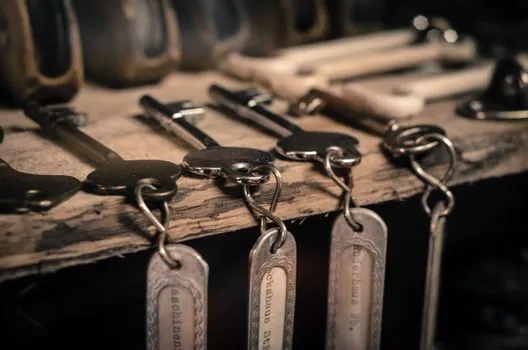
Key and keyway selection in paper mills tracks the same ISO 773, ISO 2491, ISO/R 773, DIN 6885, and ANSI B17.1 standards used elsewhere in general power transmission, with metric rectangular sections (e.g. 14 × 9, 18 × 11, 22 × 14) supplied as off-the-shelf key stock from any industrial distributor and cut to length on site. Reference data on the most common sections, tolerances, and preferred length series is published in distributor selection guides [S5] and in technical white papers on power-transmission feather keys [S6].
Three failure modes dominate pulp and paper field experience: a key that walks out of a hub retained only by a setscrew on a reversing or vibrating drive, a Woodruff key that shears because the short bearing length cannot sustain a refiner upset torque, and a taper key that has been driven in too far and crushed the keyway end. Parallel keys are recommended for transmitting unidirectional torques not subject to heavy starting loads and in applications that require the hub be withdrawn periodically or slid, with setscrew retention augmented by a cap-screw-through-key arrangement on reversing drives [S2]. A shaft collar on the outboard side of the hub is the most common additional retainer on mill couplings, taking the axial load off the key entirely.
Trackable signals for the next quarter: ISO 773 / ISO 2491 key-stock inventory at the major industrial distributors (size coverage 14 × 9 through 50 × 32 in 316 stainless, and 8 × 7 through 36 × 20 in 1045 / 4140), and a noticeable shift in OEM gear and coupling data sheets toward metric rectangular keys (versus imperial square) for new paper-machine gearboxes ordered for European and South American mill rebuilds.
See also our earlier report, Turnover box selection for automotive parts logistics: spec-first map.