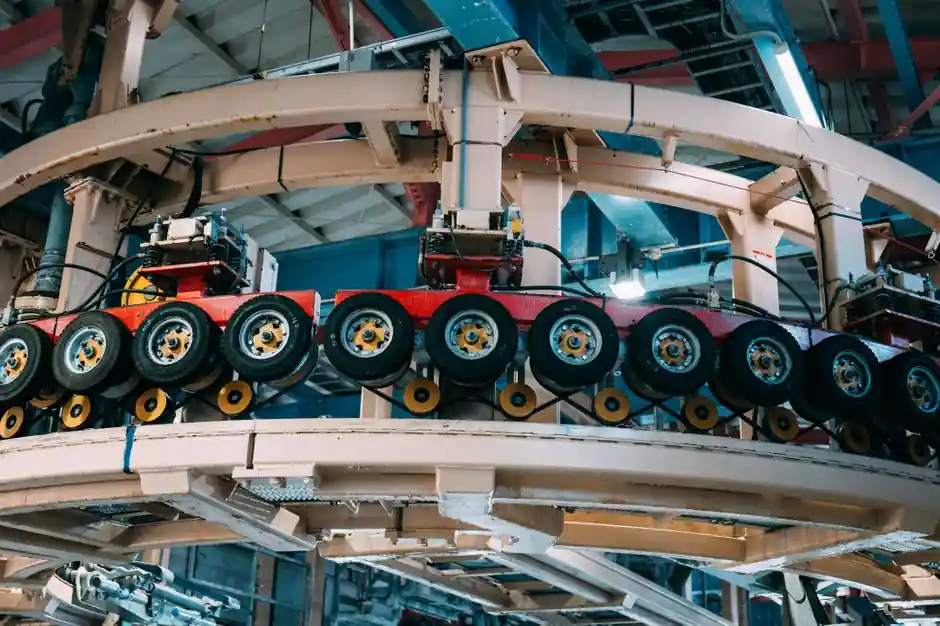
Shakeout machines for foundry casting separation span deck loads of 5 kN to 100 t and throughputs of 5–80 T/H, with paired motor power from 2×3 kW to 2×22 kW, so sizing starts from the heaviest flask in the mix rather than the median casting [S3][S4][S5].
Selection splits into three independent decisions: which deck size covers the largest pour, which exciter class survives the sand-bond type, and which drive system (natural-frequency, sub-resonant two-mass, or brute-force direct) fits the building foundation and acoustic envelope [S1][S6].
Load Class and Deck Size Mapping
Vibration shakeout models map to load in 5–10 kN steps for small foundries and 10–20 t steps for heavy castings; the Galante Sk-series runs 5 kN, 10 kN, 15 kN, 20 kN, 25 kN, 30 kN, 40 kN, and 60 kN rated load, with table sizes scaling from 1800×2000 mm at the low end to 6000×7000 mm for the Sk60 [S3]. For integrated shakeout-and-crush duty, the SLB series starts at 5–10 t on an 1800×1600 mm deck with 9.5 kW×2 motors and 130 kN×2 excitation, stepping to 30–40 t on 4500×4000 mm with 9.5 kW×6 and 130 kN×6, all running at 980 r/min [S4].
Heavier industrial units accept up to 100-ton loads on decks reaching 14 ft × 14 ft (about 4.27 m × 4.27 m) in a single-frame footprint, and offer custom "V" decks for engine blocks, grizzly decks for large-lump scalping, and back-drafted slots that protect fragile castings from impact damage [S1]. A standard 5–80 T/H throughput band with 1000–3000 mm deck width and 2000–6000 mm deck length covers most green-sand and resin-sand reclamation lines [S5].
Exciter Force, Frequency, and Drive Architecture
Mid-size units draw 15–45 kW on loaded start, dominated by exciter motor inrush, and that number is the right first filter for utility-side electrical planning [S6]. Across the Galante line, installed power scales from 5.5 kW×2 on the Sk05 up to 23 kW×2×2 (92 kW total) on the Sk60, while maximum excitation force climbs from 75 kN×2 to 300 kN×2×2 (1200 kN total) [S3]. The SLB crush-integrated line holds motor count to two or four on the smaller frames but goes to six 9.5 kW exciters on the 30–40 t SLB-25, indicating that integrated crushing adds roughly 50% to the exciter count versus a comparable standalone shakeout [S4].
Drive choice partitions the market into three architectures: natural-frequency (energy-efficient at steady state), sub-resonant two-mass (best for soft foundations and low transmitted force), and brute-force direct (highest starting force, simplest control). Carrier publishes all three as configurable options on the same frame family, which is the practical reason most foundries order against an isolation study rather than a catalog number [S1]. Continuous PLC-controlled operation is now offered as an option on entry-level Chinese OEM lines, with pre-programmed sequences for retention time and amplitude ramp [S1][S5].
Sand-Bond Type and Process Fit
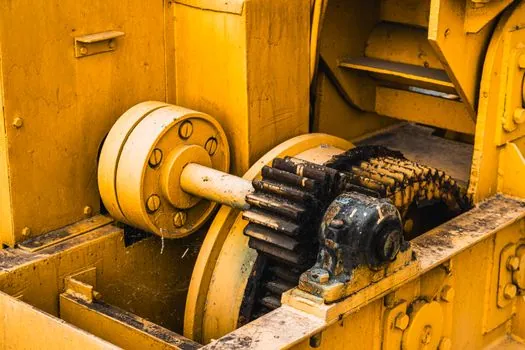
Sand-bond chemistry changes the required excitation level rather than the deck size. No-bake chemically bonded sand needs aggressive lump-breaking, while green-sand lines need high-frequency gentle stripping so reusable sand drops through the screen with minimum fines generation [S1]. For core-sand-only parts such as aluminum castings, a decoring-class shakeout running up to 25 g peak acceleration, with 6 bar pneumatic hammers for core fracture and compressed-air blow-off, leaves under 3 g of residual sand per part and runs 40–120 pcs/h on parts up to 800×500×400 mm and 80 kg [S2].
Dust loading at the discharge is severe when green sand is handled dry, so cyclones or wet scrubbers downstream are standard rather than optional, and most procurement specs bundle the shakeout with its dust train in the same RFQ [S6]. For wet-sand or chemically bonded lines, moisture-resistant wear liners and specialized sand pans are catalog options on Carrier units, and the same approach reduces liner replacement intervals on integrated SLB-type machines running at 980 r/min under resin-sand conditions [S1][S4].
Selection Criteria: Side-by-Side Comparison
Four realistic variants cover roughly 90% of the buying decisions process engineers face; the table aligns them against load, deck size, drive power, and intended sand type. Decoring-class units like the SINEX module are the right pick for aluminum cylinder heads and turbo housings under 80 kg, while heavy no-bake operations need a 100-ton-capable brute-force unit. Vibration shakeout machine is the parent product family for all of these. [S2]
Comparison across published 2026 specifications:
1. SINEX decoring module: 80 kg part limit, 800×500×400 mm envelope, 25 g peak acceleration, 6 bar pneumatic, <85 dBA at 1 m, 40–120 pcs/h, for aluminum cores only [S2].
2. Galante Sk-series standalone shakeout: 5–60 kN rated load, 1800×2000 mm to 6000×7000 mm decks, 5.5–23 kW×2 (up to 92 kW) motors, 75–300 kN×2 excitation, for green-sand and resin-sand bulk casting lines [S3].
3. Galante SLB shakeout-crusher: 5–40 t load, 1800×1600 mm to 4500×4000 mm decks, 9.5 kW×2 to ×6, 130 kN×2 to ×6, fixed 980 r/min, for foundries wanting shakeout plus lump crushing in one footprint [S4].
4. Carrier heavy no-bake / green-sand: up to 100 t load, 14 ft × 14 ft (≈4.27 m × 4.27 m) deck, natural-frequency or two-mass or brute-force drive, for steel and large iron castings, often flasked [S1].
Who Should Not Pick the Mainstream Standalone
A standalone brute-force shakeout is the wrong pick for three specific scenarios. First, any line handling only small aluminum core-sand parts under 80 kg wastes power and capital on a heavy deck; a SINEX-style decoring module at 25 g peak acceleration does the job at a fraction of the exciter rating [S2]. Second, foundries that need the shakeout step to also crush lumps to reclamation feed size should specify an SLB-class integrated unit at the RFQ stage, not bolt a crusher onto a standalone deck downstream, because the integrated frame is dynamically balanced for 980 r/min combined duty [S4]. Third, any plant with weak floor slabs or strict acoustic limits should avoid brute-force direct drive, since transmitted force and noise are the first complaints; sub-resonant two-mass or natural-frequency drives cut foundation reaction at the cost of slower amplitude ramp [S1][S6].
A unit spec'd at 15–45 kW continuous draw typically pushes 85–95 dBA at operator position without enclosure, so a soundproof cabin or remote operation should be on the same purchase order as the machine itself when the line is hand-loaded [S2][S6].
Cross-Reference for Process Engineers
For foundries also specifying upstream molding automation or downstream reclamation, the foundry shakeout selection criteria reference article lays out vibration class, sand type, and drive levers in the same vocabulary used here. Process engineers who also handle bulk-material handling on the same site will recognize the deck-width and load-class logic from plastic pallet spec maps for AS/RS and shuttle automation, where deck footprint and dynamic load drive the same kind of structural decisions [S6].
For plants running both core-intensive aluminum work and heavy iron work on the same site, the right answer is two machines, not one oversized unit, because the 25 g acceleration needed to fracture cold-box cores will damage thin-wall iron castings, and the gentle stripping that protects iron will leave bonded cores in place [S2][S1].
Verification and Trackable Signals
Shortlist logic: confirm the heaviest flask mass and multiply by 1.25 for the rated load; confirm the largest flask plan-view dimensions and add 200–400 mm clearance per side for the deck size; pick drive class from a foundation isolation study rather than a catalog default; and require an OEM test run on a sample casting before shipment acceptance. To verify a vendor's claims on the floor, run a loaded-start power draw check (typically 15–45 kW on mid-size units, dominated by exciter motors) and a residual-sand mass check (max 3 g per casting on decoring-class units) before signing the acceptance certificate. Construction machinery and equipment is the broader category this equipment sits under for tariff and shipping classification. [S1]
Spec-level background on the components involved: linear guide.