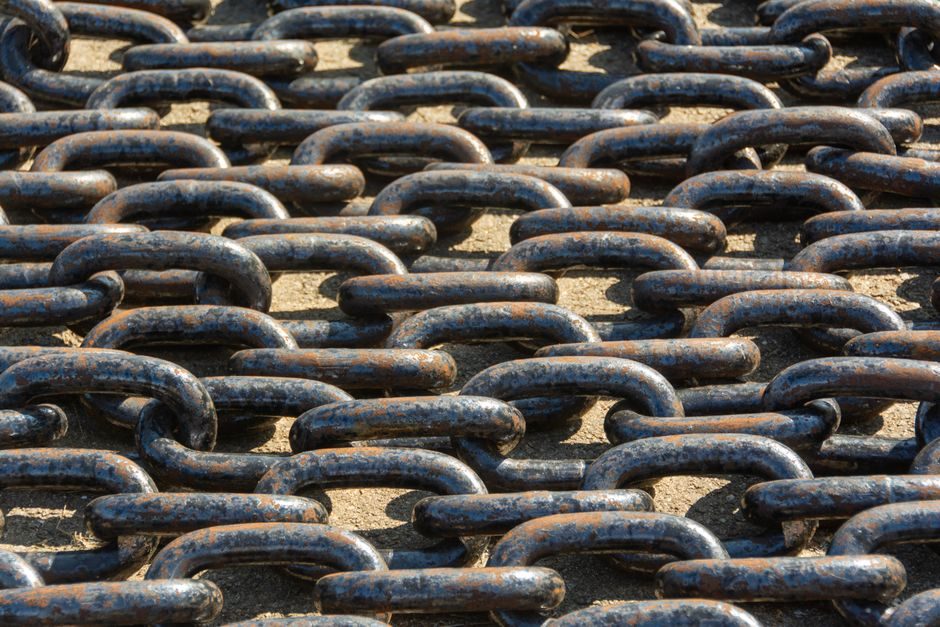
Silent chain — also called toothed chain or low-noise chain — is an assembly of staggered left/right toothed plates hinged by pins, bushes, or rollers, and is one of the default choices for heavy-load, high-speed, low-noise transmission [S2].
Construction variants listed by Hengjiu Group fall into four practical families: double-pin, double-swing, double-pitch, and pin-end-with-laser-welding [S2]. Each variant targets a different load/speed envelope, and matching the wrong type to a drive is the single most common cause of premature silent-chain failure seen on automotive and industrial-pump lines.
What a Silent Chain Actually Is: Plate Geometry and Pin Form
Silent chain consists of toothed chain plates that are hinged to each other; the chain plates of adjacent links are staggered to the left and right and are coupled by pins, bushes, or rollers [S2]. Because the load teeth are cut into the plate itself — not into a roller that rolls off a sprocket — the polygon-action impact of a standard roller chain is replaced by a meshing gear-like engagement.
Pin form is a primary differentiator within the family. Hengjiu lists four practical pin geometries: circular single pin, elliptical single pin, double pin, and D-type single pin [S2]. Elliptical and D-type pins control rotation and present a defined bearing surface to the sprocket, while double-pin arrangements are used where the chain must articulate sharply without binding. The form of the pin dictates the allowable articulation angle, which in turn sets the minimum sprocket diameter for a given pitch.
Four Main Silent-Chain Construction Types
Performance of different silent-chain types varies greatly, and so do the application conditions [S2]. The four families commonly specified in industrial purchasing are:
1. Double-pin silent chain — uses two parallel pins per articulation. The two-pin geometry resists skew under side load and is a default choice for timing drives that must hold phase across a wide temperature swing. It is also a common reference design for automotive engine camshaft drives.
2. Double-swing silent chain — designed to articulate further than a single-pin chain in a given pitch, which lets the drive package a small sprocket. Use it when the design envelope forces a small driven sprocket but the duty cycle still needs the low-noise plate-meshing action of a silent chain rather than a bush-chain.
3. Double-pitch silent chain — the pitch is doubled relative to a standard silent chain of the same width, which lowers linear weight per unit length and reduces cost. The trade-off is a higher minimum sprocket tooth count and a lower top speed; double-pitch is typical on conveyor and transfer-line duty rather than engine timing.
4. Pin-end-with-laser-welding silent chain — the pin ends are laser-welded rather than riveted or peened, which produces a more uniform upset and a cleaner bearing surface. This construction shows up where high-cycle fatigue life is required, and is a common build for OEM automotive timing-chain kits.
Selection Criteria: Load, Speed, Noise, and Articulation
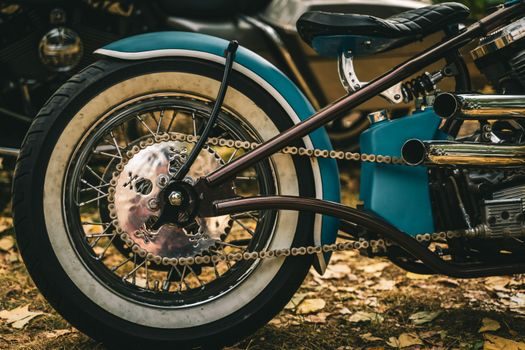
Silent chain is one of the first-choice transmission products in many industries because of its heavy-load capacity, low noise, high speed, and durability [S2]. To convert that general guidance into a working spec, four criteria have to be locked down before the type is selected:
• Power capacity vs. width. Silent-chain horsepower is set by chain width (number of plates across) and pitch. Going from a single-strand to a multi-strand layout roughly scales capacity in proportion to strand count, but only if the sprocket teeth are wide enough to support all strands. Pin form (circular vs. elliptical vs. D-type) further trims the allowable bearing load.
• Maximum continuous speed. Silent chain handles higher rim speeds than a comparable roller chain because there is no roller-impact shock at the sprocket, but the limit is still set by plate mass and lubrication. Double-pitch runs slower; double-pin and laser-welded pin-end run fastest.
• Articulation angle / minimum sprocket. The smaller the driven sprocket, the larger the articulation angle per pitch. Double-swing silent chain is built specifically to allow small-pinion drives; a circular single-pin chain of the same pitch will bind and preload the pins.
• Noise target. Compared with a roller chain of equal capacity, a silent chain typically reads several dB lower at the same speed and load because the meshing surface is the plate flank, not an impacting roller. For an existing drive being de-noised for a worker-exposure program, that is usually the decisive criterion.
Where Silent Chain Is Specified vs. Where It Is Not
Silent chain is widely used in automotive engines, transfer cases, automotive production lines, glass, machine tools, steel-rolling transmissions, industrial pumps, steam turbines, petroleum machinery, military equipment, and textile machinery [S2]. It is the default timing drive on many overhead-cam automotive engines and on transfer cases in 4WD drivelines, and it is the standard primary drive on certain high-speed machine-tool spindles where roller-chain noise would be unacceptable.
It is NOT the right choice when the drive is heavily contaminated with abrasive dirt (open-pit mining, agricultural tillage) — go to a sealed chain conveyor or an o-ring-sealed roller chain instead; it is not the right choice for very long center distances with no tensioner, because silent chain has less elongation tolerance than a conveyor chain; and it is not the right choice for cable or hose carrier service, where a cable drag chain or drag chain cable is the correct product family. In long horizontal scraper or drag-flight conveyors carrying bulk media, silent chain is usually replaced by a dedicated cable drag chain running in a trough.
Failure Modes and Operating Limits Engineers See in the Field
The dominant field failure on silent chain is plate-tooth wear at the sprocket contact zone, accelerated by oil-starvation at high speed. Because meshing is metal-on-metal with no roller to redistribute load, lubrication interval is the single largest lever on service life, and oil temperature above roughly 120 °C typically demands a synthetic PAO or ester fluid with EP additives rather than a mineral hydraulic oil. [S2]
The second failure mode is pin/bush fatigue at the articulation, particularly on circular single-pin chains run past their rated articulation angle. The visual signature is a dog-bone wear pattern on the pin, and the fix is either a smaller reduction in sprocket size or a switch to an elliptical, D-type, or double-swing pin geometry. The third failure mode — elongation beyond the take-up range — looks similar to roller-chain elongation but is harder to measure accurately, because silent chain has no roller to gauge against; pitch measurement across a fixed number of plates under a defined load is the only reliable field check.
Sourcing, Standards, and a Working Comparison
Silent-chain sourcing in 2026 is dominated by Asian OEM and aftermarket manufacturers, with Taiwan and mainland China as the two principal supply regions for industrial-pump, machine-tool, and aftermarket automotive timing-chain kits [S1]. Hengjiu Group publishes the four-type taxonomy (double-pin, double-swing, double-pitch, pin-end-with-laser-welding) that is broadly consistent with the way Japanese, German, and US catalogues classify the same products [S2].
For spec sheets, look for: pitch (mm), number of plate strands, pin form (circular / elliptical / double / D-type), minimum sprocket teeth, rated working load (kN), and recommended lubrication. Side-by-side comparison of the four types against the most common selection criteria:
• Double-pin — highest speed tolerance, best phase stability, default automotive engine timing choice, moderate articulation angle.
• Double-swing — best small-sprocket capability, lower top speed than double-pin, used where envelope forces a small driven pinion.
• Double-pitch — lowest cost per metre, lowest top speed, best on conveyor and transfer-line duty, larger minimum sprocket.
• Pin-end-with-laser-welding — best fatigue life at high cycle count, default for OEM automotive timing kits, premium price.
Trackable next signal: ISO/TC 100 work on silent-chain terminology has not produced a unified international type-designation standard to date, which is why most 2026 datasheets still label the four types by the manufacturer's own names rather than an ISO code; any move toward a single ISO type designation over the next reporting period would be a meaningful sourcing change.
Related analysis: Copper Process Control and Instrumentation: Cable, Grounding, and Field-Device Spec Map.