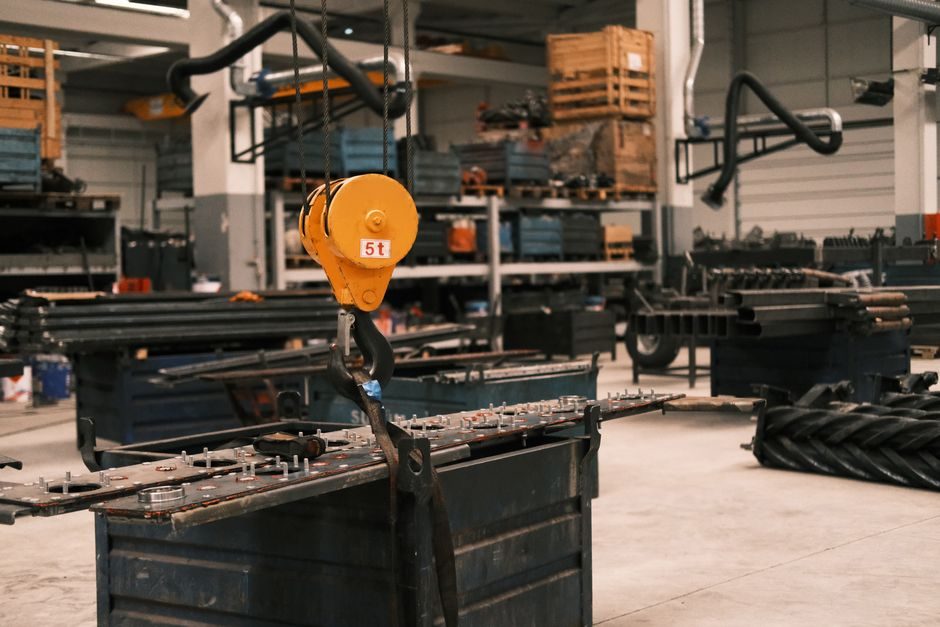
A 2026 single-girder overhead crane specification is set by three numbers — capacity, span, and lifting height — but the buying decision is actually decided by four constraints: building headroom, hook-approach to wall, FEM/ISO duty class, and whether the hazardous-area classification forces a single-girder crane build or pushes the spec to a double-girder unit [S1][S2].
The current OEM envelope on directindustry listings runs from 125 kg light-duty kits [S2] up to 70 t heavy-duty units [S1], with 1,250 kg to 10,000 kg being the band where most plant-floor and small-warehouse buyers actually purchase. The cheapest single-girder kits (manual, ≤20 t) and the most engineered explosion-proof units share the same basic geometry but diverge sharply on hoist, electrical, and price.
Top-running vs under-running (suspension): the headroom decision
A top-running single-girder crane carries the end trucks on rails above the building columns, so the girder sits high and the hook can drop the full lifting height minus the hoist body — typical in greenfield industrial halls with adequate clearance [S1][S3].
An under-running / suspension single-girder runs on the bottom flange of a runway beam that is itself suspended from the roof structure; STAHL CraneSystems describes its single-girder suspension crane as the optimal solution up to 10,000 kg in small or low production halls, where the full hall width becomes usable and the hook-to-side-wall distance is extremely small [S6]. ABUS markets the EHB as a very light crane for area-coverage materials handling inside buildings [S3], and TAWI pitches the same under-running geometry as cost-optimal, quick-delivery, and easy to install for rectangular work areas [S4].
Practical rule: choose under-running when hall height is constrained and the load is under 10 t; choose top-running when you need higher capacity, higher hook lift, or the runway must span more than ~25 m without intermediate roof support.
Capacity bands and what they cost in real options
The 2026 OEM catalogue breaks into four useful bands, each with a different hoist and structural logic: [S1]
• 125 kg – 1,500 kg: light-duty kits and ergonomic stations. OMIS offers single-girder kits from 125 kg to 60,000 kg, sold as parts for small manufacturers or distributors worldwide [S2]. TAWI targets 125–1,500 kg suspended units as cost-optimal rectangular-area handling [S4]. ABUS EHB sits at 1,250 kg for the lightest area-coverage HB system [S3].
• 2 t – 10 t: the mainstream workhorse band, where the cheapest Chinese LD-type single-girder crane with MD1 electric hoist is sold as a complete set, working class A3–A5, working temperature -25 °C to 40 °C, with pendant or cabin control [S7].
• 10 t – 25 t: heavier process and machinery-handling. Yaplex Ltd lists 0.1–20 t single/double-girder manual and hoist units aimed at commercial environments where heavy lifting is a recurring requirement [S5].
• 25 t – 70 t: heavy and special-application. IMMA Global offers up to 70 t single- and double-girder cranes, with explosion-proof, low-headroom, grab, rope-hoist, chain-hoist, custom, heavy-duty, workshop, warehouse, and molten-metal-lifting variants in a single product family [S1].
Span, lifting height, and the three build configurations
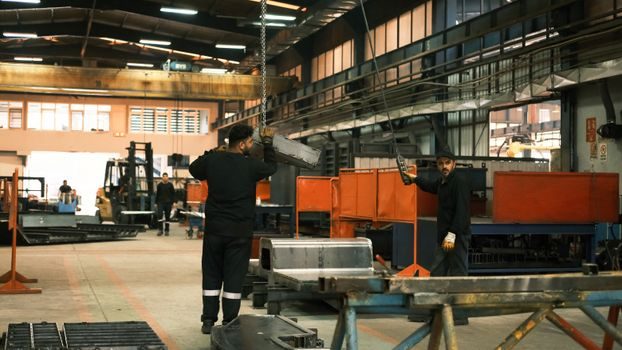
Span is the distance between runway rails and is the single biggest driver of girder weight. IMMA's 2026 spec sheet allows 3 m to 35 m spans on the 70 t family [S1], and that 12:1 range is the reason a top-running single-girder starts to lose its economic edge beyond roughly 25–30 m — at that point double-girder or gantry-crane layouts often win on deflection and wheel-load.
Three build configurations dominate 2026 OEM literature: (1) standard top-running with electric wire-rope or chain hoist between the end trucks; (2) low-headroom top-running where the hoist is mounted on a side carriage to claw back 200–400 mm of lift; (3) suspension/under-running, where the end trucks hang from the runway beam flange [S1][S3][S4][S6]. IMMA's product family also spans double-girder, with-hoist, explosion-proof, low-headroom, with-grab, rope-hoist, chain-hoist, custom, heavy-duty, workshop, warehouse and molten-metal variants, which is what a serious buyer should expect a heavy-lift vendor to offer [S1].
Hoist, drive, and control: where the BOM really lives
The hoist and its control panel typically dominate the BOM of a single-girder crane. The MD1 electric hoist paired with the LD-type single-girder crane is the 2026 default for A3–A5 light/medium duty: the published LD-5t-16.5m-9m example shows 20 m/min travelling, gear ratio 58.78, ZDY 1 21-4 motors at 2 × 0.8 kW running at 1380 rpm [S7]. This is the spec to beat when comparing Chinese-supplied units against European or Turkish alternatives, because the motor, gearbox, and brake are the parts that determine maintenance cost over a 10–15 year life.
Duty class is the spec that buyers under-check. Chinese LD-type units are A3–A5 (light to medium), and the spec sheet is explicit on working-temperature window -25 °C to 40 °C [S7]. European single-girder kits (OMIS, ABUS, TAWI) are typically FEM 2m / ISO M5–M6 for the same 1–10 t band [S2][S3][S4]. If your shift pattern is two-shift continuous or you have hot-metal or fatigue-loaded lifts, A5/M5 is the floor — anything below is a service-life penalty, not a saving.
Hazardous areas, custom builds, and who should NOT buy single-girder

Explosion-proof single-girder cranes exist but are a custom-engineered product, not a catalogue line. IMMA's 2026 listing explicitly groups explosion-proof, low-headroom, with-grab, and molten-metal-lifting variants into the same heavy-lift family, and that is the typical pattern: the basic geometry is the same, but the hoist, motors, cabling, and certification drive the price [S1]. For ATEX/IECEx zones, plan on a 30–80% cost adder over the standard unit and a longer lead time — and confirm the certification scope (hoist only, or full crane including motors and pendants) before placing the order.
Single-girder is the wrong choice in three common scenarios: (a) capacity above ~25 t where double-girder gives better hook approach and lower wheel loads; (b) spans above ~30 m where girder depth and weight make gantry crane or double-girder layouts more competitive; (c) very high duty (FEM 4m / A7–A8) where the single-girder hoist class and bridge fatigue life become the limiter. In those cases the spec should be re-opened, not pushed through with a heavier single girder.
Vendor selection, lead time, and the 2026 buying checklist
The 2026 vendor field splits into three lanes. European OEM kits (ABUS, OMIS, TAWI, STAHL) target 125 kg to 10 t with documented FEM/ISO duty classes and short delivery on standard builds [S2][S3][S4][S6]. Chinese general-purpose suppliers (Xiecheng, Okorder-listed LD-type) target the 2 t – 20 t band with MD1 hoists, A3–A5 duty, and competitive pricing, but with wider quality variance — order one extra set of wearing parts and insist on a witnessed FAT [S7][S8]. Special-application builders (IMMA, Yaplex) handle 20 t – 70 t, custom grabs, explosion-proof, and molten-metal variants, typically with longer lead times and engineered documentation [S1][S5].
For buyers comparing metrology and shop-floor equipment budgets, the same cost-tier logic used in a laser tracker 2026 buying guide applies — match the instrument class to the duty, not to the headline price. A practical 2026 buying checklist for a single-girder crane: (1) capacity 1.25× the heaviest regular load, 2× for occasional peaks; (2) span + 500 mm runway overrun at each end; (3) lifting height = max hook reach + 1 m clearance; (4) FEM/ISO duty class matched to real shift pattern; (5) hazardous-area certification scope written down; (6) hook approach dimension (top-running vs suspension) measured against the actual aisle layout; (7) vendor FAT plan, including load test at 1.25× rated capacity and brake-test cycles; (8) spare-parts kit sized to your MTTR target.
Trackable 2026 signals: IMMA's 70 t single/double-girder family is active in the directindustry catalogue as of 2026-06-06 [S1]; OMIS kits for small manufacturers/distributors remain listed at 60,000 kg maximum as of 2026-06-11 [S2]; the Chinese LD-type with MD1 hoist and A3–A5 / -25 °C to 40 °C spec remains the most-cited entry-level reference build on 2026-05-08 [S7].
For component-level specifications, see linear guide.