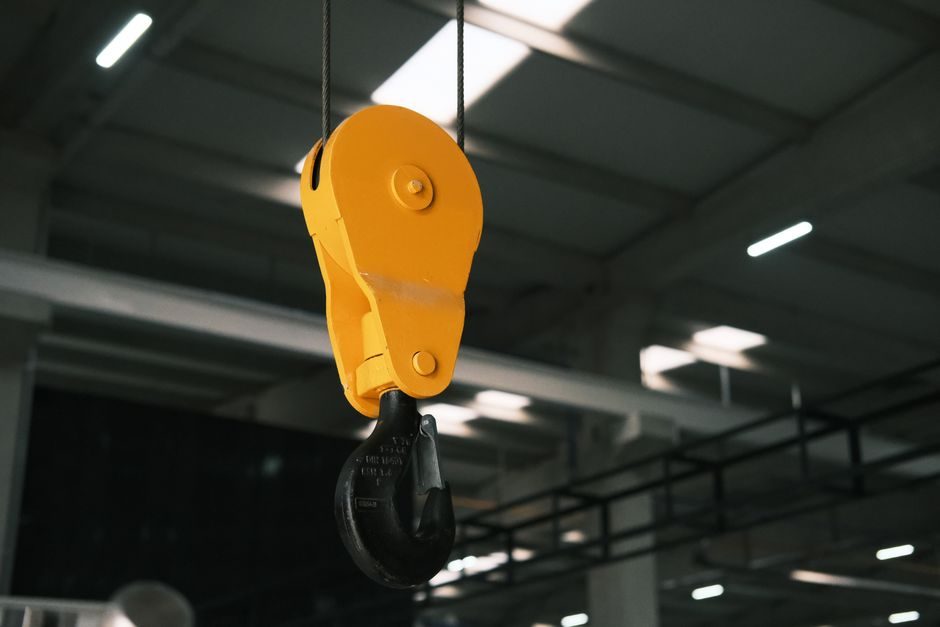
Single girder overhead travelling cranes cover a working envelope from 125 kg up to 12,000 kg of SWL, with spans reaching 32 m and lift heights between 6 m and 20 m on stock designs [S1]. The configuration is the default light-to-medium duty workhorse in workshops, assembly lines, and warehouses because one girder halves the trolley mass and the runway reaction versus a double girder crane sizing case.
Selection is not driven by capacity alone. Span, building clearance, duty class (FEM/ISO), hoist type (electric wire rope vs. electric chain vs. manual), and whether the end-carriages are top-running or under-hanging all feed back into the same calculation. A single girder crane spec for food and beverage plants typically runs 1–3 t at 10–22 m span under a stainless or galvanised finish, while a gantry crane 2026 buying guide workload starts where you need outdoor mobility or no building runway.
Six Numbers That Define the Sizing Envelope
Capacity on a light-duty single girder starts at 125 kg and tops out near 12,000 kg on the OMIS CMR stock range, with 1 t, 2 t, 3.2 t, 5 t and 10 t as the common catalogue steps [S1]. The 12,000 kg ceiling is structural: above it, the single I-beam or box girder section becomes uneconomically deep and most buyers cross over to a double-girder build.
Span on a top-running single girder reaches 32 m in the OMIS catalogue; ABUS EHB under-hanging (suspended) units cover shorter bays with the runway beams hung from the building truss [S1][S2]. Lift height runs 6–20 m on standard builds, set by the hoist drum length and the headroom above the top of the girder [S1]. Hoist lifting speed is commonly 10 m/min on monorail-speed single-speed hoists, with 5/0.8 m/min two-speed or 8/2 m/min variable-frequency options on heavier duties [S1].
Travel speeds (long-travel and cross-travel) and the FEM/ISO duty group (1Am, 1Bm, 1Cm, 2m, 3m …) are not stated in the visible product fields but drive the motor and wheel-load sizing; underspecifying duty is the single most common reason a single girder fails well before its rated cycle life.
Top-Running vs Under-Hanging: Two Structural Geometries
Top-running single girders (OMIS CMR, ABUS ZLK) sit on rails fixed to the top of the building columns; the end-carriage wheel load equals roughly (SWL + crane self-weight) / 2 per corner plus dynamic factor. The girder depth can be lower because the runway takes the bending, and you gain headroom under the hook — the typical choice for new-build industrial halls with adequate column spacing. [S1]
Under-hanging single girders (ABUS EHB) suspend the end-carriages from the bottom flange of an existing runway beam, so the building steel carries the full load and the crane itself is lighter [S2]. This is the retrofit path when the hall already has runway beams and the columns were not designed for top-running reactions. Trade-off: hook approach dimensions shrink because the girder hangs below the rail, and you inherit any runway-beam deflection.
For outdoor or no-building applications, the gantry crane price and cost guide 2026 covers the wheeled, rail-or-tyre alternative; a single girder on a gantry is the bridge part of that system.
Hoist Selection Inside the Girder
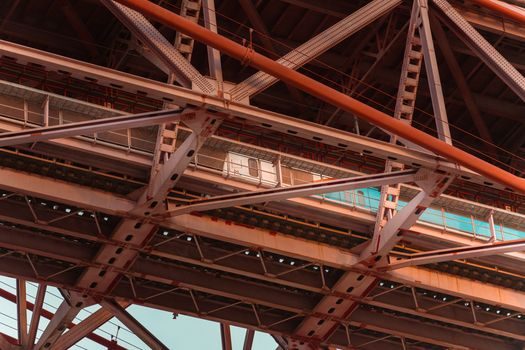
Three hoist families attach to a single girder, and the choice moves the price and the maintenance schedule as much as the capacity does. Electric wire-rope hoists (the ABUS GM-series style, also common on OMIS CMR) handle 1–10 t at standard lift heights and accept longer drum lengths for the 20 m ceiling case [S1].
Electric chain hoists cover 125 kg up to roughly 5 t in stock builds, with lower headroom loss and cleaner hook geometry — appropriate for low-headroom workshops and most food-grade single girder installations. Manual chain blocks still ship on the very light end of the range (≤ 2 t, intermittent duty) when electrification is not justified. End-carriage suspension geometry — low-headroom, standard-headroom, double-rail — sets the hook-approach dimension (C-dim), which is usually the second-most binding constraint after capacity.
Comparison: Hoist Types on a Single Girder
Three hoist options line up against four decision criteria as a quick selection matrix: [S2]
Electric wire-rope hoist: capacity 1–10 t (overlaps the top of the single-girder range), lift height up to 20 m, headroom loss ~0.8–1.2 m, duty group up to FEM 2m / ISO M5. Default for 3 t and above, and for any 5+ t or 15+ m lift case [S1].
Electric chain hoist: capacity 125 kg–5 t, lift height 6–12 m typical, headroom loss ~0.3–0.5 m, duty group up to FEM 1Cm / ISO M4. Default for ≤ 2 t, food-grade, low-headroom, and clean-room duty [S1].
Manual chain hoist: capacity ≤ 2 t, lift height 3–6 m, headroom loss ~0.3 m, duty group FEM 0–1Bm only. Specified only when cycles are rare and power is unavailable — do not put this on a production line running more than a few lifts per shift.
Selection Criteria Buyers Usually Miss

Duty class is the first one. The FEM/ISO grouping (1Am through 5m, or CMAA A through F) maps to load spectrum, daily cycles, and average hook travel; selecting one class too low halves the crane's service life. Buyers also routinely under-size the end-carriage wheel load and overrun the column base-plate reaction — the girder is fine, the runway rail or the building column is the failure point. [S3]
Hook approach (C-dimension) and headroom loss are the second and third constraints that re-spec a crane mid-project. A 1 t unit with a low-headroom trolley can gain 300–500 mm of hook lift in the same building; on a 20 m lift case that headroom margin is decisive. Finally, power feed (festoon, busbar, or conductor rail) and electrification voltage (400 V / 50 Hz three-phase in EU, 480 V / 60 Hz three-phase in US) need to be settled before the girder length is frozen, because the conductor length is set by span plus a service loop.
Standards, Sourcing and Where 2026 Pricing Actually Breaks
European single girder cranes typically ship to FEM 1.001 / EN 15011 and ISO 4301 series; US-market units to CMAA 70 / ASME B30.2. ATEX-rated units (for Zone 1/21 paint shops, solvent stores) cost roughly 20–35 % more than the same capacity in standard industrial spec, and add 4–8 weeks of lead time for the hoist certification. For a fuller cost breakdown across span, capacity and configuration, the overhead bridge crane price 2026 reference cross-checks the same line items. [S1]
Two 2026 signals worth tracking: (1) Chinese OEM catalogue widths (Xiecheng and peers) now publish single, double, and European-style suspension cranes from the same factory, compressing lead time on 1–10 t units to 4–6 weeks ex-works [S3]; (2) ABUS, OMIS and Demag are pushing the under-hanging EHB/ZLK geometry for retrofit halls because it avoids runway-beam strengthening — a working envelope to verify against any hall survey done in the last 12 months [S2].
For component-level specifications, see single girder crane, linear guide, and crossed roller guide.