
Smart valve positioners in the 2026 market converge on three selection gates — actuator type (pneumatic rotary/linear or electro-pneumatic), signal/protocol (4-20 mA with or without HART), and hazardous-area certification — and diverge sharply on stroke envelope, feed pressure, and ambient temperature limits [S1][S2].
The Azbil AVP300 series is a current-pneumatic smart positioner that receives a DC current signal from a controller and drives pneumatic actuators, with auto-setup, positive seating, and continuous self-diagnostics run from an external switch for hazardous-area commissioning [S1]. The Econ 3303 is configured for rotary single-acting actuators with a 0-90° stroke, accepts 4-20 mA on a 10-30 VDC loop, and can be ordered with HART protocol communication and a gauge block [S2].
Definition and Scope: What a "Smart" Positioner Actually Does in 2026
A smart valve positioner in 2026 is a microprocessor-based device that reads a setpoint (typically 4-20 mA), compares it to actual stem or shaft position, and drives an actuator until error is nulled — while exposing diagnostics, configuration, and (optionally) HART or Foundation Fieldbus variables to the control system [S1][S2]. Beyond the basic positioning function, Azbil's AVP300 family adds an automatic configuration program and self-diagnostics that the vendor positions as productivity and spares-reduction tools [S1].
The "smart" qualifier, versus a conventional I/P positioner, means the unit runs a calibration/auto-tune routine on power-up, stores valve-specific characterisation curves, and reports health data back to the DCS rather than just positioning the stem. The reference Azbil unit uses an external switch to trigger auto-setup, which lets commissioning happen in hazardous areas without opening the housing [S1]. The Econ 3303 takes a similar approach with automatic calibration and PID regulation, adapting control characteristics to the installed actuator [S2].
Scope matters: a positioner is not a position transmitter, and it is not an actuator. It sits on top of an actuator, on a control valve, and translates a control signal into mechanical motion with closed-loop feedback. For a deeper framing of where the positioner sits in the actuation stack, the valve positioner fundamentals entry covers the closed-loop principle, and smart valve positioner covers the diagnostic and digital-communication extensions.
Selection Criteria: The Five Gates That Decide the Buy
Five gates separate a working spec from a wasted PO: actuator interface, signal/protocol, hazardous-area classification, stroke/rotation envelope, and feed-pneumatic supply. [S2]
<strong>1. Actuator type and interface.</strong> Pneumatic rotary units such as AVP30 mount on rotary actuators with NAMUR-style interfaces, while the Econ 3303 is explicitly single-acting rotary with a 0-90° stroke and a steel shackle in the supplied mounting kit [S1][S2]. If the underlying actuator is linear, the same product family is not a drop-in — buyers should confirm shaft vs stem and mounting pattern before quoting.
<strong>2. Signal and protocol.</strong> The 2026 baseline is 4-20 mA, optionally with HART 7 superimposed on the analog loop. Econ 3303 lists HART as an optional module alongside 4-20 mA position feedback; the AVP300 is current-pneumatic with self-diagnostics and configuration over its own interface [S1][S2]. Where the DCS speaks Foundation Fieldbus or PROFIBUS PA natively, a HART-only device will not be a clean fit — that gate needs to be settled before the rest of the shortlist.
<strong>3. Hazardous-area class.</strong> Both reference units support commissioning in hazardous areas, but the certification level (ATEX 2014/34/EU category, IECEx, or Class/Div for North America) is a separate ordering code. The AVP30 datasheet specifically calls out that auto-setup can be triggered from an external switch so adjustments happen "quickly and safely in hazardous areas" [S1].
<strong>4. Stroke or rotation envelope.</strong> Econ 3303 is fixed at 0-90° rotary, with a feed pressure of 1.4-7 bar and an ambient operating range of -30 to +85 °C [S2]. A linear valve needing, say, a 20-100 mm stroke requires a different mechanical platform — stroke must be matched at the quote stage, not in commissioning.
<strong>5. Diagnostics and feedback.</strong> Azbil's positive-seating feature fully closes the valve when the input falls below a configured threshold, and self-diagnostics check positioner status continuously and alert on failure [S1]. The Econ 3303's optional 4-20 mA feedback module gives the DCS a separate position-confirmation channel without bus communication [S2].
Variant Comparison: Current-Pneumatic vs Electro-Pneumatic Rotary Positioners
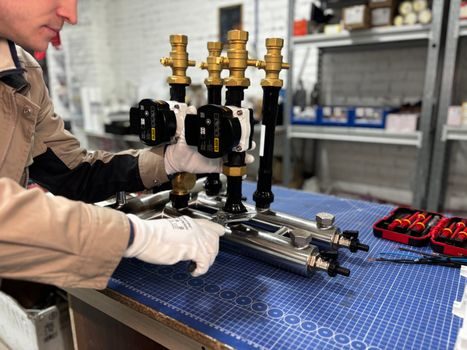
Buyers typically choose between three positioner architectures, and the right one follows from the actuator and signal stack already installed. [S1]
<strong>A) Current-to-pneumatic (I/P) smart positioner, e.g., Azbil AVP30.</strong> Pneumatic output, rotary mount, DC current setpoint, auto-setup, positive seating, continuous self-diagnostics, hazardous-area-friendly external configuration switch [S1]. Best fit where the plant runs a pneumatic actuator fleet and the controller is a conventional 4-20 mA DCS card.
<strong>B) Electro-pneumatic rotary smart positioner, e.g., Econ 3303.</strong> 4-20 mA input on a 10-30 VDC loop, electro-pneumatic actuation, single-acting rotary, 0-90° stroke, 1.4-7 bar feed pressure, -30 to +85 °C ambient, optional HART and 4-20 mA position feedback, steel shackle mounting kit [S2]. Best fit where the actuator is single-acting rotary, the air supply is regulated between 1.4 and 7 bar, and HART is desired for asset management but not required.
<strong>C) Digital-bus smart positioner (HART, Foundation Fieldbus, PROFIBUS PA).</strong> Not directly evidenced in the supplied research — buyers specifying FOUNDATION Fieldbus or PROFIBUS PA should request a variant datasheet and confirm the exact protocol revision, bus-powered current draw, and segment compatibility before purchase. Do not assume any 4-20 mA + HART unit will substitute for a true FF/PA device on a digital segment.
For an end-to-end view of how the positioner sits in the actuator selection chain, the electric actuator selection criteria guide covers the bus-and-force axes, and the pneumatic valve actuator pricing 2026 piece covers the upstream cost and torque tier logic that the positioner then controls.
Use-Case Match: Which Positioner Goes Where
Three concrete duty bands dominate 2026 positioner demand: general process control loops, safety shut-off with positive seating, and asset-management-heavy plants that want full HART diagnostics on every valve. [S1]
<strong>General process control.</strong> Either reference architecture handles throttling service on a control valve with a pneumatic actuator. The Econ 3303's PID regulation and automatic calibration are aimed at standard throttling loops where loop tuning is done at the positioner rather than the controller [S2]. The AVP30 is aimed at the same service where the plant already runs an Azbil Alphaplus valve fleet and the value is in auto-setup and self-diagnostics [S1].
<strong>Positive shut-off / safety service.</strong> Azbil's positive seating function "completely shuts off the valve if the input signal becomes lower than previously set," which is the behaviour expected of an emergency-isolation positioner on a fail-close application [S1]. A pure modulating positioner without that latch behaviour should not be specified for SIL-rated isolation without a separate solenoid trip.
<strong>Asset management and valve-signature diagnostics.</strong> Plants that already run HART-based valve diagnostics (e.g., partial-stroke testing, friction/breakout trend logs) want the HART option, which the Econ 3303 lists as a configurable module rather than a standard feature [S2]. For buyers comparing this against plug-style isolation hardware, the plug valve buying guide 2026 covers the manual isolation side, while the positioner layer above it stays distinct.
Limits, Failure Modes, and Who Should NOT Buy a Smart Positioner

Smart positioners are not always the right answer. Three hard limits bite first: feed-air quality, actuator health, and the wrong protocol. [S1]
<strong>Dirty or wet instrument air.</strong> The Econ 3303's 1.4-7 bar feed-pressure range assumes clean, dry, oil-free instrument air; a positioner is not a coalescing filter. Plants with marginal air systems should fix filtration upstream before specifying a smart positioner, or the pneumatic stage will fail well before the electronics do [S2].
<strong>Worn or uncharacterised actuators.</strong> Auto-setup routines, including Azbil's external-switch auto-setup and Econ's automatic calibration, only work if the actuator itself is mechanically sound [S1][S2]. A positioner cannot fix a packed-out stem, a leaking diaphragm, or a bent linkage — those problems show up as persistent positioner alarms, not as positioner faults, and they will drain the diagnostics budget.
<strong>Wrong digital bus.</strong> A 4-20 mA + HART positioner will not interoperate as a native node on a Foundation Fieldbus or PROFIBUS PA segment. If the brownfield is a true FF H1 segment with LAS-managed device replacement and EDD-based configuration, the buyer needs a positioner variant that explicitly supports that bus, not a HART unit with a converter.
<strong>Simple on/off isolation.</strong> A smart positioner is over-spec for a binary open/close solenoid-operated isolation valve. For those, the solenoid coil selection guide covers the appropriate hardware, and the swing check valve selection and butterfly valve selection pieces cover the upstream valve decisions.
Standards, Sourcing, and the Shortlist Logic
Positioner procurement is governed less by a single product standard and more by the surrounding installation rules. Buyers should confirm the positioner is specified against the actuator's interface standard (e.g., VDI/VDE 3845 for rotary NAMUR mounting), the hazardous-area directive (ATEX 2014/34/EU for EU, IECEx for global, NEC 500/505 for North America), and the signal stack (HART for analog-with-smart, IEC 61158 for FF/PA). Lead times on units with both HART and a specific hazardous-area certificate routinely run longer than the same unit without the certificate, so the certificate code should be on the RFQ from day one. [S2]
Shortlist logic that holds up in a procurement review: (1) fix actuator type, stroke, and air supply; (2) fix signal and protocol; (3) fix hazardous-area class; (4) only then evaluate diagnostics, feedback modules, and price. If a vendor quotes a different protocol revision than the rest of the fleet, that single mismatch will dominate lifetime cost through spares and training.
Trackable signals for the next buying cycle: the spread of HART-IP and WirelessHART gateways into brownfield DCS, the migration of positioner firmware to support FDI packages rather than legacy DTMs, and any plant-side move from category-3 to category-2 ATEX zoning on new builds, which historically widens the smart-positioner addressable fleet on skid packages [S1][S2].
Spec-level background on the components involved: linear guide.