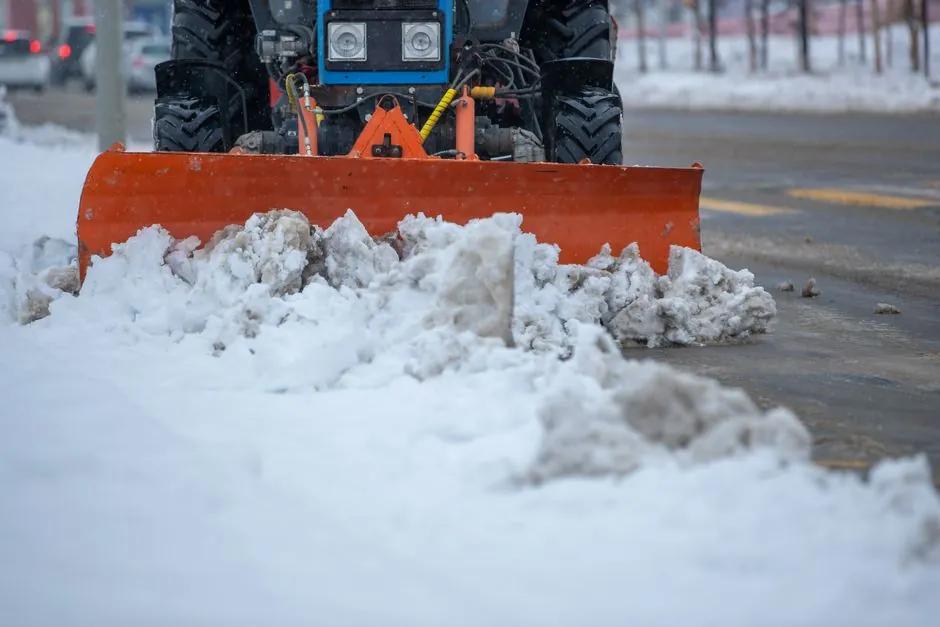
A truck-mounted crane configured for snow removal typically pairs a 3-16 t lifting unit with a front plow or underbody scraper and a rear salt/sand spreader on a 4x4 chassis, with 4.5 t GVW and 100 km/h top speed common in 2026 JMC double-cab builds [S4].
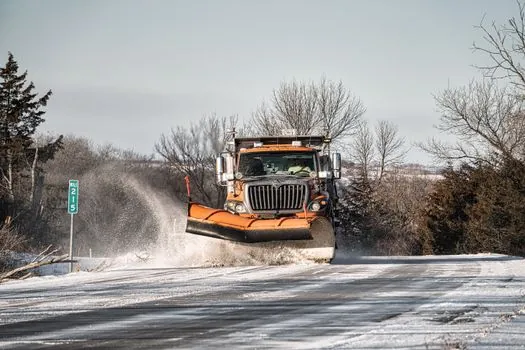
Selection pivots on five hard gates: chassis axle rating, departure angle, crane moment in the loaded posture, hopper corrosion class, and tire PR rating for cold service. Pittsburgh's published snow response routing on 2026-07-04 confirms that mixed fleets of plows and salt trucks remain the operating baseline in northern US municipalities [S1].
Chassis and Axle Load Math Before the Crane Quote
The JMC CL5040TCX6HL snow removal truck posts a 4495 kg GVW with 1725 kg / 2770 kg axle distribution, 3360 mm wheelbase, and a 13° / 22° approach / departure angle on 7.00R16LT 10PR tires [S4]. That envelope is the floor: any rear-mounted crane that pushes the rear axle past 2770 kg in the laden salt-and-crane posture disqualifies the build.
Departure angle is the silent killer of snow chassis. A 22° rating [S4] is fine for a rear hopper, but adding a folded boom crane bracket that drops the effective angle below 15° turns every curb into a contact event. Engineers should require the OEM to publish the departure angle with the crane in the transport stow position, not on a bare chassis.
Tire PR rating must be cross-checked against regional chain laws. The 10PR rating on the JMC build handles 7.00R16LT at full GVW, but operators running steel chains on compacted snow routinely derate load by 10-15% to manage chain-on-tire wear; the OEM does not publish this derate, so it is a fleet-side decision.
Boom Type Decision: Straight, Knuckle, or Telescopic
Straight boom cranes deliver maximum lift at short radius and dominate heavy municipal stock, while knuckle (articulated) booms trade peak capacity for a tighter working envelope suited to narrow alleys [S2][S6]. For snow duty, the decision is not capacity alone; it is the folded transport length on a chassis already carrying a plow and hopper.
Manufacturer catalogues published within the last 6 months confirm knuckle boom crane offerings at 4 t with 8.4 T.M. moment and CE certification, and articulated 12 t and 14 t classes for heavier municipal fleets [S2]. The 4 t knuckle class typically folds inside a 2.5 m rear overhang envelope, which preserves the 22° departure angle on the JMC platform [S4]; a 12 t straight boom on the same chassis does not.
Telescopic boom cranes enter the conversation only when the crane must reach over a loaded salt body to lift tree sections or fallen signals. For routes that stay under 6 m of side reach, a knuckle boom cuts the rear overhang and protects the departure angle. For routes that demand 8-12 m reach, a telescopic unit is the only option, and the chassis must grow to a 3-axle configuration.
Hopper, Spreader, and Corrosion Class

The JMC build specifies a Q235 carbon steel hopper at 2600 x 2060 x 400 mm, paired with a diesel powertrain at 115 HP and a 100 km/h top speed [S4]. Q235 is the cost baseline; for coastal or brine-heavy routes, 304 stainless or hot-dip galvanized hopper liners are the next tier, and operators should not accept a bare Q235 hopper on a Class A route.
Spreader throughput, rated in g/m² or L/km, is the spec the OEM leads with, but the failure mode is corrosion at the auger-to-hopper weld. The 6-month factory quality tests at Hubei Shenbai, a truck-mounted crane and snow vehicle producer, focus on hydraulic seal integrity and outrigger pad pressure rather than hopper corrosion, so the corrosion spec has to be written by the buyer [S7].
Deicing agent compatibility matters: rock salt, calcium chloride brine, and magnesium chloride each attack carbon steel at different rates. Q235 with no coating typically shows first pitting within 18-24 months on a calcium chloride route; the same hopper on a rock-salt-only route can run 5+ years. This is a route-classification decision, not an OEM decision.
Integrated Workload: Plow, Crane, and Spreader in One Pass
The 2026 Ford F-350 crane-body truck offered with V-8 4x4, 9 ft body, and Snow Plow Prep package shows the OEM direction: a single chassis plumbed for both a front plow harness and a rear crane body, with the crane and plow sharing the 12 V electrical architecture [S8]. That prep package is now table stakes for any Class 3-4 snow chassis.
The case for combining plow, crane, and spreader on one chassis is route density: a single vehicle can plow a 5 km cul-de-sac loop, stop to lift a fallen branch off the route, then resume salting, without a support truck rolling behind it. The case against is mechanical concentration; one driveline failure takes the plow, the crane, and the spreader offline at once.
Municipalities running this integrated spec typically split the fleet 60/40 between dedicated plow-only units and integrated plow-crane units, with the integrated units reserved for routes that include known lift hazards (overhead signal arms, mature tree canopy, bridge underpasses). The split is fleet-specific, not OEM-driven.
Standards and Verification Trail
Buyers should demand three documents at delivery: chassis certification (GVW, axle load, tire PR), crane CE certification per the 4 t / 8.4 T.M. knuckle class or equivalent for heavier units [S2], and a published departure angle measured with the crane in transport stow. None of these is optional, and the absence of any one of them is grounds for rejection at PDI.
For related selection work, the truck-mounted crane spec gates for pipeline work and the forestry truck-mounted crane reach and stability analysis both apply the same chassis-versus-crane envelope logic on heavier 50 t and forestry classes, and the tunneling truck-mounted crane selection map covers confined-space reach trade-offs that translate directly to narrow urban alleys.
Track the 2026-07-12 Chinese OEM catalogue refresh for new knuckle classes below 4 t [S2], the 2026-06-13 CLW Group telescopic and knuckle boom announcements [S6], and any Pittsburgh Snow Response Dashboard route updates as the next 2026-2027 winter season approaches [S1].
For the relevant spec sheets and selection criteria, see truck mounted crane, truck mounted concrete pump, and dump truck.