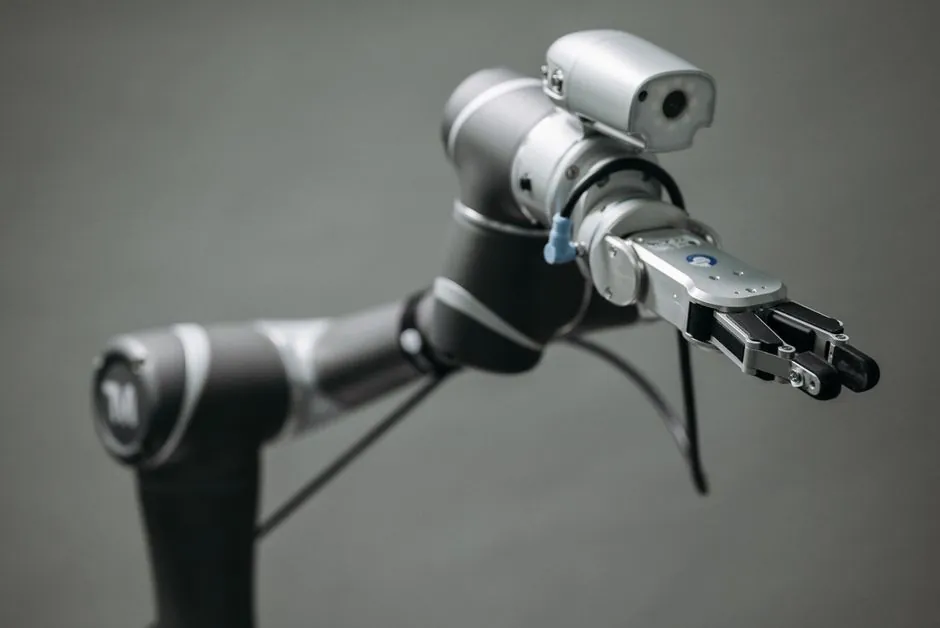
China is the gravitational center of industrial robotics in 2026: domestic output topped 458,000 units in 2025, exports grew 27% in a single year, and Chinese firms hold 70%+ of global industrial-robot installations and roughly 80% of global humanoid shipments [S3][S5]. Robot density reached 392 robots per 10,000 manufacturing workers in 2025, ranking third worldwide [S5].
For an overseas buyer the commercial case is concrete: a domestic 6-axis general-purpose arm runs at roughly 58% of an equivalent FANUC or Yaskawa price and 51% of a comparable KUKA, with fixtures and custom tooling often 60% cheaper again, so total project budgets routinely fall 40% or more against an imported baseline [S3]. Pricing, however, is the easy part; matching the machine to the destination market's certifications, voltage, and customs treatment is where most first-time imports succeed or stall.
What "made in China" actually covers: scope and brand tiers
The Chinese supplier base is not a single tier: it spans listed majors with multi-thousand-unit export track records, mid-tier specialists in welding or palletizing cells, and integrators who build application packages around third-party arms [S1][S2]. On the cobot side specifically, domestic manufacturers now supply more than 92% of China's cobot market, with the leading names including Elite Robots, JAKA Robotics, Dobot, AUBO Robotics, Siasun (DUCO), Rokae, Techman Robot, Huayan Robotics, and Flexiv [S4].
A useful split for buyers is three layers. Tier 1 covers established exporters with their own controller, servo, and reducer stack and international safety certifications. Tier 2 covers specialists with deep domain focus (arc-welding cells, palletizing, spraying) but narrower product breadth. Tier 3 covers trading companies and integrators who assemble cells around a mix of arms and third-party controllers. Each tier carries a different risk profile on after-sales support and certification traceability [S3].
Selection criteria that actually predict a successful import
For a cobot purchase, the seven criteria that separate world-class Chinese manufacturers from commodity producers are: core component self-development rate, global deployment scale, payload range, international certifications, MTBF, solution ecosystem breadth, and regional after-sales presence [S4]. Apply the same logic, with payload and reach substituted for cobot-specific items, when evaluating 6-axis industrial arms.
Concrete numbers to demand from any shortlist: payload in kg, reach in mm, repeatability in mm (typical industrial range 0.02–0.08 mm), axis count, controller I/O count, weight, and power consumption. For cobots, a published MTBF figure above 30,000 hours and a safety certification package covering ISO 10218 and ISO 13849 cat. PL d are the minimum bar for EU and North American sites [S4].
Voltage and frequency are non-negotiable spec items. A machine wired only for 380 V / 50 Hz will not run on a US 480 V / 60 Hz plant without a transformer, and a controller with a hard-coded 50 Hz servo loop will show position errors at 60 Hz. The cleanest path is a switchable 380 V / 480 V controller that accepts both 50 Hz and 60 Hz input, which several Chinese OEMs now ship as standard for export builds [S2].
Side-by-side: import options lined up against decision criteria

The decision most buyers face is not which Chinese brand, but which import channel. Direct-from-factory, China-based sourcing agent, and Western distributor each score differently on cost, control, and risk. The matrix below reflects published 2026 sourcing guidance [S1][S2][S3].
Direct-from-factory is the cheapest, typically 30–60% under Western list, and gives full control of the specification, but the buyer owns freight, customs, and warranty coordination. A China-based sourcing agent adds 5–10% to unit cost but supplies English-language QC, pre-shipment inspection, and on-the-ground dispute resolution; this is the channel most first-time importers under USD 200,000 use. A Western distributor costs the most (15–30% margin on a USD 40,000–80,000 robot) but delivers in-country service, stock spares, and a single point of accountability for warranty [S1][S2][S3].
For a 6-axis welding cell at a single EU site, direct import with a retained local system integrator for commissioning is usually the lowest total landed cost. For a multi-site North American rollout where downtime liability is high, the distributor channel is often the rational choice despite the margin, because parts and field engineers sit inside the same time zone as the line.
Pricing, payment, and Incoterms that protect the buyer's cash flow
Published factory-direct pricing for a 6-axis general-purpose arm sits in the USD 12,000–25,000 FOB China range for a 10–20 kg payload class, with palletizing and high-payload (50–200 kg) units higher. The 30% deposit / 70% before-shipment split is the most common payment schedule for first orders, with letters of credit or escrow via Alibaba Trade Assurance common for buyers without an existing relationship [S1][S3].
On Incoterms, FOB Shanghai is the default for experienced importers because the ocean freight market out of Shanghai is the most competitive and the buyer keeps control of insurance and the destination customs broker. EXW shifts more cost onto the buyer but is the right answer only when the buyer already runs a freight desk. CIF and DDP are convenient for first-time buyers but embed a freight and duty markup that can run 8–15% over FOB-equivalent landed cost [S2].
Certifications, customs, and the HS code that decides your duty bill
Industrial robots clear customs under HS code 8479.50 (machines and mechanical appliances having individual functions, not specified or included elsewhere) in most jurisdictions [S2]. Duty rates diverge sharply by destination: 0% in the EU and UK under the standard MFN tariff, and up to 25% into the US under Section 301 for origins covered by the list, which is why tariff planning is a material budget line, not a rounding error [S2].
For certifications, the destination market sets the bar. EU buyers need CE marking supported by EN ISO 10218-1 and EN ISO 13849-1 on the robot and a Machinery Directive 2006/42/EC technical file. US buyers need UL 1740 or UL 3100 for collaborative applications, plus NFPA 79 for the cell. China-made cobots at the top of the published benchmark list carry CE, UL, KCs, ISO 10218, and ISO 13849 documentation as a package, which materially shortens the importer's conformity-assessment timeline [S4]. Documentation that arrives with the shipment, not after it, is the single biggest factor in avoiding a customs hold.
Logistics and on-site commissioning: the often-missed 20% of landed cost
For ocean freight, FCL (Full Container Load) at 25–40 days port-to-port is the default for bulk or heavy units; LCL (Less than Container Load) runs 30–45 days and suits smaller or mixed-cargo orders. Air freight at 5–10 days is reserved for urgent or lightweight spares. Rail freight at 18–25 days is a cost-balanced option for Europe-bound shipments and has become a structural lane for China-to-EU robot and EV-parts trade [S1].
On-site commissioning is where many first-time importers underestimate the budget. A typical 6-axis cell needs a 3–5 day site acceptance test (SAT) by a field engineer, plus the buyer's production downtime. If the OEM does not have a local service partner in the buyer's country, dispatching an engineer from China adds flight, visa, and per-diem cost, plus a 1–2 week scheduling lead time. The question to put on every shortlist is: where is your nearest field service engineer, and what is the guaranteed response time? [S1][S2]. For a deeper look at how a robot arm's servo sizing and motion-control budget interact with the rest of the cell, see the servo drive sizing and selection field guide; for the motor-control side of the same cell, the VFD sizing and selection guide for industrial motor control covers the variable-frequency drives that often sit next to a robot on a conveyor line.
Where the China sourcing case breaks down

Three failure modes account for most unsuccessful imports. The first is certification mismatch: the machine ships with CE but the buyer needs UL for a US site, or carries a CE built against the Machinery Directive but missing the EN ISO 10218-1 robot-specific clause, which customs and the local notified body will both flag. The second is controller lock-in: a non-export controller with a Chinese-only HMI, no English documentation, and firmware updates served from a server inside China. The third is warranty ambiguity: the contract says 12 months but excludes the teach pendant, servo packs, or end-effector, so the first field failure is out of pocket [S2][S3].
A second class of risk is application fit. Sub-$10K Chinese arms are real and account for 8 of 14 global sub-$10K arm manufacturers, but they are tuned for light-payload, low-duty-cycle work, and a buyer who specs one into a 24/7 palletizing cell is buying downtime [S5]. Match the spec sheet to the duty cycle, not the sticker price.
Verification workflow that survives a pre-shipment inspection
For any order above roughly USD 20,000, run a documented three-stage verification. Stage 1 is a documentation review (ISO 9001 certificate, CE/UL file numbers, test reports, warranty terms) before the deposit is released. Stage 2 is a factory acceptance test (FAT) at the OEM site, witnessed in person or via a third-party inspector, against an agreed test sheet that includes payload, reach, repeatability, and a 4-hour continuous-run soak test. Stage 3 is a pre-shipment inspection (PSI) on 100% of finished units, checking quantity, visual quality, packaging, and that the serial numbers on the robots match the paperwork the customs broker will file under HS 8479.50 [S1][S2].
Independent third-party inspection bodies (SGS, TUV, Bureau Veritas, and the larger China-based QC firms) all run this workflow as a standard service, with typical lead time of 3–5 business days from booking to on-site report. The cost is a small single-digit percentage of the order value, and it is the cheapest insurance on the import.
What to watch over the next two quarters
Two trackable signals will tell buyers where the China robotics market is heading into late 2026 and 2027. The first is the rollout of the national Humanoid Robot Action Plan, which targets 100,000 deployed humanoids by 2027, with Unitree and AgiBot alone targeting 75,000+ units of annual capacity, more than the entire Western supply combined as of 2026 [S5]. The second is Section 301 tariff review activity for HS 8479.50 at the US border, which directly changes the duty math for any North American buyer; the current 25% rate is the baseline against which direct-import savings are calculated [S2].
Spec-level background on the components involved: linear guide, crossed roller guide, and industrial robot.