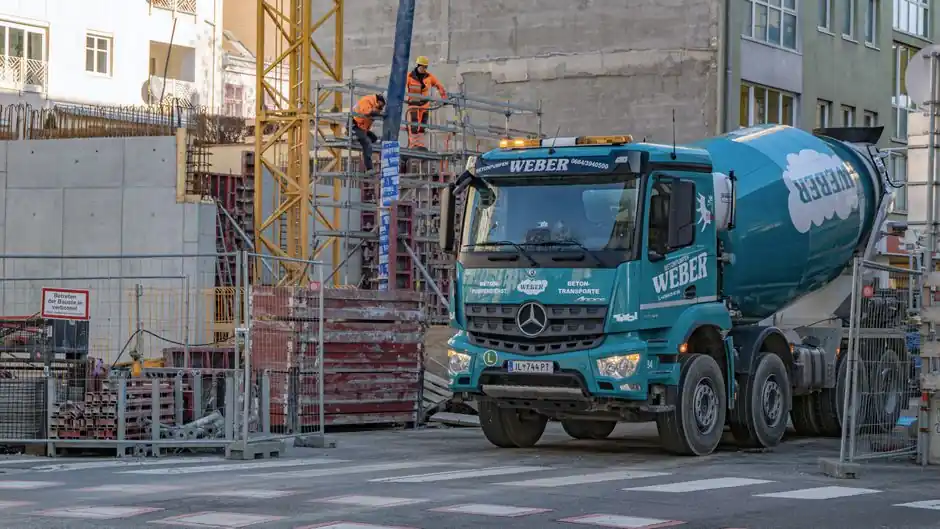
Truck-mounted concrete pumps are widely used in high-rise buildings, commercial complexes, and urban construction projects [S1].
Buyers in 2026 are sizing equipment against four hard constraints: vertical reach (commonly 43–63 m on five- and six-section booms), hourly output, urban axle-load limits, and Stage V / EPA Tier 4 final emissions compliance, with boom pumps holding the largest share of large commercial and infrastructure pours [S1][S2][S5].
Boom pumps vs line pumps vs trailer pumps: where each one fits
Boom pumps are the workhorse for vertical and long-distance concrete delivery on urban sites, with hydraulic booms reaching 60 m or higher and dominating large commercial and infrastructure pours such as metro lines, bridges, and industrial parks [S2]. For medium-rise commercial work, five-section booms around 43 m (the 43X-5RZ class) balance reach and footprint, while six-section 57–63 m configurations (57X-6RZ, 63X-6RZ class) handle taller commercial towers and tighter set-up radii [S4].
Line pumps (often called city pumps) are truck-mounted but use hoses rather than booms; models such as the CTY-100 are sized for residential pours, driveways, and street repaving where footprint and hose reach, not vertical lift, are the binding constraints [S4]. Trailer pumps sit outside the truck-mounted family but are routinely compared against them: they deliver high-pressure, long-distance pumping through steel pipelines for tall-building cores and bridge piers, and earn their place on multi-project fleets where a single unit can serve several urban sites [S3][S4].
A practical comparison against the four decision criteria most procurement teams actually score:
Boom pump: vertical reach 60 m and above; output highest in class; footprint large, needs outrigger spread; cost highest, justified on high-rise and metro work [S2][S4].
Truck-mounted line / city pump: vertical reach limited to hose length, typically under 30 m; output moderate; footprint small, fits narrow streets; cost lower, suited to residential and repair work [S4].
Trailer pump: vertical reach limited by pipeline routing, but high pressure and long horizontal runs; output moderate to high; footprint compact when stationary but needs a tow vehicle; cost mid-range, durable across multiple project cycles [S3][S4].
For most urban-infrastructure tenders the boom pump wins by default because vertical reach and pour speed outweigh its higher capital cost, while line and trailer pumps are kept in the fleet for confined or low-rise pours that do not justify mobilizing a boom [S2][S3][S4].
Sizing math: volume, distance, and height drive pump class
Selection starts with three numbers: total concrete volume in cubic metres, horizontal delivery distance, and vertical placement height, because the larger the volume and the higher the lift, the bigger the pump class required [S4]. A 43 m boom pump such as the 43X-5RZ is typically chosen for medium-rise commercial basements and mezzanines, while a 52X-5RZ (over 150 ft, roughly 46 m horizontal reach) fits street and urban repaving work, and the 57X-6RZ covers medium-to-large commercial towers where both reach and tight-quarter manoeuvring are required [S4].
For pipeline and hose layouts, Latin-American high-rise practice shows that trailer pumps on steel pipelines remain the most stable long-distance, high-pressure option, and that pipeline layout plus routine lubrication of the delivery system is a top-three driver of pumping efficiency on tall buildings, alongside mix design and operator coordination [S3].
Site constraints that override raw spec sheets
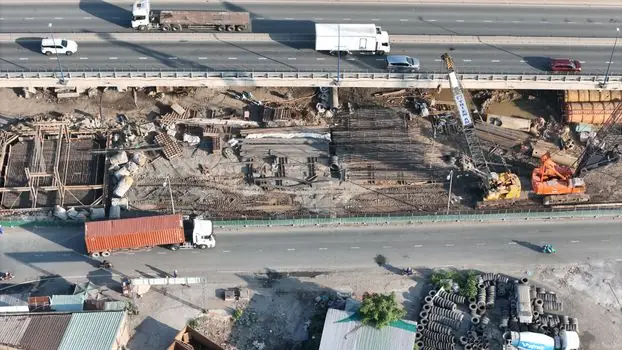
On dense urban jobs, the binding constraint is rarely maximum reach; it is the set-up envelope. Overhead power lines, narrow streets, basement excavations, and adjacent structures limit outrigger spread and boom unfolding radius, which is why five- and six-section Z-fold booms with short front outrigger spreads dominate city tenders [S4]. Line pumps and small trailer pumps are specified where the truck or trailer simply cannot get under obstructions, because hose routing solves obstacles that a rigid boom cannot fold around [S3][S4].
Ground-bearing pressure under outrigger pads is the second hidden constraint on redeveloped urban sites with buried utilities or recent fill, which is one reason procurement teams pair a truck-mounted concrete pump selection with a separate review of the carrier chassis and its axle ratings, similar to the chassis-fit logic used for concrete pump truck chassis work in winter service. For higher-output boom pumps, the same outrigger and ground-pressure discipline that governs mining pours also applies in city basements, as detailed in boom, outrigger, and ground-pressure criteria for mining pump-truck selection.
Cost, fleet economics, and total ownership
Capital outlay scales steeply with boom length and control sophistication, and long-boom, high-pressure pump-trucks are described as requiring significant upfront investment, especially when paired with advanced electronic control and telemetry packages [S6]. Fleet operators, contractors, and rental companies are the primary buyers in markets where labour is expensive and terrain is inconsistent, and municipal authorities procure in bulk through public-private partnerships for roadwork, irrigation, and smart-city projects [S2].
The total-cost case for a boom pump improves when one unit can service multiple high-rise cycles over its service life, because a well-maintained trailer or boom pump can run across several urban projects and amortize its purchase price across far more cubic metres than a single site would pour [S2][S3]. For demolition and re-pour work adjacent to live infrastructure, the same fleet-economics argument shows up in concrete-mixer-truck selection for demolition projects, where one chassis is expected to cycle across multiple pours per shift.
Technology trends shaping the 2026 buying decision
New truck-mounted pumps are integrating digital pressure monitoring, real-time performance diagnostics, and semi-autonomous boom operation, with electrified truck chassis and hybrid hydraulic systems moving from concept to commercial offering [S2]. These features matter for urban procurement because they directly affect pour quality (consistent pressure reduces blockages), operator skill requirements (a scarce resource in tight labour markets), and the data trail that public-sector clients increasingly demand for infrastructure contracts [S2][S3].
According to internal modeling by Strategic Market Research, the global truck-mounted concrete pump market is poised to grow at a 6.1% CAGR, reaching approximately USD 6.70 billion in 2030, up from an estimated USD 4.7 billion in 2024, driven by rapid urbanization, megaproject pipelines, and skilled-labour shortages in the construction sector [S2]. Within that growth, the concrete-pumps market as a whole is projected to expand from USD 11.06 billion in 2025 to USD 19.67 billion by 2035, with the North American market tracked to reach USD 2,524.1 million by 2035 [S5].
Selection criteria checklist for urban-infrastructure tenders
Specifiers should score candidates on at least six criteria: required vertical reach in metres, hourly output in cubic metres per hour, horizontal reach and outrigger envelope, chassis axle rating and emissions tier, electronic control and telematics package, and total cost of ownership over an expected 5–10 year service life across multiple urban sites [S2][S4]. For high-rise and metro work the minimum bar is a 43–63 m five- or six-section boom with high-pressure hydraulics, while for residential, street, and confined-area pours a truck-mounted line pump or trailer pump is the more cost-effective match [S1][S2][S3][S4].
Trackable signals to watch into late 2026: OEM announcements of electrified or hybrid chassis for the 50+ m boom class, broader availability of semi-autonomous boom controls on mid-tier rather than only flagship models, and any tightening of urban low-emission zones that pushes Stage V / Tier 4 final chassis into procurement specifications for publicly funded infrastructure projects [S2][S5].
For the relevant spec sheets and selection criteria, see truck mounted concrete pump, truck mounted crane, and concrete pump truck.