Explosion-proof overhead bridge cranes must combine sealed ignition-control systems, suitable structural design, and a documented hazardous-area classification.
Published product data describes a double girder explosion-proof bridge crane for hazardous area Zone 1 or Zone 2, proofing grades IIB and IIC, ignition temperature groups T1–T4, and working duties A3–A4 [S4].
Hazardous-Area Scope and Protection Basis
An explosion-proof overhead bridge crane is a lifting system intended for locations where flammable gases, vapors, or dust can create an explosive atmosphere [S1][S5]. It differs from a standard overhead bridge crane because electrical equipment, motors, controls, brakes, cabling, and materials that can generate heat, sparks, or static electricity must be addressed as parts of one protected system [S1][S8].
Published hazardous-location coverage includes Class 1, 2, and 3 locations and Division 1 and Division 2 classifications, with Groups C, D, E, F, and G offered by one custom crane supplier [S2]. A double-girder example is specified for Zone 1 or Zone 2, protection not exceeding IIB and IIC, and temperature groups T1 through T4 [S4]. These ratings describe one configuration, not a universal permission to operate the crane in every hazardous area.
The first design decision is therefore the exact operating envelope: location classification, gas or dust group, temperature group, and the presence of corrosive, conductive, wet, or outdoor conditions. Using an explosion-proof motor, explosion-proof button, and associated controls without matching the complete crane to the classified area can leave the system outside its intended protection basis.
Capacity, Span, and Duty Selection
That broad range confirms that capacity is a project parameter rather than a fixed feature of explosion-proof design. Load, hook approach, trolley arrangement, lift height, span, operating cycle, and duty must be established before electrical and mechanical protection are selected.
A double-girder explosion-proof bridge crane example is rated for working duties A3–A4 [S4]. By comparison, a separate manufacturer identifies explosion-proof underhung and top-running bridge cranes as distinct configurations with explosion-resistant structures, explosion-proof electrical systems, and safety devices including limit switches, overload protection, and collision avoidance [S5].
The comparison is straightforward: single-girder or underhung designs can suit lighter-duty or space-constrained installations, while a double-girder configuration provides a separate structural platform for larger loads and more demanding lifting arrangements. The sources do not establish a universal load cutoff between these configurations, so bridge size and girder count cannot be selected from the product names alone.
Electrical, Control, and Braking Architecture
Sealed electrical systems and spark-resistant materials are identified as principal ignition-control features of explosion-proof overhead cranes [S1]. The electrical architecture must also account for the explosion-proof light, junction boxes, pushbuttons, motor, limit switches, brakes, and control devices installed along the bridge and trolley. Published descriptions specifically identify explosion-proof controls and electrical components [S5].
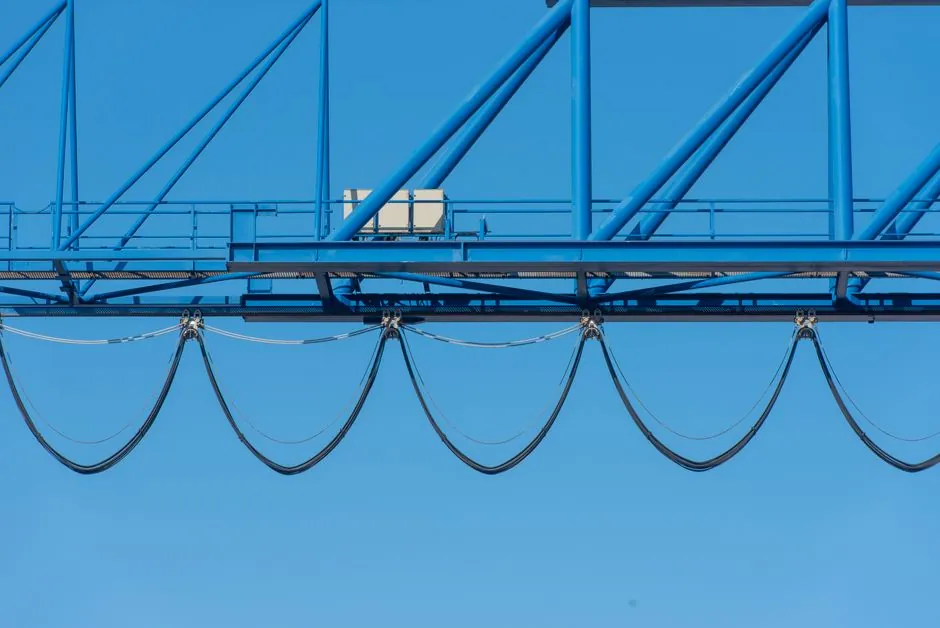
Cabling is a system boundary rather than a minor accessory. Explosion-proof bridge cranes require coordinated treatment of power supply, festoon or conductor-bar systems, control conductors, grounding, and connections capable of remaining safe in the classified area [S8]. The related comparison of conductor bar versus festoon systems for crane bridge power is useful because both methods affect installation geometry, cable handling, and maintenance access.
One custom supplier offers explosion-resistant features across overhead bridge cranes, trolley hoists, and custom lifting devices [S2]. This supports a whole-equipment approach: matching only the hoist motor while leaving controls, brakes, wiring, or ancillary devices outside the required protection can compromise the installation.
Double Girder Versus Underhung and Top-Running
Double-girder and underhung cranes are compared by four practical criteria: load capacity, installation envelope, structural configuration, and hazardous-location suitability. Published examples establish Zone 1 and Zone 2 use, IIB and IIC protection capability, T1–T4 temperature groups, and A3–A4 duties for one double-girder design [S4]. Separate product information covers explosion-proof underhung and top-running bridge cranes with protected electrical systems and lifting safeguards [S5].
Suitable Applications and Procurement Limits

Explosion-proof overhead bridge cranes are used in chemical, oil, gas, and mining environments where explosive gases, vapours, or dusts may be present [S5]. These systems suit maintenance, material handling, and production lifting where routine ignition sources from the crane cannot be accepted. They are not intended for every factory simply because dust is present; the combustible material, zone, and classification must support the specified protection.
The product is generally not for users seeking a low-cost standard bridge crane with no classified-area duty. A standard crane may be appropriate outside the hazardous boundary, while a hazardous-area crane requires a documented protection plan. Suppliers describe these machines as custom or specially engineered systems, and one portfolio covers capacities from 125 kg to 160 tons [S1][S3].
Operator training is also part of the operating case. Specialized training and compliance with the applicable safety regulations are identified as requirements for explosion-proof bridge cranes [S5]. The crane package should therefore include hazardous-area drawings, component certificates, operating instructions, inspection requirements, and clear boundaries between authorized and prohibited work.
Verification Checklist Before Purchase
A purchaser's data request should require the hazardous-area classification, equipment group, temperature group, certified component list, lifting capacity, span, lift height, duty classification, control voltage, braking arrangement, power-supply method, and applicable documentation. Those fields distinguish a genuinely specified system from a general claim of “explosion proof.” [S4]
Four checks provide a practical release gate. First, confirm Zone 1 or Zone 2 suitability against the actual classified area rather than relying on the product category. Second, reconcile the stated IIB or IIC capability and T1–T4 group with the site requirement [S4]. Third, verify that the electrical bill of material includes the motor, controls, buttons, junction boxes, lighting, brakes, and other installed equipment. Fourth, record the duty and load cycle, including the cited A3–A4 range, as an explicit design parameter [S4].
For procurement tracking, the decisive technical package contains the signed specification, classification drawing, certification documents, calculations, and serial-number-controlled equipment list. A vendor claim without those records should remain a quotation item, not an approved hazardous-area crane.