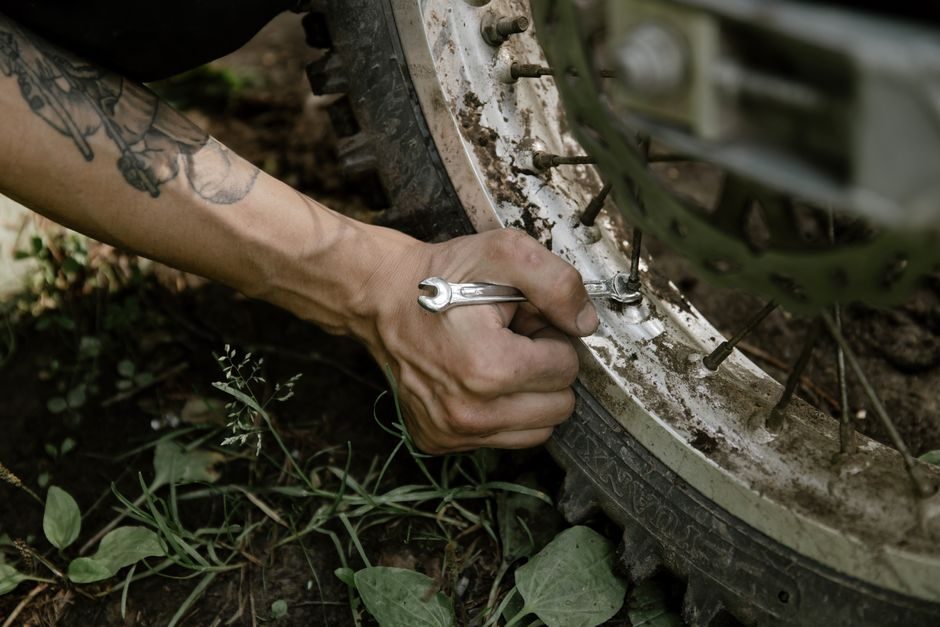
A spring washer only delivers its rated preload when the concave face bears against the joint material, the bolt is sized to DIN 7980 or BS 4464, and torque is applied to roughly 70–80% of the bolt's yield strength with a controlled, two-stage method [S2][S3][S4].
Spring washers in M3–M30 sizes span free heights (H) of 2–12 mm and section thicknesses (s) of 1–6 mm in the metric Type A range [S7], which means installation tolerance, not catalog selection, decides whether a joint holds up under vibration or thermal cycling.
Concave-Side-Down: The Single Rule That Determines Joint Behaviour
The conical Belleville and split-lock variants both work by storing elastic energy when flattened; if the convex face is placed against the bearing surface, the washer inverts under load and sheds preload rather than building it [S2][S5]. A steel bolt, the Belleville spring washer, a flat washer, and the nut should be assembled in that order, with the spring element installed between the flat washer and the nut when joint stack-up requires uniform bearing pressure [S3]. All hardware should be lubricated with silicone spray or an equivalent lubricant before the nut is run down, because unlubricated threads drive scatter of ±25% or more in clamp-load versus the calculated torque target [S3].
For metric sizes M3 through M30, the Type A standard (DIN 7980, BS 4464) fixes inside diameter d_min between 3.1 mm and 30.5 mm, outside diameter D_max between 5.5 mm and 43.9 mm, and free height H between 2 mm and 12 mm [S7]. Selecting a washer outside its matched screw diameter range is the most common cause of the washer riding over the chamfer rather than seating flat, a failure mode visible immediately as a gap under the bolt head.
Torque Selection: Why the Spring Washer Changes the Formula
Because a spring washer stores part of the tightening energy as elastic strain, the clamp force on the joint is lower than for the same torque applied to a flat washer alone — typically 60–75% of the torque that would otherwise reach the joint [S4]. A first pass to roughly 50–60% of the target torque, followed by a final pass to the full value, brings the washer into its elastic operating band and avoids plastic set during installation [S3][S4]. For M10 steel bolts in the 8.8/10.9 grade range, this generally lands the final torque near 45–55 N·m when a single Belleville is in the stack, but the manufacturer torque chart always overrides the rule of thumb when the equipment documentation specifies otherwise [S3].
Re-torque is not optional in high-vibration or thermal-cycling service: settling of the joint surfaces and relaxation of the spring washer both bleed clamp load in the first 24–72 hours, and a verification pass within that window is the documented practice for bolted connections on rotating machinery [S3][S4]. Skipping the re-torque is the single most common root cause found in field teardowns of failed flange and motor-mount bolts.
Material and Finish Choices for Installation Environment
Standard metric Type A spring washers are stocked in steel with zinc and clear finish, or in stainless steel self-colour, and the choice is dictated by galvanic compatibility with the bolt and the joint material [S7]. A steel spring washer under a stainless bolt will eat the bolt in a wet environment; a stainless spring washer under a hot-dip-galvanized structural bolt on a transmission tower is the correct pairing because both the washer and the bolt are below the zinc's melting point and share anodic potential [S7]. Spring washers placed against aluminium conductors or aluminium joint faces require a flat washer as a barrier, since the spring element's edge concentrates stress and will cold-flow the softer aluminium within weeks if direct contact is allowed [S3].
When the joint sees temperatures above 200 °C, a standard spring steel washer loses roughly 30–40% of its preload within the first 100 hours and is the wrong component — specify an Inconel or stainless Belleville rated for the operating band instead [S2]. The failure pattern is bolt loosening without visible washer damage, which is why the symptom is so often misattributed to under-torqueing rather than to the wrong material.
Where Spring Washers Are Specified — and Where They Should Be Removed
Spring washers are correctly specified under bolted joints subject to vibration, thermal expansion, or dynamic loading: automotive suspension and engine components, motor and pump feet, electrical bolted lugs, conveyor drives, and structural connections on mining and rail equipment [S1][S2][S3]. In each of these, the washer's job is to maintain a residual preload above the threshold at which the joint would otherwise slip and self-loosen.
They should not be specified as a substitute for proper joint design on a static, low-vibration joint — a flat washer or a sealing washer is the correct choice when the load case is sealing rather than preload retention, and adding a spring washer to a calibrated joint can push the bolt past its yield point when the stack-up was never sized for the additional elastic travel. A common false economy is pairing a spring washer with a linear guide carriage bolt to "fix" carriage drift; the correct fix is the carriage's specified preload adjustment, not a stiffer washer in series with the bearing block. Spring washers also do not replace the crossed-roller guide factory-spacer stack on precision slides — installing one will preload the rollers outside their design window and accelerate brinelling.
Inspection and Acceptance: What a Correctly Installed Spring Washer Looks Like
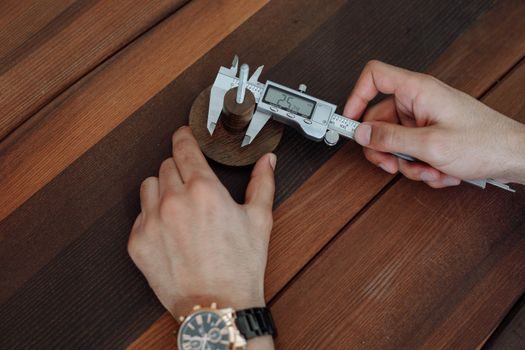
A correctly seated spring washer shows three observable conditions after torque-up: the gap between the bolt head and the joint face is uniform around the circumference, the washer cannot be rotated with finger pressure against the bolt, and a 0.05–0.10 mm feeler gauge will not enter between the washer and the bearing surface anywhere on the perimeter [S5][S6]. Acceptance testing on critical joints uses a torque-audit pass within 24–72 hours; the joint passes if the audit torque reaches at least 85% of the installation value without further rotation [S4].
Rejection criteria are equally concrete: visible flattening beyond the washer's rated free-height deflection, any radial cracking at the slit of a split-lock washer, corrosion pitting deeper than 0.1 mm, or measurable rotation of the washer after the audit pass all mean the washer must be replaced, not re-torqued [S4][S5]. A washer that has yielded cannot be recovered by additional torque — additional tightening simply adds tension to a spring that no longer springs.
Comparison: Washer Type vs. Decision Criteria
Four common washer types compete for the same bolt stack-up, and the selection matrix is short enough to fit on a clipboard. A spring washer (Belleville or split lock) is correct when the dominant failure mode is vibration-induced loosening and the joint tolerates ±5–10% preload variation; a flat washer is correct when the requirement is load distribution or bearing-surface protection without preload retention; a sealing washer is correct when the joint must contain a fluid or gas against a pressure differential; and a structural bevel washer is correct when the bearing surface is sloped more than 5° from the bolt axis [S2][S6]. Cost-per-joint runs lowest on flat, mid-range on spring, and highest on sealing, while installation time tracks the same order because sealing and bevel washers require orientation checks that spring washers also need but flat washers do not.
For maintenance planning, the signal to track is re-torque compliance on critical joints: a documented re-torque pass within 72 hours of commissioning is the strongest predictor of long-term joint integrity, and the absence of that record is the single most common finding in post-incident bolt-failure reports [S3][S4]. Build the re-torque step into the commissioning checklist before the joint is boxed in, because the access goes away with the first cable tray or pipe hanger.
Related analysis: Oxygen Detector Selection for Food Processing: 2026 Spec Map.