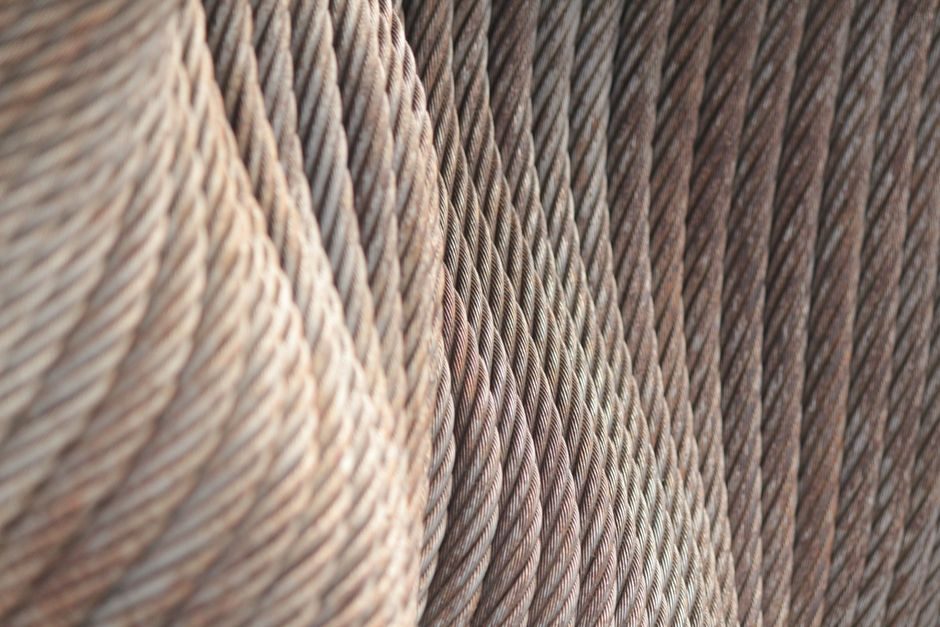
A stainless steel coil reaches the market only after five sequential operations — melting/continuous casting, hot rolling, cold rolling, annealing & pickling, and finishing/slitting — and every step imposes a hard spec gate on the next [S1][S4].
China-origin coil typically ships in austenitic 304, 304L, 316, 316L and ferritic/martensitic 201, 430, 410 grades with thicknesses from 0.3 mm to 6.0 mm and widths cut to order; 200-series austenitic (201/J1/J3/J4) and 400-series ferritic (430) account for the bulk of the hairline, BA and mirror-finish decorative inventory [S3].
Stage 1 — Melting, Refining and Continuous Casting
Process begins in an EAF or AOD vessel where scrap stainless, ferrochrome and nickel are melted, decarbured and desulphurised to hit the target Cr/Ni ratio — typically 18-20 Cr / 8-10 Ni for 304 and 16-18 Cr / 10-14 Ni for 316 — before the molten steel is teemed into a slab caster that produces 150-250 mm thick slabs, the starting stock for downstream rolling [S1][S4].
End-users who later send coil into stainless pipe or stainless-steel food-grade tubing rely on this stage to set the inclusion count and the C+N level, because once the slab solidifies the composition is effectively locked [S1].
Stage 2 — Hot Rolling to Hot-Rolled Coil (HRC)
Reheated slabs pass through a roughing mill and a 6- or 7-stand tandem finishing mill, exiting at 2.0-12.0 mm thickness as a black, oxidised hot-rolled coil; this is the only stage that can economically break down a 200 mm slab to a coilable gauge, and most subsequent cold reduction is done from this HRC feedstock [S1][S4].
Allinmetal reports hot-band coils are then descaled by shot blasting or pickling before further processing, with a hard spec gate on surface cleanliness because any oxide rolled into the next pass becomes a deep subsurface defect [S4].
Stage 3 — Cold Rolling to Cold-Rolled Coil (CRC)
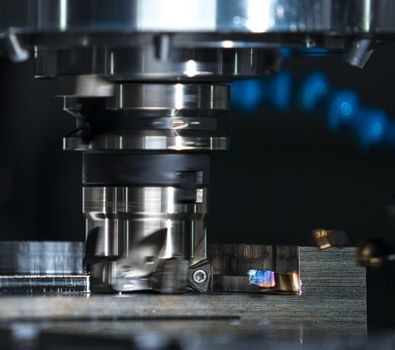
Pickled HRC is reduced on a Sendzimir or 20-high reversing mill (or a tandem cold mill) to final gauges typically 0.3-3.0 mm; each pass work-hardens the strip, so a 304 austenitic going from 3.0 mm to 0.6 mm can pick up 150-200 HV of hardness before the next gate — annealing [S1][S4].
Tianjin Teda Ganghua, a 20-year China exporter, lists cold-rolled 304 and 316 coil and strip in thicknesses down to 0.3 mm with 2B, BA and mirror finishes as catalogue staples, mirroring the 0.3 / 0.4 / 0.5 mm 201 J1/J3 hairline stock that Guangdong Baojia ships at a 10-ton minimum order [S1].
Stage 4 — Annealing and Pickling
Work-hardened strip goes through a bright annealing line (typically 1 040-1 100 °C in a HNX atmosphere for 304/316) to restore ductility, followed by mixed-acid pickling (HF + HNO₃) to remove the oxide scale formed during annealing; skip the pickle and the coil fails cosmetic inspection on the very next station [S1][S4].
This stage is where stainless steel coil earns its corrosion-resistance rating — a 316L with a properly restored passive surface will out-perform an under-annealed 304 in chloride service by an order of magnitude, and the only way to verify the passivity is a ferrite-free, oxide-free surface finish [S1][S4].
Stage 5 — Finishing, Skin-Pass and Slitting
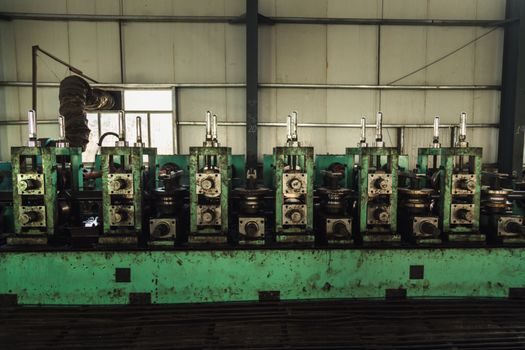
Final surface and dimensional quality is set on a skin-pass (temper-pass) mill running 0.5-2.0 % elongation, which imparts the surface roughness (Ra) target, levels the strip, and sets mechanical properties for stamping; the line then slits to customer width and recoils to the specified inner/outer diameter [S1][S4].
Supplier-side FAQ lists five common surface finishes — mill, 2B, brushed (NO.4 / HL), mirror (BA / 8K) and patterned (embossed) — and five routine surface defects — scratches, pits, stains, roughness and edge damage — that buyers should specify against in the purchase order rather than discover on receipt [S3]. Guangdong Baojia's catalogue crosses 2B, NO.4 hairline, Scotch-brite, BA, mirror and PVC-coated on the same 201J1/J3 base, showing how finish choice multiplies SKU count off a single melt.
Process Route Comparison — Hot vs Cold and 200 vs 300 Series
On four practical decision criteria the route choice lines up as follows: (1) dimensional tolerance — cold-rolled 304 holds ±0.02 mm on 0.5 mm strip vs hot-rolled 304 at ±0.10 mm; (2) surface roughness — cold 2B sits at Ra 0.2-0.5 µm vs hot No.1 at 3.0-6.0 µm; (3) mechanical strength — cold full-hard 304 reaches 1 000-1 300 MPa tensile after heavy reduction, annealed 304 sits at 500-700 MPa; (4) cost & lead time — 200-series (201/J1/J3) and 430 ferritic run 15-25 % cheaper than 304 but trade away corrosion resistance in chloride or marine atmospheres [S1][S3].
For high-temperature service, the stainless pipe and tube industry typically feeds off 304L/316L annealed coil, while decorative elevator-panel and appliance-kitchen applications feed off 201/J1 cold-rolled BA or mirror coil — same process line, two different markets [S1].
Standards, Quality Control and the Sourcing Signal

Export-grade Chinese mills typically hold ISO 9001 plus product certifications such as SGS / TUV / CE mill test certificates, with full traceability from the melt heat number to the slit coil; Shandong Lite Special Steel, Jiangsu Jinwei, Yinxie Metal and Allinmetal all list ISO 9001 family certification and full MTC traceability on their B2B profiles [S4][S5][S6].
Buyers should pin the spec on ASTM A240 / A480 (sheet/strip chemistry and tolerances) and EN 10088-2 (European equivalent) on the PO, then verify via 3.1 MTC and PMI (XRF) check on receipt; for pipe and tube downstream, link the coil certificate to the welded or seamless stainless pipe certificate to keep the chain unbroken [S1][S4].
Watch for coil-line capacity expansion announcements from the LISCO, TISCO, Baosteel and JISCO group of authorised mills that Teda Ganghua redistributes, and for any new 200-series hairline / mirror lines coming out of Guangdong — these two signals lead the market by roughly one quarter and tell you whether 201/J3 spot prices will soften or harden in Q3 2026 [S1].
For component-level specifications, see solenoid coil.
For related coverage, see Sander Advantages and Disadvantages: A Spec-Driven Field Reference.