
ABS injection moulding lines in 2026 are now run as closed-loop MES cells rather than stand-alone presses, with barrel-zone thermocouples, cavity-pressure sensors and shot-end encoders streaming data to OPC UA gateways that hand off to ERP at a 100–500 ms cycle [S4][S5].
Typical deployments combine a 80–1600 tonne clamping-force press, a hot-runner controller with 4–24 zones, a robot or pick-and-place handler, and a vision station that confirms part geometry against a CAD-derived golden image; on a well-tuned ABS housing line this stack cuts scrap below 1% and lifts overall equipment effectiveness (OEE) into the 80–90% band [S4].
Engineers specifying ABS should treat acrylonitrile-butadiene-styrene as an amorphous thermoplastic with a glass transition near 105 °C, a recommended melt temperature window of 220–260 °C, and a mould surface target of 40–80 °C; outside that window the butadiene rubber phase starts to shear-degrade and surface gloss drops fast, a failure mode engineering plastics buyers routinely see on un-instrumented legacy presses.
ABS Process Window and the Sensors That Hold It
ABS behaves predictably only when the barrel profile, mould temperature and injection profile are all held inside a narrow band: melt 220–260 °C, mould 40–80 °C, injection pressure 80–140 MPa, and a packing-hold tail that ends before the part drops below the heat-deflection temperature, typically quoted near 95–100 °C for general-purpose grades [S4].
On a smart cell the practical sensor map is now standard: barrel-zone thermocouples on each of 3–5 zones, a mould-surface pyrometer or RTD at the cavity, a strain-gauge or piezoelectric cavity-pressure sensor behind an ejector pin, and a linear encoder on the screw or the tie bars. Each tag lands in an OPC UA namespace, gets time-stamped against the shot counter, and is written to a process historian so that a 50-shot golden curve can be overlaid on the live trace [S4].
The shift from a hard-wired press to a networked cell is also where additive manufacturing material workflows start to overlap: factories running ABS pellets through injection moulding in the morning and ABS-like photopolymer resins through SLA or SLS in the afternoon are now sharing the same MES recipe library, the same operator login, and the same lot genealogy [S2][S4].
From Stand-Alone Press to MES-Driven Cell
A 2026 ABS smart cell is no longer a press with a robot bolted to it; it is a manufacturing execution system (MES) node that owns the routing, the alarm policy and the quality disposition for every shot. The MES tracks mould setup, dryer dwell time (typically 2–4 h at 80 °C to drive moisture below 0.02%), material lot, and any colour-masterbatch ratio, then releases the cell only when the human-machine interface (HMI) confirms interlocks are green [S4].
Two integration layers matter in practice. First, the press-to-MES link usually runs on OPC UA over TCP, with a cycle time of 100–500 ms that is more than fast enough for the 5–60 s ABS cycle. Second, the MES-to-ERP hand-off is normally a REST or message-queue call that fires on lot close, so the planner sees a real finished-goods count instead of a shift-end estimate. Plants that skip the second layer often discover that their "smart" line still produces a paper traveller at the end of the shift [S4].
The same MES pattern is already documented on polypropylene lines, where closed-loop control of melt temperature and injection speed has cut scrap by 10–30% versus a manually tuned baseline; the architecture transfers to ABS without modification beyond the recipe table, as covered in the polypropylene resin smart manufacturing signals from 2026.
Selection Criteria: Press, Robot, Sensor Stack

Specifying an ABS smart cell comes down to four decisions that interact. Clamping force must be sized to 2.5–4.0 tonnes per square inch of projected area, with a comfortable margin for glass-filled or flame-retardant grades that run higher viscosity. Shot volume must be 60–80% of barrel capacity to keep residence time short enough that the butadiene phase does not crosslink in the barrel [S4].
The robot or handler side is governed by cycle-time budget: a 6-axis articulated arm in the 6–12 kg payload class covers most ABS enclosures, while a 3-axis Cartesian beam robot is the cheaper fit for trays and thin-wall packaging. Either path needs a vacuum or gripper changeover that is recipe-driven through the MES, not a tool-crib bench task [S3].
For the sensor stack the field is now tri-modal: thermocouples and RTDs handle the slow thermal channel, cavity-pressure sensors and accelerometers handle the fast mechanical channel, and a 2D or 3D machine-vision station handles the geometric and cosmetic channel. A practical cell runs the three channels on a single edge gateway that publishes to the MES on OPC UA, which is the same pattern used for smart camera inspection stations on metal-stamping lines [S3][S4].
Where Smart Manufacturing Pays Back on ABS
The clearest ROI sits in three ABS use cases: consumer electronics housings, automotive interior trim, and small domestic appliances.
Automotive interior trim is the second strong case. ABS and PC/ABS blends for dashboards, door panels and centre consoles need class-A surface finish, which means mould-temperature control to within ±2 °C and a humid-air dryer that holds dewpoint below -40 °C. A smart cell logs both, alarms on drift, and routes suspect shots to a quarantine bin instead of a finished-goods pallet [S2][S4].
Small domestic appliances and tool housings form the third case, where the plastic pallet end-of-line often doubles as the value-add: the MES captures the mould shot, prints and applies a GS1-compliant label, then stacks on a pallet whose tare weight is known to the WMS so the shipping manifest closes automatically. The same logic is visible in polypropylene resin manufacturing, where recipe control at the reactor translates directly to pellet-handling accuracy downstream.
AI, Robotics and the 2026 Hiring Signal

Artificial intelligence on the ABS cell has moved from concept to standard feature. Supervised models trained on thousands of golden shots flag out-of-trend cavity-pressure curves before the part is ejected, and a well-tuned model catches short-shots, flash, and weld-line defects at first-article stage rather than at the end-of-line gauge [S3][S4].
The labour market has caught up: a June 2026 NIST report identified more than 200 knowledge, skills and abilities (KSAs) that advanced-manufacturing workers now need, with data literacy, robotics operation and basic Python listed as table stakes for anyone commissioning a smart cell [S3]. Rockwell Automation's 2026 State of Smart Manufacturing report adds that digital transformation is now treated as essential rather than optional by most plant leaders, which is why ABS moulders are budgeting MES licences and edge-gateway hardware as recurring lines rather than capex spikes [S3].
That same NIST report is also pushing hiring managers to look for technicians who can read an OPC UA namespace as fluently as a hydraulic schematic, and the skills gap is now large enough that an MES-led ABS line will often be run with one fewer operator and one more controls technician than a 2018-vintage equivalent cell [S3].
Limitations, Failure Modes and What Smart Does Not Fix
Smart manufacturing does not absolve the process engineer of fundamentals. ABS still degrades if residence time exceeds roughly 5–8 minutes at the upper end of the melt window, and a closed-loop controller that holds melt temperature perfectly while letting residence time drift is still going to produce yellowing and a drop in impact strength. The MES should alarm on residence time as well as temperature, not substitute one for the other [S4].
Another failure mode is data without context. A plant can instrument every zone and still produce scrap if the dryer is starved and the polymer is hydrolysing in the barrel; the moisture sensor is the single piece of instrumentation that more often pays back than a cavity-pressure sensor, because ABS absorbs up to 0.3–0.5% moisture at room humidity and that moisture shows up as silver streaking long before it shows up as a dimensional defect [S4].
Finally, OPC UA, MQTT and PROFINET all coexist on the same shop floor, and a smart cell that promises end-to-end traceability but routes half its tags through a proprietary vendor cloud is not actually a smart cell, it is a vendor lock-in with a dashboard. The Singapore Business Federation survey of 2025 noted 97% of manufacturers now see digital transformation as important, but only a much smaller share run their MES on-prem or on a portable open standard rather than inside a vendor SaaS boundary [S2].
Comparison: Smart-Cell Stack Options
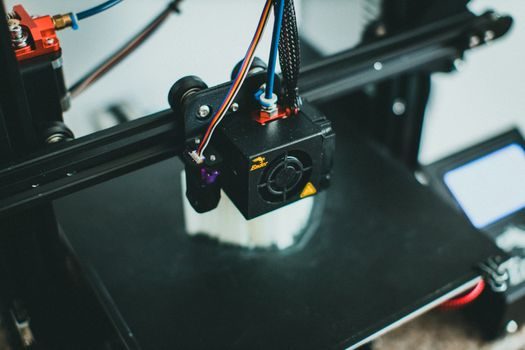
Buyers weighing an ABS smart-cell build in 2026 typically choose between three reference architectures: a vendor-bundled turnkey cell, an open-standards cell built around an independent MES, and a hybrid where the press is vendor-controlled but the rest of the cell is OPC UA-native. The bundled cell is the fastest to commission but the hardest to reconfigure; the open-standards cell is the most flexible but demands in-house controls staff; the hybrid is the most common compromise. [S1]
On cost, a turnkey cell from a major press builder typically carries a 15–25% premium over an equivalent open-standards build, partly because the MES licence is bundled and partly because the fieldbus is closed. On cycle-time capability, all three architectures can hit sub-30 s ABS cycles on a 200-tonne press; the difference is in changeover time, where an open-standards cell with recipe-driven robots and vision typically swaps a mould in 15–30 minutes versus 45–90 minutes on the bundled cell. On data ownership, the open-standards path is the only one that keeps the historian inside the plant firewall, which is increasingly a procurement requirement in medical and food-grade ABS work [S2][S3][S4].
On staffing, all three architectures now assume a controls or mechatronics technician on shift, not just a press operator, which is the single biggest change in the ABS moulding workforce over the last five years [S3].
Standards, Sourcing and What to Track Next
There is no single ABS-specific smart-manufacturing standard; the binding documents are general industrial ones. ISO 9001 still governs the quality system, IEC 61131-3 governs the PLC programming languages, OPC UA (IEC 62541) governs the machine-to-MES hand-off, and ISA-95 governs the MES-to-ERP layering that the cell is expected to honour [S4].
Two signals are worth tracking through the rest of 2026. First, the rate at which ABS moulders in APAC publish OPC UA companion specifications for injection moulding, which is currently the only reliable sign that a vendor's "smart" claim is more than marketing. Second, the spread of smart valve positioner and smart meter standards from process plants into the discrete-plastics world, which is where the next round of cross-industry MES integration is most likely to land [S2][S4].
A useful next node is the IMTS 2024 Smart Manufacturing Experience archive and the SME roadmap for 2026 events, which together publish a steady cadence of case studies on ABS and PC/ABS cells that have actually been running in production for at least 12 months [S3]. Pair that with the latest NIST KSA report and the Rockwell 2026 State of Smart Manufacturing study to anchor any ABS automation budget review in figures that can be cited, not adjectives that cannot [S3].