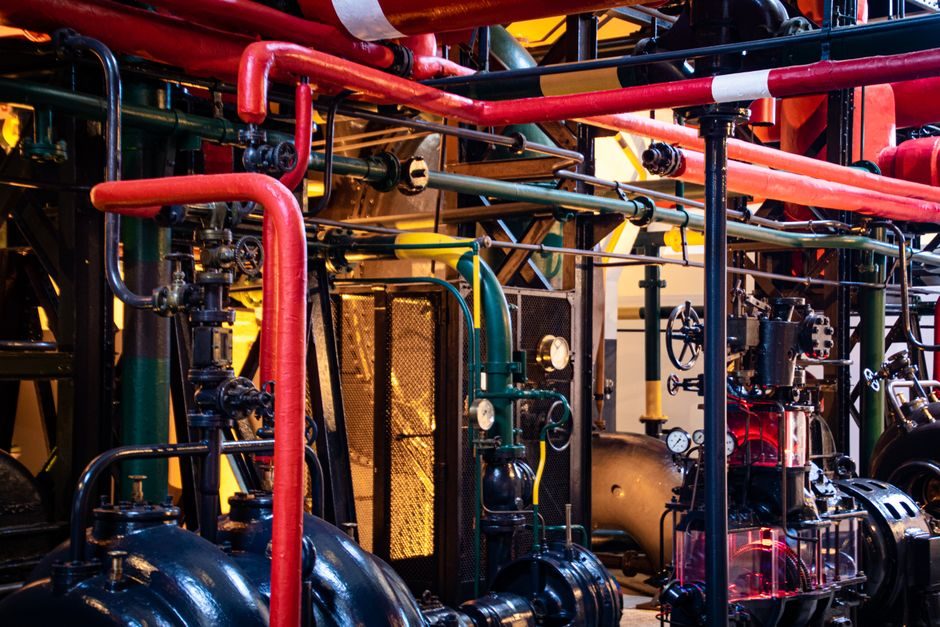
A steam trap is a self-actuated valve installed at the low point of steam lines, drip legs, heat exchangers and steam separators whose sole function is to differentiate condensate from live steam and discharge only the liquid phase [S3]. The 2024 global steam-trap market was valued at USD 4.57 billion and is forecast to reach USD 5.57 billion by 2029 at a projected CAGR consistent with the 4.75→5.57 B trajectory published in 2023 [S2].
Selection work in 2026 collapses to four physical decisions — operating principle, body/connection rating, continuous discharge capacity (kg/h), and failure-mode behaviour — because steam systems are unforgiving: a trap that fails open wastes fuel, a trap that fails closed waterlogs the heat exchanger and accelerates waterhammer. The same failure-mode logic governs companion equipment on a steam header, which is why plant engineers usually spec a steam separator upstream of the trap station to keep the trap from cycling on wet steam slugs.
Float, Thermostatic, Inverted-Bucket, Thermodynamic — the four mechanisms compared
Float-and-thermostatic (F&T) traps modulate continuously and handle very high cold-condensate loads at start-up, with typical capacities published by manufacturers in the 100–8 000 kg/h envelope and a float chamber rated for pressures commonly up to PN40 / Class 300 [S3]. Thermostatic (bellows or bimetal) traps operate on temperature differential — they subcool condensate a few °C below saturation before discharging — and are the workhorse on tracing lines, drips and small heat exchangers, with operating ranges typically 0.25–40 bar. Inverted-bucket traps are intermittent-discharge mechanical units that tolerate waterhammer and superheat, and are widely used on process lines sized 15–50 mm. Thermodynamic (disc) traps are single-orifice units that discharge on velocity/pressure differential, are small, light, and tolerate superheat to roughly 250 °C, but discharge air sluggishly and are sensitive to back-pressure variation. As a quantitative anchor: 13Cr/SS internals are used in thermodynamic-disc traps for clean steam service; cast-iron bodies dominate PN16 drip applications, while forged steel (A105 / F11) bodies are required for Class 600 and above.
Capacity, differential pressure and the "safety factor" trap
Sizing a trap starts from the steam load (kg/h) of the downstream equipment, then divides by the available differential pressure (inlet pressure minus back-pressure) to read the manufacturer's published capacity curve. Two engineers will size the same trap differently because most published capacity tables are continuous-discharge ratings; for an F&T trap the rating is the modulating maximum, for a thermodynamic trap it is the hot-discharge intermittent maximum. Standard practice multiplies the calculated load by a safety factor of 2–3× to absorb start-up load, air handling, and wear margin — a margin that is dropped to 1.5× only on instrumented, well-traced drip legs. Differential pressure must also clear the trap's minimum operating ΔP (typically 0.25–0.5 bar for thermostatic units; 0.5–1.0 bar for thermodynamic discs) or the trap will not open under load. A disc trap at 10 bar inlet with 0.3 bar back-pressure may be unable to discharge against the 0.5 bar minimum and will simply lock closed — a common cold-loop failure mode that a sizing spreadsheet hides unless ΔP is checked explicitly. [S1]
Body, connection and material — the part the piping designer must lock first
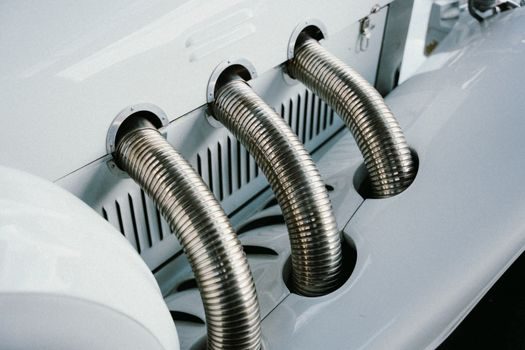
Body selection is a piping-class decision, not a trap decision. Carbon steel (WCB / A216 WCC) is the default for Class 150–300 saturated-steam service; cast iron (GG-25 / ASTM A126) is permitted on PN16 / Class 125 lines below 220 °C and is the cheapest option, but is brittle under thermal shock and is forbidden on superheated lines. Stainless (CF8 / 1.4308) or alloy (WC6 / WC9) bodies enter at temperatures above 400 °C or where condensate is corrosive — amine reboilers, sour condensates, and pharmaceutical clean-steam loops. End connections follow the line class: threaded (NPT/BSP) up to DN25 / Class 800, socket-weld on small-bore Class 300–600, flanged (ANSI B16.5 / EN 1092-1) at DN50 and above, and butt-weld on high-pressure Class 600+ where gasket blow-out becomes a concern. A failure here is a leak path: a Class 150 iron body on a Class 300 line fails at hydrotest. [S2]
Failure modes, testing standards and the trap-station layout
Every mechanism has a characteristic failure mode that drives the design of the bypass and test port. F&T traps fail closed when the float chamber fills with debris or the thermostatic air-vent sticks — they stop discharging condensate and waterlog the heat exchanger, a slow but expensive failure. Inverted-bucket traps fail open when the bucket wears or vents, which dumps live steam to drain — a fast, audible, expensive failure. Thermodynamic disc traps fail open when the disc seat erodes, with the same steam-loss profile. Detection discipline therefore matters as much as mechanism choice: ultrasonic survey, thermography at the discharge pipe (a failed-open trap reads near inlet temperature; a failed-closed trap reads cold), and a permanently installed test valve on the discharge side of every trap. The trap station itself is normally a three-valve manifold (inlet isolation + outlet check + test/drain), with a crossed-roller guide-style "strainer-first" rule: a Y-strainer upstream of the trap with a 20-mesh screen is cheap insurance against a debris failure that would otherwise eat a 200 USD float in a week. Station layout also dictates where a linear guide of bypass and isolation valves is positioned relative to the header — a layout choice that belongs on the isometric, not in the trap datasheet. [S3]
Applications — what to spec where in 2026
On process plant steam headers, F&T traps dominate the main drip legs and reboiler bottoms because the air-handling capacity of the thermostatic air-vent is unmatched; on chemical plants with corrosive condensate, an F&T with a stainless float and Hastelloy internals is the default. On steam tracing of instrument lines and small-bore drips (DN15–DN25), thermostatic bellows traps are the workhorse, sized 0.5–2× the condensate load with a 5 °C sub-cool element. On main-line drips and turbine drains, inverted-bucket traps survive waterhammer and superheat and tolerate dirt better than F&T. On tracing manifolds, panel heating and small sterilisers, thermodynamic disc traps are the cheapest option and tolerate the superheat of a saturated line that has flashed. On the discharge side of every steam-driven flow meter and on jacket heating loops, a thermostatic trap is the default, paired with a vacuum breaker on the downstream side. Steam tracing on a pressure transmitter impulse line follows the same rule: thermostatic, sized for the worst-case start-up load, with a test valve to verify discharge without breaking the line. [S4]
What to confirm with the factory before PO — and what to budget in 2026
Before releasing a purchase order, the spec sheet should carry the operating principle, body material, end connection, pressure class, capacity at the actual ΔP (not the catalogue max), sub-cool setting, blow-down volume, and the failure-mode statement. A complete datasheet pack for a Class 300 stainless F&T in 2026 typically sits in a 600–1 200 USD range, a thermodynamic disc in cast iron at PN16 is closer to 80–250 USD, and a high-pressure inverted-bucket in forged steel crosses 2 000 USD. Sourcing channels still run OEM-direct (Spirax-Sarco, Armstrong, TLV, GESTRA, Watts), regional industrial distributors, and a growing cross-border catalog tier on platforms like the 2026 industrial spec listings that mirror the Vacuum Packaging Machine 2026 Buying Guide sourcing approach — verify the country of origin, the pressure-equipment directive conformity (PED 2014/68/EU for the EU), and the foundry audit before releasing. Two follow-up signals worth tracking into the second half of 2026: the steam-trap market forecast update to the 5.57 B 2029 figure published in 2023 [S2], and any harmonisation of PED / ASME B16.34 traceability paperwork that plants will see in Q4 2026 delivery notes.