Steel fiber selection for concrete reinforcement is governed by three measurable levers — aspect ratio (length-to-diameter, typically 30-100), wire tensile strength (1100-2850 MPa range across cold-drawn carbon grades), and end-hook geometry — with hooked-end cold-drawn wire fibers dominating structural slab and shotcrete applications, as cataloged by [S1] (2026-03).
This guide covers the four product families, three binding-performance failure modes, and the dosing-vs-performance math that separates a 30 kg/m³ dosage spec from a 45 kg/m³ industrial-floor spec [S1] (2026-03). Sizing and selection here refers to fiber geometry, not steel beam sizing.
Fiber Type Taxonomy: Hooked-End, Flat-End, Corrugated and Melt-Extracted
Hooked-end cold-drawn steel fibers account for the majority of commercial supply in the concrete reinforcement category [S1] (2026-03). The taxonomy of steel fiber for concrete reinforcement spans four production routes, each with a distinct aspect-ratio window and pull-out behaviour: hooked-end, flat-end (straight), corrugated, and melt-extracted (carbon-steel melt-pulled).
Straight cut-wire and melt-extracted fibers are now widely regarded as sub-optimal for structural binding. Sogou Baike's pavement-engineering reference flags both: cut round wire exhibits poor matrix bond, while melt-extracted carbon-steel fiber develops a surface oxide scale during high-temperature cooling that "severely reduces bond with the matrix" — and recommends both types be phased out [S3] (2022-06). That observation is consistent with the displacement toward deformed (hooked or corrugated) fibers in current supplier catalogs [S1] (2026-03).
Sizing Math: Length, Diameter, Aspect Ratio and Slurry Limits
Steel fiber geometry is specified by length (commonly 25-60 mm), equivalent diameter (0.35-1.0 mm), and the derived aspect ratio. Aspect ratio 30-50 is typical for 30-35 mm hook-end fibers in slab-on-grade pours, while 60-100 covers 50-60 mm fibers used in shotcrete and pre-cast [S1] (2026-03). The Sogou pavement reference notes that the upper bound is set by workability: fibers above the practical length threshold will ball in the mixer and reduce slump, with the practical limit usually placed around 60 mm length / 1.0 mm diameter for standard concrete [S3] (2022-06).
Cross-section is the other lever. Round wire is the most common feedstock for cold-drawn hook-end fiber; flat/crimped fibers of the same mass and aspect ratio have higher surface area per kg and pull-out load, but at higher unit cost [S1] (2026-03). For comparison against non-metallic reinforcement in slab applications, see concrete fiber selection criteria — non-metallic fibers sit in a different strength-and-stiffness band and are not a drop-in substitute on structural slabs.
Tensile Grade, Material Standard and Dosing Math
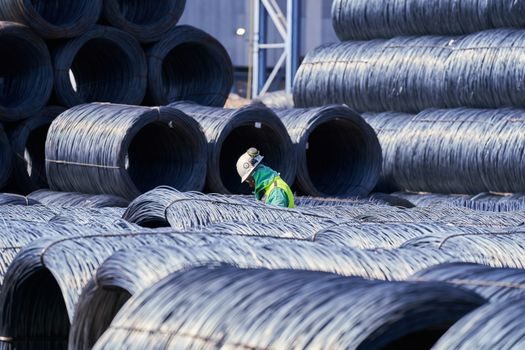
Wire feedstock is normally low-carbon cold-drawn steel with tensile strength in the 1100-1500 MPa range for general concrete use, and high-carbon cold-drawn grades reaching 2000-2850 MPa for shotcrete and refractory lining [S1] (2026-03). Dosing is expressed in kg of fiber per m³ of placed concrete: industrial floor and jointless slab specs commonly land at 30-45 kg/m³, while heavy-duty pavement and tunnel segments climb to 50-80 kg/m³, and refractory castables can exceed 100 kg/m³.
For Sogou Baike pavement practice, "steel fiber concrete pavement" is defined as cement-concrete pavement with steel fibers blended into the surface course, with bond-to-matrix being the single most critical performance parameter — reinforcing the case for deformed over smooth fibers [S3] (2022-06). The chemistry lever is independent of geometry: stainless and chrome-alloy fibers exist for corrosive or high-temperature service, but those grades are not stocked by general construction distributors — they cross over into alloy oilfield supply chains such as the 1%, 3% and 13% chrome production-tubing lines carried by [S2] (2026-06).
Selection Criteria: Where Each Geometry Wins
Hooked-end cold-drawn wire fiber at 30/0.5 mm (aspect ratio 60) is the default pick for industrial floor slabs, jointless pours, and warehouse decks, where crack-width control and impact resistance dominate the design brief. Flat-end or undulated fibers at 25-35 mm with lower aspect ratio (~40) suit pre-cast elements and thin-section overlays where balling risk is high. Corrugated or indented fibers at 50-60 mm with aspect ratio 80-100 are the call for shotcrete tunnel linings and pre-cast segments, where pull-out energy after first crack is the design driver [S1] (2026-03).
The inverse cases — when steel fiber is the wrong choice — include wet-process shotcrete with high slump demand, structural members requiring yield-line or plastic-hinge modelling, and any element where fire-spalling protection rules out metallic fiber. For high-temperature or chemically aggressive process linings, the move is to alloy or stainless fibers, covered in chemical-process steel fiber specs — a related but distinct spec frame. The connection-and-jointing side of concrete reinforcement is a separate buying problem, mapped in rebar coupler pricing by grade.
Three Failure Modes: Pull-Out, Balling and Corrosion Staining
Pull-out is the dominant failure mode for straight and melt-extracted fibers and the reason both are largely deprecated for structural use [S3] (2022-06). Balling — fiber clumping in the mixer — is an aspect-ratio and length issue: fibers longer than the practical ~60 mm threshold, or aspect ratios above ~100, agglomerate and reduce workability [S3] (2022-06). Corrosion staining on the slab surface is a cosmetic risk for black-steel fibers in wet or chloride-exposed service; the fix is either lower dosage at the surface, a sealed surface hardener, or a switch to stainless/chrome-alloy fiber [S1] (2026-03).
For material-property comparison against non-metallic reinforcement, carbon fiber and steel fiber encyclopedia entries cover the stiffness and density contrast that drives most substitution decisions. Fiber converter specs the dosing and length-conversion math for plants moving between fiber systems.
Standards, Certification and Sourcing Channel
Steel fiber for concrete is typically supplied against manufacturer data sheets referencing EN 14889-1 (the European steel-fiber-for-concrete standard, covering tensile, geometry and batching tolerances) and ASTM A820 (the U.S. steel-fiber-for-concrete standard, classifying fibers by type and giving geometry / aspect-ratio requirements). Mill test certificates should list tensile strength of the parent wire, fiber length, equivalent diameter, and aspect ratio per lot. For shotcrete applications, EN 14487 and EFNARC guidelines are commonly referenced in the spec sheet, and project documents for tunnel or mining segments typically call for fibers tested to those methods [S1] (2026-03).
Buying channels split three ways: direct from a fiber mill (best for 5+ ton lots and custom hook geometry), through a regional industrial-metal distributor such as oilfield and chrome-alloy outfits [S2] (2026-06), or via concrete-floor specialist contractors that bundle fiber with design and placement. Trackable next signals: specifier preference for >30 mm length on 2026 warehouse-floor RFQs (visible in the supplier catalog's product range [S1] (2026-03)), and continued displacement of straight cut-wire fiber from structural specs per pavement reference guidance [S3] (2022-06).