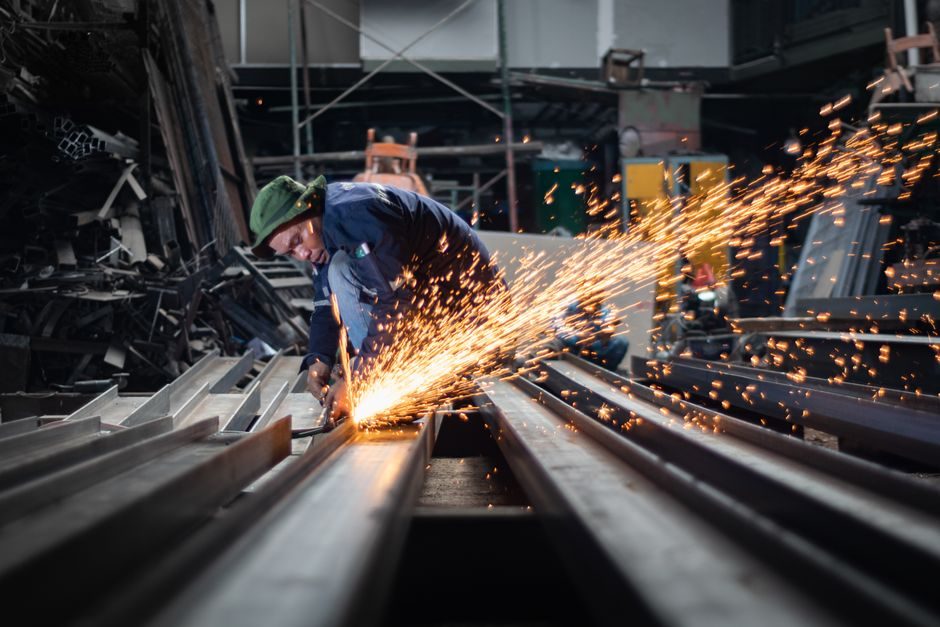
Welded steel mesh outperforms woven mesh on dimensional stability and load uniformity, with typical wire diameters of 0.5–2mm and grid openings of 5–25mm specified for ferro-cement reinforcement applications [S6]. The intersections are fused by resistance spot welding rather than mechanical interlacing, which is the single fact that drives every downstream trade-off buyers need to evaluate.
Engineers across construction, fencing, machine guarding, and mining routinely spec welded mesh when the panel must hold a fixed aperture under load, but the same rigidity that holds shape also makes the panel unforgiving on curves, prone to weld-nugget corrosion, and limited in sheet thickness compared with woven or expanded alternatives. This article lines the main options up against cost, mechanical behaviour, corrosion, and formability so spec writers can match product to duty.
How Welded Mesh Is Made and Why It Behaves the Way It Does
Welded mesh is built from cold-drawn low-carbon steel wire of single-wire tensile strength not less than 4500 kgf/cm², fed as orthogonal warp and weft into a resistance welding line that fuses each crossing with a nugget weld [S6]. Because the joint is a metallurgical bond rather than a friction grip, the panel behaves like a two-dimensional plate — apertures stay square under load and stiffness is roughly proportional to wire diameter squared, so doubling wire diameter roughly quadruples panel rigidity for the same grid [S6]. The same cold-drawing step that raises tensile strength also work-hardens the wire, which is why welded mesh is sold almost exclusively in coil or flat-panel form rather than as flexible rolls.
For comparison, woven mesh (also called "编织网" in Chinese ferro-cement references) uses the same minimum 4500 kgf/cm² single-wire tensile strength but joins wires by mechanical crimp; it flexes, drapes over curves, and absorbs impact without permanent set, at the cost of aperture drift under sustained load [S6]. The two products are not drop-in substitutes: a spec calling out welded mesh for a curved shell will fight the installer, while a spec calling for woven mesh on a load-bearing slab will see apertures open and crack patterns wander.
Advantages: Where Welded Mesh Earns Its Place
Welded mesh cuts installation labour on flat work because panels arrive pre-squared and the grid spacing stays put while concrete is placed, which directly improves crack-width control in ferro-cement and slab-on-grade applications [S6]. The 5–25mm opening range overlaps the spacing used for crack-control reinforcement in mortars, so designers can dial aperture to aggregate size without field modification. Weld nuggets also transfer shear across the intersection, so a loaded panel distributes point loads across multiple wires instead of the two wires that would carry the load in an equivalent woven sheet.
Production economics favour welded mesh where aperture uniformity and high open-area throughput matter: resistance welding runs at multiple intersections per second, and because the joint is a fused nugget rather than a mechanical interlace, panel flatness tolerances are tighter than woven equivalents of the same wire gauge. Galvanized welded mesh extends that base spec into outdoor service — hot-dip or electro-galvanized finishes are routinely applied to the wire before welding, with common wire gauges in the 0.9–4.0mm range and grades typically described as 8# through 20# in supplier catalogues [S3]. The protective zinc layer is what allows the same welded panel to be used in agricultural fencing, animal cages, and architectural cladding without secondary coating.
Disadvantages: The Failure Modes Buyers Must Price In
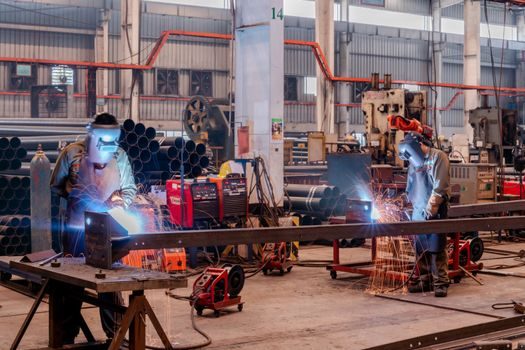
The first hard limit is formability: because every intersection is a rigid fused nugget, welded mesh will not drape over compound curves and will kink or pop welds if forced, so curved shells, cylindrical tanks, and complex architectural forms usually route back to woven or expanded mesh [S6]. The second is corrosion at the weld zone — the resistance-welding process burns off the galvanized coating locally around each nugget, creating a small anode/cathode cell that corrodes preferentially if the panel is later cut, scratched, or exposed to chlorides; powder-coated or PVC-over-galvanized welded mesh is the standard mitigation. Buyers should specify weld-zone coating repair (zinc-rich primer on cut edges) whenever panels are field-trimmed.
A third limit is panel weight versus delivered coverage: welded mesh in heavier gauges (above ~4mm wire) gets heavy fast, and the rigidity that helps flatwork becomes a freight and handling penalty on site. Compared with expanded metal mesh of the same thickness, welded mesh typically uses more steel per square metre for equivalent opening size, which raises both material cost and dead load. Finally, welded mesh panels cannot be "stretched" to absorb impact the way chain-link or woven mesh can, so high-impact or vibration-loaded service (crusher linings, vibrating conveyor decks) usually goes to woven or specialty products; for related duty context, see Vibrating Conveyor: Real Advantages, Real Limits, Real Spec Gates.
Welded vs Woven vs Expanded: A Criteria-Based Comparison
For spec-writing, the cleanest cut is on four criteria: aperture stability, formability, corrosion sensitivity, and cost per square metre at equivalent wire gauge. Welded mesh wins on aperture stability (rigid fused joints) and loses on formability (no compound-curve draping). Woven mesh wins on formability and impact absorption and loses on aperture stability under sustained tensile load. Expanded mesh — cut and stretched from a single steel sheet — sits between the two on most criteria and offers the best weld-free corrosion profile because there are no heat-affected zones; the trade-off is a diamond pattern that is harder to lap and a stiffer feel per kilogram than woven. [S1]
On cost, welded mesh in standard 0.9–4.0mm galvanized wire (grades 8#–20#) is the most economical option at production volumes because resistance welding is a high-throughput process, and the same advantage shows up in delivered price for fencing, partitioning, and slab reinforcement [S3]. Expanded mesh carries a processing premium for the slitting-and-stretching step. Woven mesh pricing varies widely with crimp style and wire gauge. For context on how mesh-based systems integrate into broader steel selection, see Steel Section TCO: 30-Year Cost Lines, Hidden Drivers and Comparison Bands.
Material Grades, Coatings, and Where Welded Mesh Fits
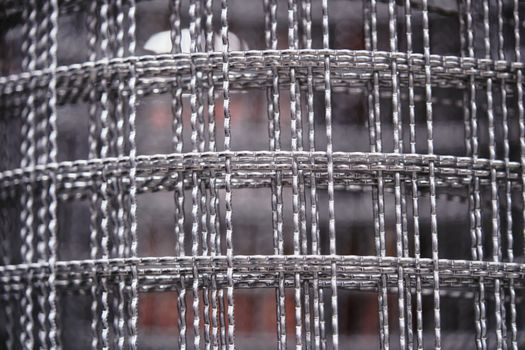
Base wire for most welded mesh is cold-drawn low-carbon steel with the 4500 kgf/cm² minimum single-wire tensile strength cited in ferro-cement references, often supplied as galvanized or black (uncoated) [S6]. The mesh itself inherits the base steel's metallurgy, so design rules that apply to carbon steel wire also apply to the panel: weldability is good, ductility is moderate, and corrosion resistance in the as-welded, uncoated state is poor. Where higher strength is required, alloyed wire can be substituted — the same panel architecture is produced in alloy steel grades for mining screens and stainless steel for food-grade and marine service, though at a steep material premium.
Coating selection drives most of the lifetime cost. Electro-galvanizing (zinc applied electrolytically) is the most common and lowest-cost finish on welded mesh, typically used for indoor and benign-outdoor service, and is widely available in the 0.9–4.0mm wire-gauge range that defines most commercial welded mesh SKUs [S3]. Hot-dip galvanizing after welding gives thicker zinc coverage but risks masking or partially filling the weld zone. PVC or polyester powder coating over galvanized wire is the standard answer for coastal, chemical, or animal-contact service. The base steel mesh category page indexes these variants for cross-reference.
Selection Criteria: Who Should Spec Welded, Who Should Not
Spec welded mesh when the duty is flat or singly curved, the load is static or slowly cyclic, and aperture uniformity matters more than drape: concrete slab crack control, ferro-cement boat hulls (using the 5–25mm grid and 0.5–2mm wire range), machine guards, security partitions, gabion-style retaining elements, and standard agricultural fencing all sit firmly in this camp [S6]. The cost-per-square-metre advantage in standard gauges, combined with dimensional stability that survives concrete placement, is what makes welded mesh the default rather than the exception in these uses.
Do not spec welded mesh for compound-curve architectural panels, high-impact screens, vibrating-deck service, or any duty where the panel will see sustained out-of-plane flexing; in those uses the rigid weld nuggets become crack-initiation sites and the panel will fail by weld pop or wire fatigue well before a woven or expanded alternative would. Buyers in these regimes should evaluate woven mesh for formability, expanded mesh for corrosion robustness, or specialty products for impact. For a sense of how a similar advantages-and-limits framing applies to a different power-tool category, see Demolition Hammer Advantages, Disadvantages and Spec Gates.
Standards, Sourcing, and Trackable Signals

Welded mesh for structural concrete reinforcement is typically ordered against recognised national or regional standards for welded fabric (commonly referenced under designations that govern wire diameter, weld shear strength, and panel geometry), and buyers should confirm the applicable standard on the mill test certificate rather than rely on supplier trade names. Material-grade declarations should call out the base wire standard (carbon-steel wire to the relevant national wire-rope-and-wire specification) and the coating standard separately, since the two failure modes — base-metal rupture and coating-driven corrosion — are governed by different documents. For broader material context, the alloy steel and carbon steel encyclopedia entries index the underlying metallurgy referenced in welded-mesh datasheets. [S2]
Two trackable signals to watch through the rest of 2026: (1) tightening of zinc-coating weight requirements on welded mesh sold into EU and UK construction, driven by durability-class revisions in concrete-reinforcement standards; and (2) growing availability of weld-zone-repair primer kits as standard accessories from major galvanized-mesh shippers, which would indicate the industry is moving from "field-fix after cutting" to "fix at the factory" to address the localized corrosion issue at the resistance-weld HAZ. Either signal is a useful spec-writing prompt to re-bid the relevant mesh SKU. Related process-equipment context is in Vibrating Conveyor: Real Advantages, Real Limits, Real Spec Gates.