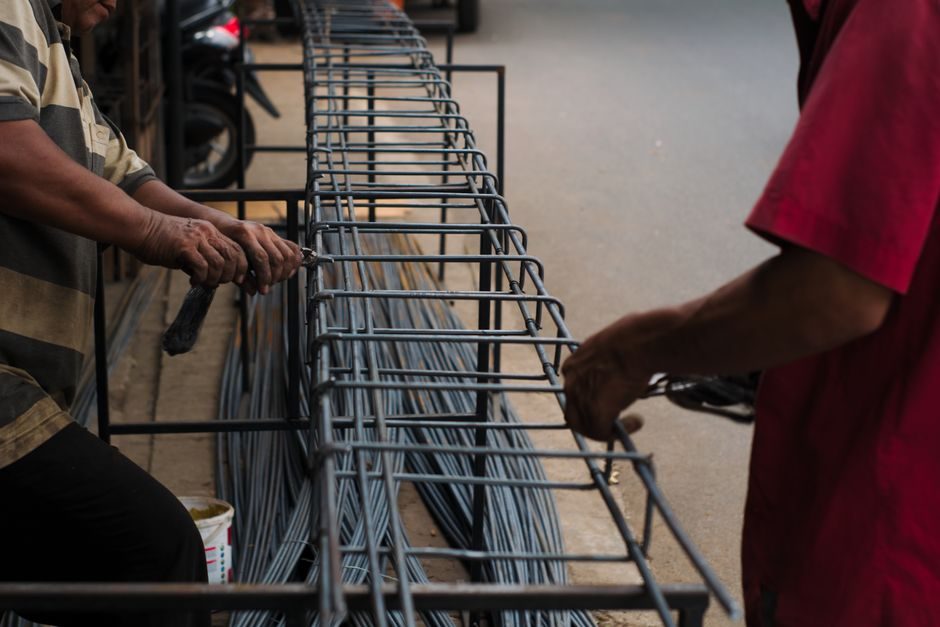
Steel rebar for concrete reinforcement is produced by hot-rolling steel billets through automated multi-stand mills into nominal diameters from #3 (9.5 mm) to #18 (57.3 mm), with U.S. grades of 40, 60, and 75 ksi [S3].
The dominant product family in U.S. construction is carbon-steel deformed bar to ASTM A615, with low-alloy weldable bar to ASTM A706 and stainless variants to ASTM A955 specified where corrosion or weldability drives the call [S3][S4]. Understanding the upstream process — billet chemistry, reheating, reduction ratio, and the quench–temper cycle that sets grade — is what separates a workable spec from a rebar call-back.
Raw Stock: Billet, Scrap Charge and Reheat Furnace
Re-bar rolling starts with continuously cast billets in the 100–200 mm square range, charged into a reheat furnace at roughly 1100–1250 °C so the austenite grain is fully re-solutioned before the first stand [S6].
Modern mills integrate recycled scrap into the EAF or BOF charge; the rolling sequence is the same but the residuals (Cu, Ni, Cr, Sn) must be controlled because they drive surface-cracking susceptibility in the reheat furnace. As the billet passes the first roughing stands the cross-section is reduced rapidly to seal any internal porosity from casting — a reduction of area that is insufficient leaves centreline defects which surface during bending on site [S6].
Hot-Rolling: Roughing, Intermediate and Finishing Trains
The hot-rolling sequence is a three-train layout: roughing stand(s) to break down the billet, an intermediate train to approach the bar profile, and a finishing block of closely spaced stands that prints the final nominal diameter and the deformation pattern (lugs) that gives rebar its bond with concrete [S6].
Reduction of cross-sectional area from ingoing billet to finished bar is the dominant mechanical-property lever — it refines the austenite grain, improves through-thickness homogeneity, and welds up internal defects from the cast billet [S6]. Modern rolling mills are highly automated, with closed-loop thickness and temperature control and online bar-pass counters; CMC's ChromX guide, for example, calls out ASTM A1035 Grade 100 and AASHTO M 334 Grade 100 high-strength bars where 100,000 psi yield (≈ 690 MPa) is used for spiral confinement and design in tension per ACI 318-14 and ACI ITG-6R-10 [S6].
Quench-and-Temper (Q&T) and Microalloy Routes to Grade 60/75/100
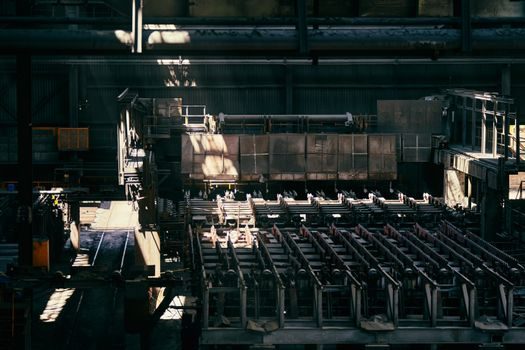
Grade 40 is essentially the as-rolled, hot-rolled pearlite–ferrite microstructure; Grade 60 and Grade 75 require either microalloying (V, Nb, Ti) or a post-rolling Q&T cycle where the bar is rapidly water-cooled from the finish-rolling temperature and then tempered on a cooling bed [S6].
The Q&T route is what makes a Grade 75 bar cost more than Grade 60 — the cap layer is martensitic/bainitic, the core stays more ductile, and the bar passes the bend and elongation requirements of ASTM A615/A706 even at the higher yield [S3][S6]. CMC's ChromX 9100, 4100 and 2100 product lines use this approach to hit 100 ksi yield with corrosion-resistant chemistry, ICC-ES-evaluated for use in spirals up to 100,000 psi yield per ACI 318-14 [S6]. If your spec calls "Grade 60" without naming a route, the mill will default to a cost-driven route — pin the standard, not just the number.
Sizing, Grades and the ASTM/BS/CSA Standard Map
U.S. rebar sizes are designated by the nominal diameter in eighths of an inch: #3 = 9.5 mm through #18 = 57.3 mm, with #4, #5 and #6 being the most common light-commercial sizes [S3].
Yield-strength grades are stamped on the deformation pattern: Grade 40 (≈ 276 MPa) for light residential slabs, Grade 60 (≈ 414 MPa) as the all-purpose default, Grade 75 (≈ 517 MPa) for bridges, dams and heavy infrastructure [S3]. Standard selection follows the environment and weldability: ASTM A615 is the default carbon-steel bar, ASTM A706 is the low-alloy weldable variant required where rebar is spliced by welding or used in seismic detailing, ASTM A955 covers stainless bar, ASTM A996 covers rail-steel and axle-steel bars, and ASTM A1034 covers the mechanical testing of those products [S3][S4]. Outside the U.S., BS 4449 governs UK supply and CSA G30.18 governs Canada; equivalent sizing across metric markets is the 6 m to 12 m cut length [S3]. For a deeper dive on the upstream steel-grade trade-offs and lifecycle cost lines, see the steel plate spec reference.
Deformation Pattern, Mechanical Testing and QA Gates

ASTM A1034/A103M covers the tensile testing that confirms rebar meets the grade's yield, tensile and elongation envelope — typical acceptance is yield ≥ 60 ksi for Grade 60 with tensile ≥ 90 ksi and elongation ≥ 9% in 200 mm for #3–#6 bars [S4].
Deformed-bar lug height, spacing and gap are controlled to ASTM A615/A706 geometry, and bend tests (typically 180° over a 3d pin for #3–#5) are performed per heat to confirm the surface hasn't been decarburised or cracked. The production-cut equipment feeding the bed is described under rebar bender tooling; for splicing detail and mechanical-coupler behaviour see rebar coupler. Project-side QA/QC on rebar placement is increasingly automated — UpCodes released a Plan-Review AI module on 2026-06-03 that cross-checks drawings against 11 million locally adopted code clauses before permit submission [S2].
Fabrication: Cutting, Bending and Mechanical Splicing
Rebar fabrication is the post-mill step of cutting, benders, and threading/coupling the mill bar to project dimensions; tolerances on cut length, hook angle and bend radius are typically ±25 mm on cut and ±2° on bend for standard fabrication [S5].
The fabrication shop is where the rebar supplied from the mill becomes a placed assembly: shear or abrasive cut-off saws drop the bar to length, rebar benders form hooks and stirrups, and either lap splices (overlap length ≥ 40d in tension for Grade 60) or mechanical rebar couplers carry load across joints. The mill's heat number is the traceable identifier on every fabrication bundle; the QA/QC handover carries a mill cert per ASTM A615/A706 with the heat analysis, tensile results and bend-test record so the receiving inspector can sign off without re-testing [S3][S4][S5].
Process Selection by Application: Carbon, Epoxy, Stainless, Galvanised, GFRP
Process selection is driven by exposure and lifecycle cost, not by the bar's strength: carbon-steel A615 is the default for interior concrete, epoxy-coated bar is used in chloride-exposed slabs, hot-dip galvanised (≈ 85 µm zinc) for moderate exposure, stainless A955 for marine/bridge decks, and glass-fibre-reinforced-polymer (GFRP) for non-magnetic or highly corrosive assets where steel is incompatible [S3].
For a side-by-side view, the standard A615 carbon bar has the lowest material cost but a 40–60-year service life in benign interior exposure; epoxy and galvanised push that to 60–80 years in moderate exposure; stainless and GFRP target 100+ years in marine or de-icing-salt environments. High-strength Q&T bars (Grade 100 / A1035) cut congestion in seismic joints but require verified splice and hook detailing per ACI 318-14 and ACI ITG-6R-10 [S6]. Downstream demand signals — rebar consumption tracks the broader steel demand cycle; see the steel demand 2026–2030 outlook for the macro framing.
Common Spec Pitfalls and Failure Modes
Specifying "rebar Grade 60" without naming ASTM A615 or A706 leaves the mill free to ship non-weldable A615 stock to a seismic project that needs A706 weldability — a recurring call-back cause [S3][S4].
Other frequent failures: (i) ordering cut length without checking mill stock length and triggering a non-standard cropping charge; (ii) mixing imperial (#) and metric (mm) call-outs on the same drawing so a #5 (15.875 mm) is confused with a 16 mm metric; (iii) ignoring the bend-radius limit on Grade 75/100 bars (the Q&T microstructure cracks on tight bends — most specs cap pin diameter at 6d for #3–#8 and 8d for #9 and larger); (iv) specifying stainless A955 without confirming the austenitic grade (typical 304LN vs 316LN) because chloride pitting resistance differs by roughly an order of magnitude. Trackable signals to watch: ASTM committee A01.05 ballots on the next A615/A706 revisions, and ICC-ES re-evaluations of high-strength Q&T product listings under ESR-4041 and related reports.