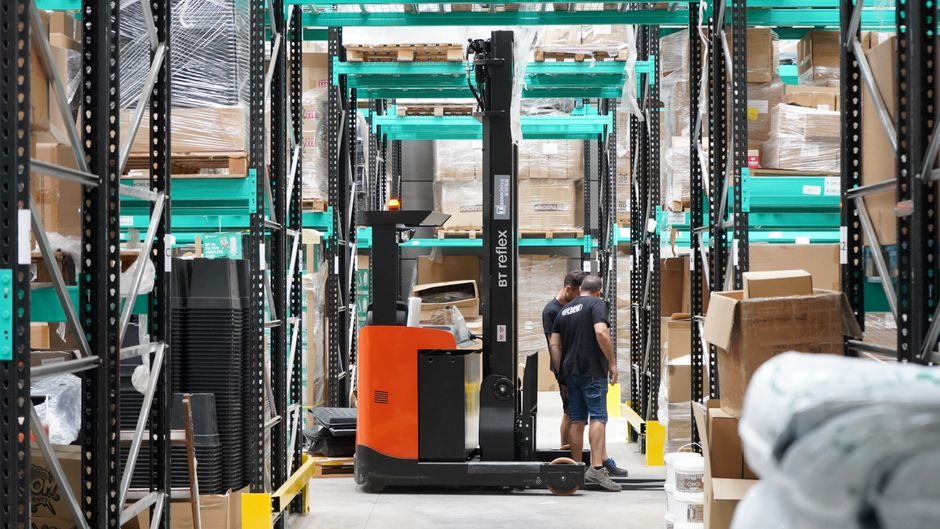
Specifying an industrial storage rack on 2026-06-27 is a five-variable decision: rated load per beam pair, frame geometry (selective, drive-in, cantilever, mezzanine), base-plate and anchor bolt pattern, compliance with EN 15635 / FEM 10.2.06, and the floor slab's verified compressive strength (typically ≥25 N/mm² for standard selective systems).
Krost Shelving & Racking, in operation since 1965 and serving more than 20 industries across Africa, illustrates the modern racking integrator model: in-house design, manufacturing, and installation bundled under one contract, with engineered drawings signed off against the site slab report [S5]. Chinese OEM/ODM capacity mirrors that breadth — Shandong Topeasy Industrial Equipment Co., Ltd. (15 years in shelving) lists pallet rack, cantilever rack, mezzanine floor rack, barrel rack and ceiling storage rack as parallel product lines from a single Weifang facility [S2].
Load Class and Beam Pair Rating: Where Buyers Mismatch First
Beam pair ratings on selective pallet racking commonly run 250 kg, 500 kg, 1000 kg, 2000 kg, 3000 kg and 4000 kg per pair, with frame upright heights of 2.4 m to 11 m and bay depths of 800 mm to 1200 mm — every step up in capacity roughly doubles the steel mass in the column and thickens the beam gauge. Chinese manufacturer listings confirm the spread: Shandong Topeasy lists pallet rack, cantilever rack, mezzanine floor rack and barrel rack as discrete lines rather than one configurable SKU [S2].
Specifying a beam rating 25% above the heaviest live pallet is the conservative rule — the 25% margin absorbs fork-truck impact loads, eccentric pickup forces, and the creep of wooden pallets that sag at the stringer over time. EN 15635 — the European "in-use" inspection standard — explicitly requires that beam capacity match the load, and that operators visibly mark beam load plates; the standard is the reason most load plates are stamped rather than adhesive. The matching FEM 10.2.06 design code defines how that capacity is calculated in the first place.
Selective vs Drive-In vs Cantilever: Geometry Drives Throughput
Selective pallet racking gives 100% SKU accessibility (every pallet faces the aisle) at roughly 35% net warehouse utilisation, and is the default for SKUs above 200 with FIFO rotation. Push-back and pallet-flow systems sit between the two, around 50% utilisation, with deeper lanes (2-5 pallets deep) [S5].
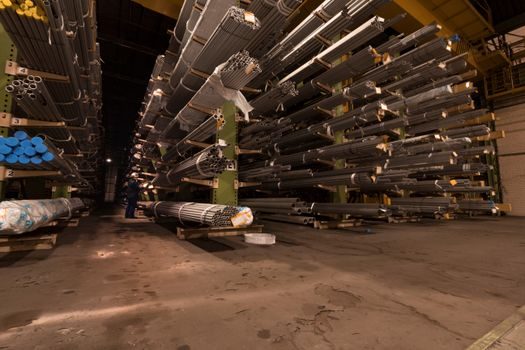
Cantilever rack — open long-arm columns — is the only geometry for long stock: timber, pipe, bar stock, structural steel, sheet goods. A 5 m cantilever arm on a 6 m column is a typical heavy-industrial configuration; the long arms eliminate the need for an end-frame cross-brace, which is what makes storage of 6 m lengths possible at all [S2]. Cantilever arms typically rate 250 kg to 1500 kg per arm pair depending on arm length, and column heights run 2.4 m to 6 m. A criteria-based comparison of the four main industrial rack types:
Selective pallet rack — 100% access, 35% net utilisation, FIFO, 200+ SKUs. Drive-in / drive-through — 1-2 access faces, 60-65% utilisation, LIFO/FIFO bulk, 50-200 SKUs. Push-back / pallet-flow — 2-5-deep lanes, 50% utilisation, mixed rotation. Cantilever — long-load only, 250-1500 kg/arm, open access, 100% SKU access on the long axis. Mezzanine — adds a floor on top of a rack structure, doubles the cubic-metre usage of a given footprint at the cost of point-load on the slab [S2][S5].
Frame Material, Finish, and the Corrosion Question
Most industrial selective rack is cold-formed galvanised or powder-coated steel, with a structural-grade steel of S235/S275 (European designation) or SS400/Q235 (Japanese/Chinese equivalent). Hot-dip galvanising to ISO 1461 is the standard for outdoor or cold-store duty — typical zinc coating weight is 70-85 µm (≈505-610 g/m²), which gives 20-30 year service life in C3 (urban/light industrial) atmospheres, less in C4 (coastal/industrial). [S1]
For ambient dry warehouses, polyester powder coat at 60-80 µm thickness over a zinc-rich primer is the default and gives indoor service lives well past 20 years. Galvanised reel-off coil is the cheaper route and is acceptable for indoor duty; cut-end corrosion is the failure mode to watch — once a beam is cut, the galvanic protection is broken at the cut edge, so indoor spec usually calls for powder-coated cut parts and hot-dip-galvanised solid sections only where they sit in a corrosive micro-environment. Inside freezer warehouses, the rack should be hot-dip galvanised throughout because condensation runs down the columns.
Anchoring, Seismic Bracing, and the Slab Below
Standard M12 × 100 mm mechanical anchors (or M16 for heavy-duty frames) into a slab with verified ≥25 N/mm² compressive strength is the typical European/Chinese baseline. Each base plate is anchored through a minimum of two bolts, and the anchor capacity is checked against the uplift force from fork-truck impact (a 5 kN horizontal impact at 300 mm height is the typical design load). [S2]
Seismic zones change the arithmetic. EN 1998-1 (Eurocode 8) governs European seismic design, and a Zone 2A site (typical Italian, Greek, Turkish, Romanian installations) adds horizontal bracing, heavier base plates, and often a third anchor per plate. In the US, AISI / FEMA 154 / IBC 2018 Chapter 16 drive the equivalent design with site class A-F multipliers on spectral acceleration. Storage rack in seismic zones is rarely a "drop-in" selection — the anchor bolt pattern, frame bracing, and beam-to-column clips must all be engineered against the site class.
Compliance, Inspection, and EN 15635 "In-Use"

EN 15635 is the operational standard every EU-spec rack is judged by after installation: a competent person inspects weekly for visible damage, a technically qualified person inspects annually, and any damaged component is removed from service or down-rated by 25% until repaired. The standard is the reason most operators keep a "rack inspection register" alongside their load plate drawings. [S3]
FEM 10.2.06 sits upstream of EN 15635 and defines how the rated capacity is calculated in the first place (partial safety factors, deflection limits, beam-end-connector capacity). A buyer can ask for the FEM calculation report per frame type — every compliant OEM will produce one. In North America, the equivalent design codes are ANSI MH16.1 (steel shelving) and ANSI MH26.2 (pallet rack), with RMI's "Specification for the Design, Testing, and Utilization of Industrial Steel Storage Racks" being the in-use reference. China uses GB/T 28576 (design) and CECS 23 (anchor design) as the local stack; the FEM 10.2.06 design output still travels as the common language when an EU or US project sources Chinese OEM capacity [S2].
Storage Cage and Specialty Sub-Racks
Stackable storage cage is the typical sub-rack for loose parts, tools, and order-picking totes — wire-mesh sides, forklift pockets, stacking corners, and 500-1500 kg unit load are the common range. Post-pallet stackable cage is the variant that sits on a standard EUR/CHE pallet footprint (1200 × 800 mm) so the cage can be moved on the same fork-truck fleet as the pallet rack itself. Cantilever rack for bar stock and sheet goods, and barrel rack for liquid drums, sit in the same specialty family as the storage cage [S2].
Stackable cage design choices that bite later: mesh aperture size (drives what falls through), stacking-corner engagement (drives vertical stack stability at 4-high), and forklift pocket dimensions (must match the truck fork cross-section, not the truck itself). Buyers routinely get this wrong by specifying EUR/ISO standard 100 × 40 mm fork pockets on a fleet that runs 100 × 50 mm forks — the cage slips, and the fork sits high, and the stack becomes unstable at 3-high.
Cost Levers and Sourcing Reality in 2026

A standard selective pallet rack bay (2 uprights + 2 beam pairs, 2.7 m high, 2.7 m wide, 1.1 m deep, 1000 kg/beam) in 2026 prices around USD 180-260 ex-works China for a 1-2 container order, with a 500-bay minimum for engineered drawings signed off against the site slab. A 5000-bay DC turnkey (rack, install, anchoring, signage, EN 15635 inspection pack) typically lands in the USD 1.4-2.2 million band; engineering and installation run 25-40% of the rack material cost on a turnkey project. The pair of crane spec guides and the loading-bay pairing spec sit one click away when a project pairs racking with material-handling equipment. [S4]
Three signals to track over the next 6 months: (1) the FEM 10.2.06 / EN 15512 review cycle output for cold-formed steel sections — the open item is whether EN 15512 will formally accept the FEM 10.2.06 capacity tables as a closed-form solution; (2) the post-Galway EN 15635 enforcement round in Ireland, where the HSA has been running rack-fall inspections against warehouse logistics operators, and the report is expected to publish enforcement numbers in late 2026; (3) the Chinese GB/T 28576 alignment with FEM 10.2.06 — the 2025 revision added the seismic category but kept the partial safety factors close to FEM's, so most Chinese OEM/ODM capacity is bid-compatible on EU projects without re-engineering [S2].