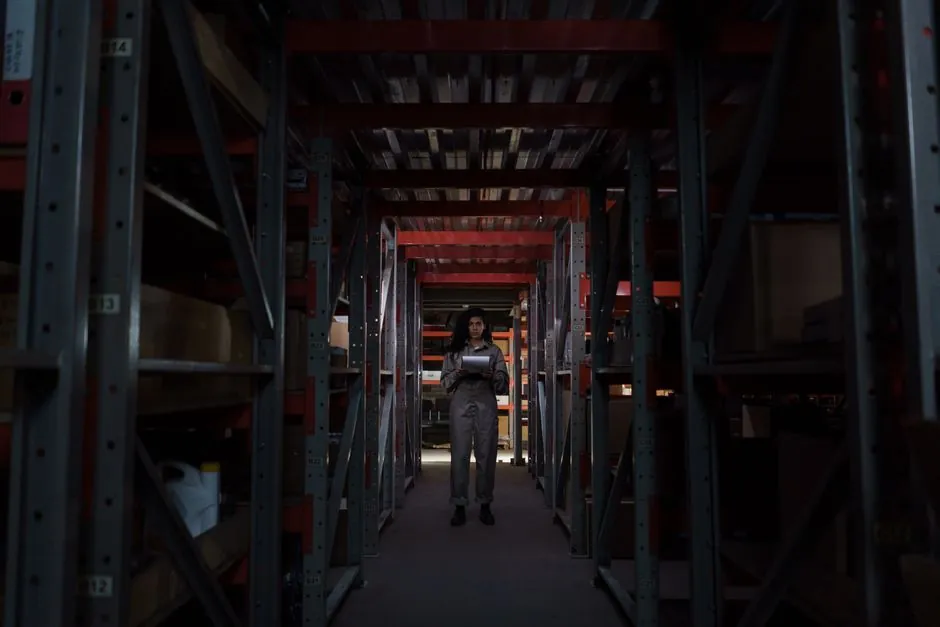
Seven rack families cover the bulk of industrial warehouse storage, and the right pick is set by three engineering gates: pallet density per SKU, inventory rotation (FIFO vs LIFO), and the physical geometry of the load [S1][S3].
Selective, double-deep, drive-in, drive-thru, push-back, pallet flow, and cantilever racks are the standard menu; matching a facility's SKU profile and forklift fleet to one of these is the fastest way to control cost-per-pallet-position and aisle footprint [S1][S4].
Selective pallet rack: the baseline low-density system
Selective pallet rack is the default U.S. warehouse configuration because every pallet is directly accessible without moving neighbors, and the budget price is $50-$80 per pallet position, the lowest cost-per-pallet-position in the family [S1]. It supports any forklift, holds SKUs of any size, and is the simplest structure to install, but it also gives the lowest storage density and requires the widest forklift aisles [S1][S3]. A 40" x 48" pallet is the de facto standard that selective rack is dimensioned around, which is why selective rack scales to nearly any product volume [S3]. For operations running FIFO with many low-turn SKUs, the pallet rack format is the right starting point; facilities chasing density beyond 1-pallet-deep should step into the next tier.
Double-deep and push-back: low-cost density bumps for LIFO stock
Double-deep rack stores two rows back-to-back instead of one, lifting density without changing aisle count, and runs $80-$200 per pallet position because of the longer beams and heavier uprights [S1]. It is a LIFO-only format, and operators typically need a double-reach forklift or extension pantograph to pick the rear row, which is a real capex gate if that truck is not already on the fleet [S1]. Push-back rack uses nested carts on a slight pitch so pallets are loaded from the front and pushed back, recovering 2-5 deep positions per lane and running in LIFO; it suits the same SKU-multiplicity profile as double-deep but with no reach-truck requirement, traded for more moving parts that need maintenance [S4]. Both are common answers when a storage rack buyer needs more pallet positions inside the same building footprint without a new pick aisle.
Drive-in and drive-thru: high-density block storage

Drive-in rack lets forklifts drive directly into the rack structure on rails, typically supporting 4-10+ pallets deep per lane, and is built for LIFO bulk storage of homogeneous SKUs such as food, beverage, and seasonal goods [S1]. Drive-thru is the FIFO twin, with openings on both ends so pallets can enter one side and exit the other, which is why cold storage, canneries, and produce distributors favor it for date-sensitive inventory [S1]. Both systems sacrifice selectivity: a blocked lane in a drive-in bay can halt forklift access to every pallet behind it, so they are wrong for high-SKU operations and right for low-SKU, high-velocity bulk stock [S3][S4]. The uprights and rails are heavier than selective rack to handle the impact loading of a forklift driving into the structure, which is why insurance and seismic bracing requirements differ.
Pallet flow rack: FIFO with gravity
Pallet flow rack uses inclined rollers or wheels so loaded pallets travel by gravity to the pick face, and the next load is inserted at the upstream end, enforcing FIFO without a forklift inside the rack [S1][S4]. It fits facilities with several pallets per SKU and FIFO rotation, including date-sensitive consumables and short-shelf-life goods, and is far more selective than drive-thru because every lane is its own SKU channel [S3]. Throughput is set by roller pitch, brake speed, and lane length; longer lanes raise density but slow replenishment, and damaged rollers are a common maintenance pain point. For warehouses that need FIFO but cannot afford a drive-thru's aisle congestion, pallet flow is the engineered middle ground.
Cantilever rack: long, bulky, non-palletized loads
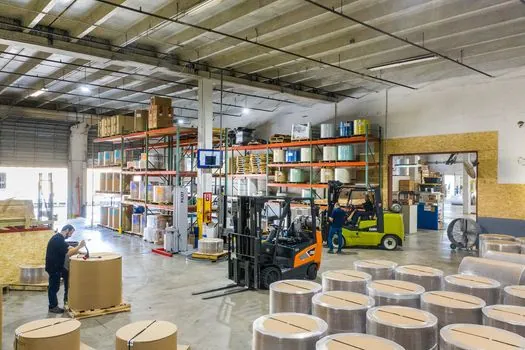
Cantilever rack replaces the front upright beams with horizontal arms anchored to a single column, so pipes, lumber, steel bar, furniture, and carpet rolls can be loaded lengthwise without obstruction from pallet-rack cross-bracing [S1]. Standard arm lengths run roughly 24" to 48" with capacities often in the 1,000-4,000 lb-per-arm range for roll-formed sections, and heavier structural-steel cantilever columns can be spec'd for steel-service-center duty [S1]. The system is open-fronted, so crane loading or extended-fork handling is straightforward, and it is the right answer any time a load's longest dimension exceeds standard pallet depth. Where cantilever does not fit: uniform palletized cartons, which still belong on selective or flow rack.
Comparison: which rack matches which operation
On the four engineering gates most spec sheets care about, the rack family lines up as follows: selective rack wins on selectivity and lowest capex but loses on density; double-deep and push-back add 1-2x density at $80-$200 per position with a LIFO lock-in; drive-in and drive-thru push density further but kill lane-level selectivity; pallet flow is the FIFO workhorse where date rotation matters; cantilever handles geometry that no pallet rack can [S1][S3][S4]. A practical rule: 1 pallet per SKU or many SKUs = selective; multiple pallets per SKU with LIFO = double-deep or push-back; multiple pallets per SKU with FIFO = pallet flow; long non-palletized loads = cantilever. The same logic also feeds downstream material handling decisions on forklift type, aisle width, and seismic bracing class.
Selection gates and the standards that back them
Before a spec is written, four inputs must be locked: pallet size (40" x 48" U.S. standard), load weight per beam, beam length and upright height, and the seismic zone, which sets anchoring and base-plate requirements for the storage rack structure [S3]. Cold storage adds cost because installation time stretches in freezers, and forklift operators work in lower-visibility conditions that change aisle-width math [S3]. For operations already running automotive-style or heavy-industrial kit, the same selection discipline that drives crawler crane vs overhead bridge crane choices applies: site, capacity, and cycle rate decide the family before model numbers do. Buyers comparing racking vendors should ask for stamped calculations, not brochures, and verify that the supplier's seismic and load ratings match the warehouse's actual U.S. or international code path.
Trackable signals for the next procurement cycle: U.S. warehouse vacancy in core logistics markets, which drives capex appetite for rack upgrades; OSHA enforcement actions on rack anchorage and column protection, which tighten spec language; and forklift lead times for double-reach and articulating trucks, which gate double-deep and articulated-rack rollouts.