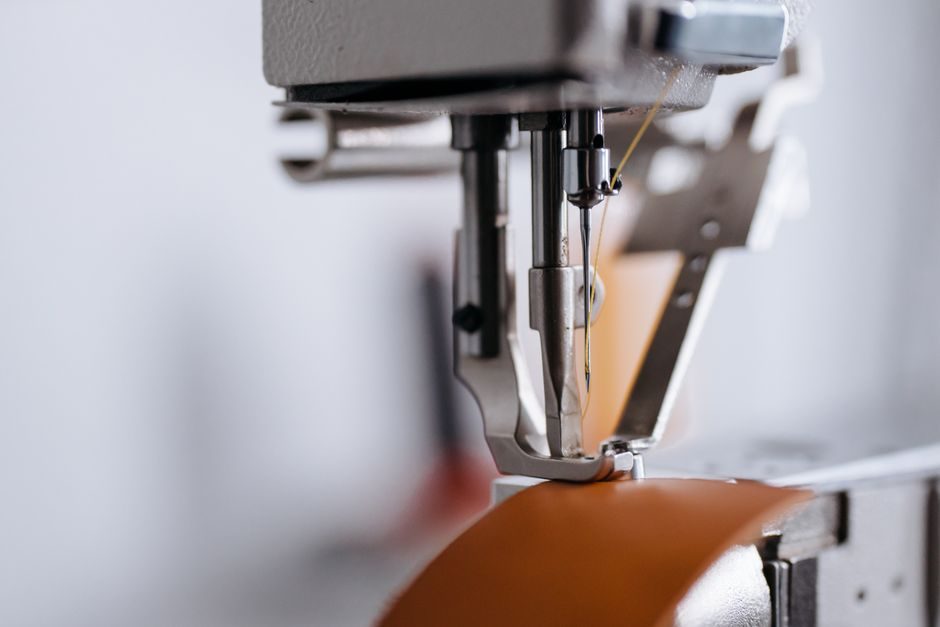
Strapping machine selection is decided by four engineering variables — automation level, strap material, cycle rate and whether a top press is fitted — and the available OEM catalog already spans the spectrum, from semi-automatic bench units drawing 1 kW to high-speed strapping machine lines reaching 65 packages per minute [S1][S2][S3].
On 2026-07-12, sourcing channels list semi-automatic, fully automatic and unmanned categories from at least 15 European and Asian manufacturers, with PP (polypropylene) strap the dominant consumable and PET (polyester) and metal-strap variants supplied for heavier or higher-tension duty [S1][S2][S9].
Three Machine Classes and Their Operating Envelope
Selection begins by mapping the load against the machine class, because each tier carries a distinct cycle, footprint and power envelope [S1][S2].
Semi-automatic units such as the DH-101A handle package widths down to 80 mm and package heights down to 60 mm at roughly 1 kW draw, sit on a roller-equipped workbench and suit low-volume batch work [S2]. Mid-range automatic benchtop lines — typified by the ISG Pack Easy Strap 309/312 at 40 p/min in a 1,460 × 1,240 mm frame — suit general packaging, print and postal applications where an operator feeds each cycle [S2]. High-end fully-automatic units like the Speed Strap 505P-509P-512P, rated 65 p/min in a 1,460 × 1,240 mm frame, integrate a 180° rotatable touch-screen HMI, 24 VDC brushless motors and a double pneumatic stabilising press for unattended line integration [S3].
Unmanned / inline strapping machines (4–5 manufacturers, ~17–18 catalog models on DirectIndustry) are specified when the line must run without an operator presence at the strapping station; these include both standard and pneumatic top-press variants, with optional SUS 304 stainless-steel construction for washdown areas [S2]. The Hummer DH-101A pattern and the ISG Pack Easy Strap 309R/312R (rated up to 35 p/min, with 30% fewer mechanical parts than a traditional machine) illustrate the trade between simplicity and throughput [S2].
Strap Material and Width: PP, PET or Steel
Strap material choice fixes both the consumable cost per metre and the machine's tension head, sealing method and strap-path geometry [S1][S2][S3][S9].
PP strap is the default for cartons, parcels, printed media and general light-to-medium bundling; the ULINE H-959 polypropylene machine runs 1/4″–5/8″ (≈6.4–15.9 mm) strap, tension adjustable from 10 to 100 lbs, heat-welds the seal and dispenses up to 17 straps per minute from 8×8″ or 9×8″ cores at 110 V supply [S6]. The Speed Strap 505P-509P-512P accepts strap widths 5–12 mm with coil outside diameters 400–500 mm and digital tension adjustment from 1 kg up to 45 kg, so the same frame can run both narrow PP and wider PP on different SKUs [S3].
PET strap is specified where higher retained tension and shock absorption are required — brick packs, bottled water, building materials — and most PP/PET automatic machines can run both, with the strap-path and weld-cooling parameters adjusted on the HMI [S3]. Metal strap (steel) is reserved for sharp-edged, very heavy or high-temperature loads (steel coils, glass, sawn timber) and is paired with dedicated metal-strap machines such as those shown for "profiles, metal strap" applications on the Speed Strap 505P product record [S3]. Whichever material is chosen, sealing is heat-weld (no separate seal needed) on PP/PET automatic units, while steel-strap machines typically use a notch-and-crimp seal [S1][S3][S6].
Throughput, Frame Size and Power — Reading the Datasheet
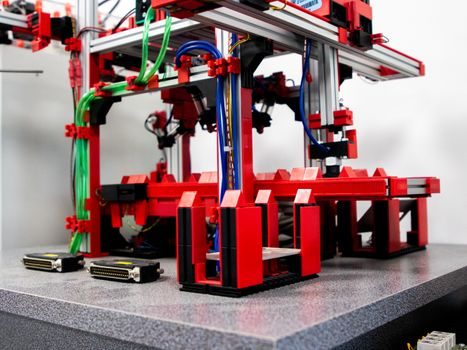
Throughput is the second-ranked criterion after strap type, and the published p/min figures in OEM catalogs are a direct filter for line balancing [S1][S2][S3].
Entry-level semi-automatic benchtop machines such as the DH-101A sit at the low end (operator-paced, single-package cycles) while the ISG Pack SoniXs TRC-6 fully-automatic line reaches 38 p/min in a frame sized for products up to 2,600 mm wide, with an optional side pusher and five-sided package alignment [S1]. At the top of the speed table, the Speed Strap 505P-509P-512P delivers 65 p/min from a 0.7 kW brushless-motor drive, weighing 145 kg and drawing 220 V single-phase — meaningful because the same throughput class on older machines typically consumed 2 kW or more [S3].
Frame footprint is the third filter: PR90 vertical-strapping units reach 4,720 mm overall height and 1,600 mm width to handle pallet loads with two or more vertical straps at a preset distance, while compact benchtop BP-series presses (Easy Strap 309BP–312BP) fit 1,780 × 2,100 mm and run 0–40 p/min with the top press engaged [S1]. Buyers should always cross-check the strap-width window, the external coil diameter accepted, and the power supply phase — a 110 V PP unit such as the ULINE H-959 cannot simply be dropped into a 220 V single-phase European line without a transformer, and a 220 V machine cannot be plugged into a North American 110 V outlet [S3][S6].
Top-Press and Compression: When the Press Earns Its Place
A top press is the single most important add-on for unstable or compressible loads, and the OEM catalog treats it as a defining feature rather than an accessory [S1][S2][S3].
Pneumatic or mechanical top presses pre-compress the load before the strap is tensioned and sealed, eliminating the rebound effect that otherwise loosens PP/PET straps within minutes of cycling — the problem is most visible on stacks of cardboard, on magazine bundles and on palletised loads of soft packaging [S3]. The Speed Strap 505P-509P-512P integrates a double pneumatic stabilising press as standard, the Q8AP and Q8S-M2P table-top presses are sold with full-automatic top-press options, and the TL5P with press delivers a 3 × 2 crossed strapping pattern on cans for one Swedish end-of-line installation [S1][S3]. Pneumatic top-press versions are also offered in SUS 304 stainless steel for food, pharmaceutical and chemical plants where washdown is required [S2].
Conversely, a top press is unnecessary — and adds cost, height and maintenance — when strapping rigid, dimensionally stable products such as sawn timber, metal extrusions or stacked concrete blocks; in those cases a plain strap-and-weld cycle is faster and cheaper [S1][S3]. Buyers should also confirm whether the press is mechanical (spring/cam, lower cost, slower) or pneumatic (consistent force, faster, requires 6 bar compressed air) and budget accordingly [S1][S2][S3].
Decision Matrix: Matching Machine Class to Load Profile
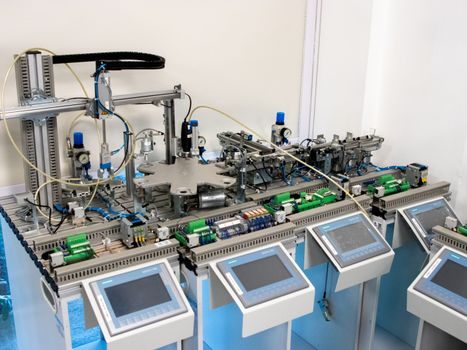
The cleanest way to specify is to score each load against four criteria — cycle rate, strap material, press requirement and operator presence — and then read off the matching machine class [S1][S2][S3][S6].
Below 10 p/min with an operator present and PP strap up to 15.9 mm wide, a semi-automatic benchtop unit such as the ULINE H-959 (110 V, 10–100 lbs tension, 17 p/min ceiling) or the DH-101A is the lowest-cost fit [S2][S6]. At 30–50 p/min with a single operator feeding the cycle, a fully-automatic BP-series press unit (Easy Strap 309BP-312BP at 0–40 p/min, or Easy Strap 309R-312R at 0–35 p/min with 30% fewer mechanical parts) covers cartons, print and parcel duty [S2]. Above 50 p/min on a fully integrated line with no operator at the station, the Speed Strap 505P-509P-512P at 65 p/min or the SoniXs TRC-6 at 38 p/min in a 2,600 mm-wide frame become the baseline [S1][S3]. For pallet duty, the PR90 vertical unit (4,720 mm height, 8–19 mm strap) or dedicated horizontal pallet strappers with 15 p/min and 2.2 kW drives are the correct class [S1].
Material-wise: PP for general cartons and light bundles; PET for brick, beverage and building-material packs; metal strap only for sharp-edged, very heavy or high-temperature loads [S1][S3][S6]. Press requirement: include a pneumatic or mechanical top press whenever the load is compressible, stackable or rebound-prone; omit it for rigid extrusions, timber or concrete [S1][2][S3]. Operator presence: semi-automatic for batch or low-volume work, automatic with operator for general packaging, fully-automatic / unmanned for line-integrated production [S2].
Supplier Qualification, Service and Sourcing Reality
Beyond the spec sheet, two commercial risks dominate: warranty/parts access for machines bought through import channels, and after-sales service radius relative to the plant [S1][S2][S9][S10].
DirectIndustry lists at least 15 manufacturers with press-equipped strapping machines, dominated in catalog volume by ISG Pack (Italy) and Humboldt Verpackungstechnik GmbH (Germany) for the European market, and by Dongguan Xutian, Qingdao Ausense, Shenzhen Jiatuo and Yuanxu Packing for the Asian market [S1][S2]. On Made-in-China.com, full PP strapping lines are listed in the US$15,000–95,000/set range (Shenzhen Jiatuo Plastic Machinery) and Qingdao Zhongrui Plastics Machinery quotes US$46,999–55,999/set on Diamond/Audited-supplier tiers [S9]. The igus UK product catalogue also cross-sells dry-tech bearings, energy chains and linear guides into the strapping-machine builder channel, illustrating how the machine-builder supply chain sits on top of standard polymer and bearing components rather than fully custom parts [S5].
The H-959 ships with a 6-month warranty and is sold through a North American catalog distributor, while European lines such as the Speed Strap 505P-509P-512P are sold direct from the OEM with a 180° rotatable HMI, brushless 24 VDC motors and an Easyfast® strap-guide system that needs no tools to disassemble — both of which materially reduce mean-time-to-repair [S3][S6]. A practical next step: shortlist two machines per class, request a video of the cycle on your actual product, and confirm with each OEM the strap-width range, coil diameter, power phase, and the lead time on the strap-path wear parts — the HMI, the strap cutter blade and the weld-cooling block are the three components that drive unscheduled downtime on these lines [S1][S2][S3][S6]. For a closer look at how pallet and end-of-line equipment is specified alongside a strapping band choice, see the broader pallet jack and material-handling cost guide and the stretch wrapper selection map.
For component-level specifications, see linear guide.