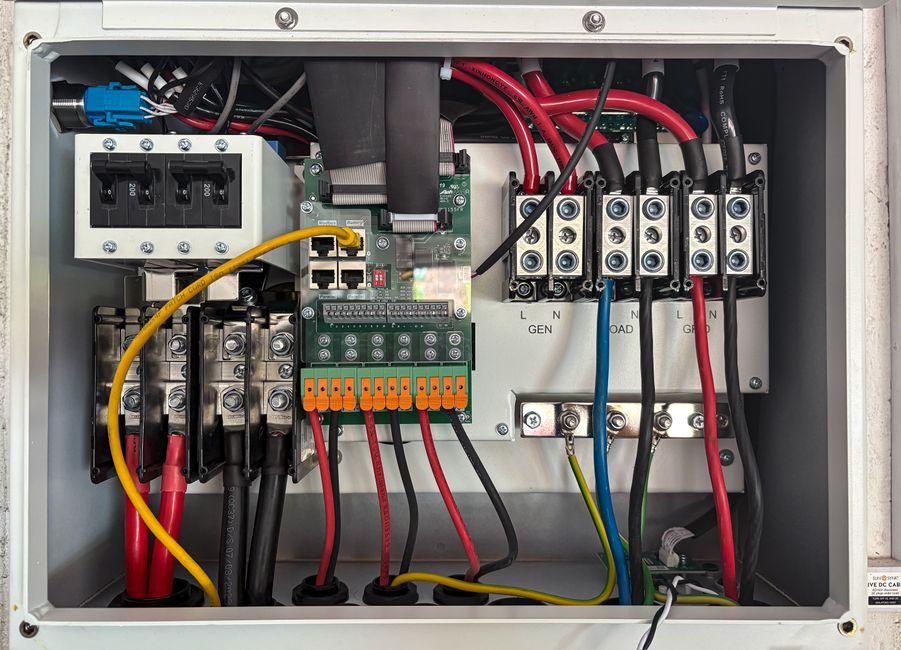
An AC/DC switching power supply (SMPS) takes a wide AC mains input, rectifies and chopper-stabilises it into a single regulated DC bus (most commonly 5 V, 12 V, 24 V or 48 V), while a DC-DC converter is a downstream block that takes that existing DC bus and converts it to a different DC voltage — isolated or non-isolated — for sub-boards, sensors, motor drives and communication rails [S1][S2].
The two blocks are routinely stacked: a 24 VDC industrial SMPS feeds a tray of point-of-load DC-DC converters that produce 5 V, 3.3 V, ±12 V or 48 V for the loads behind it. ATI's industrial SMPS line, for example, targets 12 V/24 V outputs with integrated protection for automation and LED lighting [S1], and Henlv's catalogue lists both AC/DC and DC/DC converters under the same product family [S2].
Definition and Conversion Scope
A switching power supply is the front-end power stage: it accepts an AC input (often a universal 85–264 VAC range on industrial units) and delivers one or more isolated, regulated DC outputs. The "switching" in the name refers to the high-frequency MOSFET/IGBT chopper (typically 50 kHz to 500 kHz in commercial designs) that replaces the bulky 50/60 Hz mains transformer, which is why 300 W SMPS units ship in a 1U footprint and weigh a fraction of an equivalent linear supply [S1].
A DC-DC converter is a stage that assumes a DC source is already present — for example, a 24 V industrial bus or a 48 V telecom rail — and produces a different DC output voltage with a defined isolation barrier (1.5 kV to 3 kV typical) and regulation accuracy (often ±1% to ±3%). DC-DC converters are sold in PCB-mount packages (1/16, 1/8, 1/4, 1/2 brick), chassis-mount bricks for DIN-rail panels, and as enclosed modules with screw terminations [S2].
Topologies, Efficiency and Power Bands
Most industrial SMPS in the 50–600 W range use a single-stage flyback (sub-150 W) or a two-stage PFC + LLC/forward topology (150–1,500 W), achieving 85–94% efficiency at full load. ATI's 12 V/24 V family is built for industrial automation, LED lighting, telecom infrastructure and instrumentation — applications where the AC mains has to be turned into a stable, protected DC bus [S1]. Sinpro's HBA360 (360 W) and HBA600 (600 W) AC/DC platforms sit in the same 150–600 W band and target industrial and medical deployments [S3].
DC-DC converters split into non-isolated topologies — buck (step-down), boost (step-up), buck-boost — and isolated topologies such as flyback, forward, push-pull and bridge. Industrial 24 V-to-5 V or 48 V-to-12 V modules commonly run at 88–96% efficiency at half-to-full load, and isolated 1–3 kV versions are used wherever the sub-board must float from the chassis ground. Henlv lists both "DC DC Converter" and "Power Module" as separate main-product categories alongside the SMPS line, which is the typical supplier structure for this two-stage architecture [S2].
Selection Criteria: Where Each Block Belongs
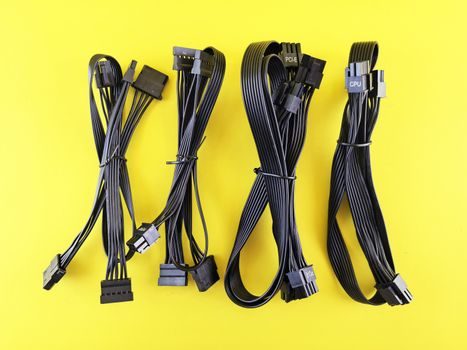
Use a switching power supply when the system has only AC mains available and the load needs one or two well-regulated DC rails. Use a DC-DC converter when a regulated DC rail is already present and the load needs an additional voltage, or when galvanic isolation is required between two grounds inside the cabinet [S1][S2].
Spec gates to lock down before sourcing either block:
— Input range: universal AC input (typically 85–264 VAC, 47–63 Hz) versus a fixed DC input window (e.g. 18–36 VDC for nominal 24 V, or 36–75 VDC for nominal 48 V telecom).
— Output voltage and trim range, line/load regulation (commonly ±1% to ±5%), ripple/noise (tens to low hundreds of mV peak-to-peak).
— Isolation voltage (input-to-output, input-to-ground, output-to-ground) and creepage/clearance per the target safety standard (IEC 62368-1 for ITE, IEC 60601-1 for medical, IEC 61558 for industrial control transformers).
— Protections: OVP, OCP, SCP, OTP, and the recovery behaviour (latch-off vs auto-recovery). ATI explicitly markets "comprehensive protection" as a design-in feature on its industrial SMPS family [S1].
— Environmental: operating temperature, derating curve, humidity, vibration, conformal coating.
— Certifications and region marks: UL, cUL, CE, CB, CCC, RCM, and the relevant safety/EMC standard numbers for the end product.
Comparison Matrix: SMPS vs DC-DC Converter
For an engineer weighing the two blocks, the decision usually comes down to four axes — input source, isolation, typical power band, and physical form factor: [S1]
— Input source: SMPS = AC mains (universal AC or single-voltage AC); DC-DC = already-regulated DC bus (12 V, 24 V, 48 V, 110 V, ±24 V split, etc.).
— Isolation: SMPS provides mains-to-output isolation (typically 3 kVAC to 4 kVAC); DC-DC converters are sold in both non-isolated and isolated variants (1.5 kVDC to 3 kVDC), so the engineer must choose based on whether the downstream ground is the same as the bus ground.
— Power band: SMPS commonly 15 W to 3,000 W in enclosed or U-frame chassis; DC-DC point-of-load modules 1 W to 600 W, with high-power brick DC-DC (1/4-brick, full-brick) reaching 600–1,200 W for telecom and railway.
— Form factor: SMPS = enclosed chassis with screw terminals or DIN-rail clip; DC-DC = PCB-mount brick, chassis-mount brick with screw terminations, or DIN-rail module. Sinpro's HBA360 and HBA600 are enclosed AC/DC units sized for cabinet integration [S3].
— Typical applications: SMPS front-ends a cabinet, machine, test rig or LED array; DC-DC distributes voltage inside that cabinet, on backplanes, on motor-drive control boards, on telecom line cards, and inside EV subsystems.
Real Use Cases and Stacking Pattern
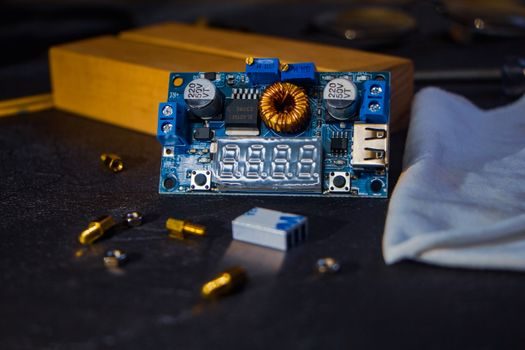
A typical industrial control cabinet stacks the two blocks: a 24 VDC 10 A SMPS (240 W) on the DIN rail feeds several point-of-load DC-DC converters — a 24 V-to-5 V/3 A isolated module for an HMI panel, a 24 V-to-12 V non-isolated module for a sensor cluster, and a 24 V-to-±15 V isolated module for an analogue front-end. ATI's product positioning — "stable DC output voltage, high-efficiency power conversion, and comprehensive protection for industrial automation, LED lighting, telecom infrastructure" — is the same set of cabinets where the downstream DC-DC chain is fitted [S1].
In EV and electric-motor systems, the architecture moves to higher voltages: a 400 V or 800 V traction pack feeds an isolated high-power DC-DC converter that drops to 12 V or 48 V for auxiliary loads, and the SMPS-style AC/DC charger is only present at the wallbox. Sinpro's product line reflects this split, with "SPS", "EV Parts", "Motor&Controller" and "DC-DC" listed as four separate operations blocks on the corporate site [S3].
Limitations, Failure Modes and Sourcing Reality
SMPS that run near full load with poor airflow typically derate after 50 °C ambient; derating curves and the temperature of the airflow boundary are the usual contract-killers when a 300 W unit is dropped into a sealed cabinet. DC-DC point-of-load modules have a tighter efficiency penalty at light load, and synchronous-buck designs are sensitive to minimum-load conditions — a common cause of unstable output when the sub-board is mostly sleeping [S1][S2].
Sourcing-side reality: most small- and mid-power SMPS and DC-DC modules are sourced through Chinese OEM/ODM channels. Henlv, listed on Made-in-China as a manufacturer/trading combination in Shanghai's Minhang district, lists "Switching Power Supply, AC DC Converter, DC DC Converter, Power Module, Power Converter" as its main product set — a one-stop catalogue that mirrors the full AC/DC and DC/DC stack [S2]. Sinpro, exhibiting at AMPA & Autotronics Taipei 2026 and InfoComm 2026, sits more in the AC/DC and pro-AV specialist zone [S3].
For a broader sourcing map and the cost/spec levers behind the wattage bands, the Switching Power Supply Buying Guide 2026 walks through the spec gates and supplier tiers in detail.
Standards, Safety and Compliance Anchors
Both block families sit on a small set of anchor standards. The applicable safety standard depends on the end product, not the converter family: IEC 62368-1 for information-technology equipment, IEC 60601-1 for medical devices, IEC 61558 for industrial transformers and power supplies, and IEC 61010-1 for measurement/laboratory equipment. EMC conformance against IEC 61000-4-2/3/4/5/6 and the relevant EN 55011/55032 class is the other gate, and the datasheet's test report is what closes the cabinet-level CE/UKCA/FCC declaration [S1][S3].
DC-DC converters that sit on telecom rails often carry NEBS Level 3 or ETSI EN 300 132-2 conformance; railway and traction variants are screened to EN 50155 (including the temperature class and the shock/vibration envelope). These standards are not interchangeable with the SMPS-side safety standards — the two blocks are tested separately before being stacked.
Choosing the Right Block for the Job
If the cabinet has only AC mains, specify the SMPS first, fix the output voltage (24 VDC is the most common industrial rail, 12 VDC dominates in LED and embedded), and then choose DC-DC converters to feed each sub-load at its required voltage and isolation level. If a regulated DC bus is already in the panel, skip the SMPS and start at the DC-DC layer. Mixing them inside a single design is the normal pattern, not a special case [S1][S2][S3].
The verifiable next signals to track: tier-1 SMPS suppliers releasing 600–1,000 W GaN-based AC/DC platforms through 2H 2026, the 48 V rail consolidating as a cabinet-level standard alongside 24 V, and isolated 1/16-brick and 1/32-brick DC-DC modules continuing to push the power-density envelope for the 24 V-to-PoL conversion stage. The HBA360/HBA600 product releases by Sinpro are one of the visible data points in the 2026 industrial AC/DC roadmap [S3].
For component-level specifications, see dc power supply.