
In 2026 the switching power supply market is mature, but the spec traps have not gone away: engineers still get burned by undersized output current, wrong input ranges for 380–480 V plant feeds, or DIN-rail units that lack the hazardous-location rating their panel actually sits in. The good news — catalog SKUs are transparent. AutomationDirect's RHINO line alone lists a 50 W chassis-mount PSS24-050-S at 24 VDC/2.2 A with a 21.6–26.4 VDC adjustable output window [S2], a 120 W PSR-24-120 DIN-rail unit at 24 VDC/5 A in a metal housing [S8], and a 240 W PSB24-240S at 24 VDC/10 A with 120/240 VAC or 120–375 VDC input acceptance and aluminum housing [S4].
What has changed since 2024 is the breadth of the low-wattage import catalog. Made-in-China lists 65 W AC/DC medical-grade modules from Zhejiang suppliers (e.g. Ninghai Yingjiao) at US$5–15 FOB per piece, MOQ 1,000 [S3]. For programmable AC sources at the other end, Xi'an Jerrystar Instrument lists 50/60/400 Hz units with THD <3%, power factor >0.9, efficiency >0.85, RS232/RS485, LCD display, at US$2,800/piece MOQ 1 [S7]. Those four numbers (THD, PF, efficiency, interface) are the minimum disclosure any quote at that price point should carry.
Definition and Scope: What a Switching Power Supply Is Doing in Your Cabinet
A switching power supply (SMPS) takes an AC or wide-range DC input, chops it at high frequency (typically 50–500 kHz), and regulates a DC output through a transformer and feedback loop — replacing the old 50/60 Hz linear transformer with something 70–90% efficient and four to ten times lighter. For an industrial controls cabinet, that almost always means a 24 VDC output rail feeding PLCs, sensors, and relays. A linear DC power supply still wins in some low-noise analog or lab-instrument niches, but for control panels the SMPS is the default — the design reference is the third edition of Abraham Pressman's *Switching Power Supply Design* (the standard engineer-side textbook) [S9].
Catalog scope covers three families: (1) enclosed chassis-mount (screw-down, panel-cutout), (2) DIN-rail mount (35 mm rail, the control-cabinet default), and (3) open-frame or PCB-mount for OEM integration. AutomationDirect's PSS chassis-mount family (50 W) [S2] sits next to PSR DIN-rail (120 W) [S8] and PSB DIN-rail (240 W) [S4] — same 24 VDC output, three different form factors and wattage bands. Picking the right family is the first decision; the spec gates follow.
Spec Gate 1: Input Voltage Window and Phase
Most industrial SMPS accept a wide input: AutomationDirect's PSB24-240S takes 120/240 VAC single-phase *or* 120–375 VDC, which lets the same unit ride a battery-backed DC bus or a rectified 240 VAC tap without re-wiring [S4]. The PSR-24-120 is rated 120/240 VAC nominal 1-phase [S8]; the PSS24-050-S is 120/240 VAC nominal 1-phase [S2]. Anything described as "universal input" should be 85–264 VAC or 90–264 VAC, 47–63 Hz; units that only list 220 VAC or 110 VAC nominal are single-region and will fail in a 380–480 V three-phase plant unless you add a step-down transformer upstream.
For three-phase 380–480 V plant feeds, you need a phase-specific DIN-rail supply (e.g. Phoenix Contact QUINT, Siemens SITOP smart, or PULS DIMENSION Q-Series) — none of the AutomationDirect RHINO SKUs above are three-phase. Confirm phase count from the datasheet's "input" line, not the marketing tagline. Programmable AC sources like the Xi'an Jerrystar 50/60/400 Hz unit at US$2,800 [S7] are a different category — they *generate* the input, typically for avionics or military 400 Hz testing, and should not be confused with a panel-mount SMPS.
Spec Gate 2: Output Voltage, Current, and Adjustability
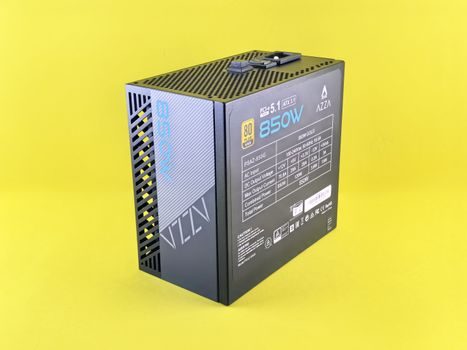
The 24 VDC rail dominates industrial SMPS, with output windows typically adjustable ±10% (e.g. 21.6–26.4 VDC on the PSS24-050-S [S2] and 22–28 VDC on the PSB24-240S [S4]) to compensate for cable drop on long sensor runs. 12 VDC and 48 VDC rails exist for telecom and PoE, but if your PLC and sensor mix is the load, 24 VDC is the de-facto spec. The 5 VDC/±12 VDC/±15 VDC rails are essentially legacy — they show up in test equipment and older instrument retrofits, not new control panels.
Current sizing is where engineers most often under-spec. A common rule of thumb from the field (not a named standard) is to size the supply at 1.5–2× the continuous load sum, so a 120 W PSR-24-120 [S8] feeding a 60 W continuous load leaves headroom for inrush from contactors and solenoid valves. Note that a 240 W SMPS does not always fit in the same footprint as a 50 W one — the PSB24-240S measures longer on the DIN rail than the PSR-24-120, so check the datasheet's depth dimension against cabinet real estate before committing. For more on the switching power supply category and its place next to linear and DC options, the SourceBySpec encyclopedia entry covers the topology contrast.
Spec Gate 3: Mechanical Format, Cooling, and Environment
Form factor dictates cabinet layout. The three common formats (enclosed chassis-mount, DIN-rail mount, open-frame) all appear in the 2026 catalog, with DIN-rail dominating new industrial builds. The PSS24-050-S is an enclosed chassis-mount unit [S2]; the PSR-24-120 is a 35 mm DIN-rail mount with a metal housing [S8]; the PSB24-240S is a 35 mm DIN-rail mount with an aluminum housing [S4]. Aluminum housings dissipate heat better at the 240 W tier and weigh less, which matters in mobile or marine cabinets.
Cooling method is the silent spec. Most industrial SMPS in the 50–240 W band are convection-cooled (no fan) — quieter, no moving parts, no fan-failure failure mode. Above ~300 W, fan-cooled becomes common. For dusty or oil-laden environments (woodworking, food processing, foundry), specify a sealed or conformal-coated unit; for outdoor enclosures, look for an operating temperature rating of –25 °C to +70 °C with derating above 50–60 °C. The PSB24-240S was listed as hazardous-location rated before retirement in November 2025 [S4], which is the kind of certification (UL Class I Div 2, ATEX Zone 2) that locks in a premium of 20–40% over a non-rated equivalent. Replacement is the PSR-24-240.
Spec Gate 4: Certifications, Efficiency, and MTBF
Certifications drive where the unit can legally ship. UL 508 (industrial control equipment) and UL 60950-1 / UL 62368-1 (ITE) cover North American cabinets; CE and the Low Voltage Directive (2014/35/EU) cover Europe; CCC covers China; RCM covers Australia. For medical, IEC 60601-1 is mandatory; Made-in-China's 65 W medical-grade listings from Zhejiang suppliers explicitly cite compliance with this family of standards [S3]. For hazardous locations, the unit should carry UL Class I Div 2, ATEX Zone 2, or IECEx — the retired PSB24-240S carried such a rating [S4], which is why it stayed in spec sheets for refinery and chemical-plant retrofits.
Efficiency numbers worth tracking: 80 PLUS does not apply to industrial SMPS, but look for ≥85% at full load (the Xi'an Jerrystar programmable AC source lists 0.85 efficiency at full load [S7]), and ≥90% for premium DIN-rail units from Phoenix Contact, Siemens, or PULS. Power factor correction (PFC) >0.9 is the threshold above which an industrial SMPS stops pulling harmonic current that disturbs other equipment on the same bus — the Xi'an Jerrystar unit's 0.9 PF claim [S7] sits at that line. MTBF figures of 300,000–500,000 hours (MIL-HDBK-217F, ground benign, 25 °C) are typical; ignore any MTBF claim that is not pinned to a calculation method.
Who It Is For — and Who Should Pick a Different Topology
An industrial SMPS is the right call for: PLC and I/O power (24 VDC), solenoid and relay coils, sensor and encoder power, HMI panels, low-voltage LED lighting, and battery-backed DC distribution where the same unit can run on AC mains or DC bus. It is *not* the right call for: precision analog front-ends where ripple must be below 10 mV (use a linear post-regulator after the SMPS, or a linear DC supply directly); high-voltage capacitor-charging or X-ray tube supplies (custom topology); RF transmitter chains (linear or special low-noise SMPS); and any load that explicitly requires an isolating transformer with multi-kVA continuous rating (use a transformer + linear or a custom design). For a programmable lab source, an off-the-shelf industrial SMPS will not replace a unit like the Xi'an Jerrystar 400 Hz AC source at US$2,800 with its RS232/RS485 interface and LCD [S7] — that is a different product class.
Cost Bands, Sourcing Levers, and Lead-Time Reality (2026)
Pricing tiers in mid-2026 look like this: 15–65 W industrial-grade AC/DC modules from Chinese Tier-1 OEM suppliers (Ninghai Yingjiao and peers on Made-in-China) at US$5–15 FOB per piece at 1,000-piece MOQ [S3]; 50–240 W DIN-rail and chassis-mount units from Western catalog houses (AutomationDirect RHINO line: PSS24-050-S, PSR-24-120, PSB24-240S) at roughly US$70–300 list per SKU depending on wattage and certifications [S2][S8][S4]; and 400 Hz programmable AC sources at US$2,800/piece MOQ 1 [S7]. Sourcing levers that move price: MOQ commitment (1,000 vs 1 piece moves the same 65 W module from US$5 to US$15+ on the import side), certifications bundle (adding ATEX or IECEx can add 20–40%), and brand premium (Phoenix Contact / Siemens / PULS sit roughly 2–3× AutomationDirect RHINO at the same wattage).
Lead-time signals: the PSR-24-120 is backordered with 361 units due earliest 2026-07-06 per the AutomationDirect catalog page [S8], and the PSB24-240S was retired in November 2025 with PSR-24-240 listed as the comparable replacement [S4] — two concrete nodes a 2026 buyer should track. For those sizing adjacent categories, the Limit Switch Buying Guide 2026 covers the same spec-gate and sourcing-lever framework for a related DIN-rail ecosystem, and the Multistage Centrifugal Pump Price 2026 piece applies a parallel cost-band structure on the rotating-equipment side. The fastest single signal to watch through Q3 2026 is whether the PSR-24-240 replacement stabilizes stock on AutomationDirect's DIN-rail line, and whether the US$5–15 band on Made-in-China 65 W modules holds against any new UL 62368-1 or IEC 60601-1 audit cycle.
For component-level specifications, see linear guide.