Three operating families dominate the tank cleaning machine market in mid-2026: rotary spray-jet nozzles sized to a tank opening, multi-stage aqueous/ultrasonic wash lines with one to five process tanks, and permanently-installed cargo tank cleaning systems built to the ABS Enhanced Cargo Tank Cleaning (ECTC) notation [S7].
Across the rotary category, published OEM datasheets show operating pressures spanning 3-200 bar with cleaning cycles of 2-12 minutes and minimum tank openings from 100 mm up to 158 mm, while multi-stage aqueous lines on the DirectIndustry index already list 29 manufacturers and 101 products in the multi-tank segment [S3][S4].
Rotary spray-jet nozzles: pressure classes, cycle time, and reach
Rotary spray-jet tank cleaning machines are classified first by their drive mechanism and second by operating pressure, with published model lines spanning 3-20 bar, 5-50 bar, 4-20 bar, and 500-1000 bar variants on the same product page [S4].
Mid-pressure models in the 3-20 bar class deliver an 8 m spray diameter with a 2-4 minute cycle and a 100 mm minimum tank opening, while 4-20 bar units extend to a 20 m spray diameter on a 6-12 minute cycle; high-pressure 500-1000 bar machines with 6-12 minute cycles target heavy rust and paraffin in petrochemical and underground storage service [S4][S6]. The DG15 3D rotary nozzle pairs a 15 m spray diameter with a 100 mm opening, illustrating the engineering trade-off between throw distance and access port size [S4].
Multi-stage aqueous and ultrasonic wash lines
Multi-stage cleaning machines combine pre-wash, wash, rinse, and drying in 2-5 sequential tanks, with 29 manufacturers listing 101 products in this category and 12 manufacturers listing 22 products in the 2-tank subset [S2][S3].
Tank capacities in the published TIERRATECH ultrasonic line range from 66 gal (2 tanks) to 317 gal (3 tanks), with internal working dimensions from 30 x 17.7 x 24.8 in up to 200.8 x 13.1 x 29.5 in, and ultrasonic operating temperatures reaching 100 °C in 3-stage aqueous systems such as the Guyson CRD450 Mk3 [S3]. KKS Ultraschall AG's NW series shows 180-580 L single-tank ultrasonic baths for large industrial parts, while Silberhorn's MWS 4 series reports a 5.6 m² footprint for the 2-tank configuration and 6.6 m² for the 3-tank version — a useful rule of thumb when planning floor loading [S2]. BRIO Ultrasonics claims 30% lower energy consumption than standard ultrasonic technologies in its BR-450 MS 450 L unit, though the comparison baseline is OEM-defined [S3].
Permanently-installed marine cargo cleaning systems (ABS ECTC)
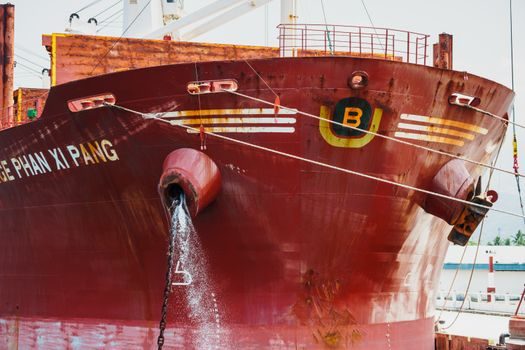
For chemical and oil tankers, the ABS Guide for Enhanced Cargo Tank Cleaning sets requirements for the optional ECTC notation, which permits cleaning cargo tanks without confined space entry through permanently-installed or portable machines [S7].
ECTC compliance differs fundamentally from in-plant aqueous washers: cargo tank systems must handle crude, slops, and chemical residues while satisfying structural, fire-protection, and personnel-entry-elimination criteria that allow tank entry to be waived under specific conditions, and the guide explicitly covers both bulk-oil and chemical-cargo vessels [S7]. Buyers specifying ECTC equipment should treat the ABS notation as the controlling document rather than generic industrial wash-line standards, since the design intent — eliminating human entry — drives the machine architecture. For storage vessels on land, the same engineering intent informs the IBC tank and tank container cleaning skids sold for chemical logistics.
Selection criteria: opening, soil, hazard class, throughput
Four engineering parameters select between the three families: minimum tank opening, soil type, hazard classification, and required cycle throughput. [S4]
Rotary jets fit any vessel with a 100-158 mm nozzle port, handle rust, paraffin, and bulk solids at 3-1000 bar, and serve petrochemical, food, and tank container fleets; multi-stage aqueous lines suit workshops cleaning discrete parts with defined oils, chips, and emulsions at 30-100 °C and capacities from 66 to 1200 gal [S3][S4][S6]. Marine ECTC machines are non-negotiable for tanker owners trading under the ABS optional notation, but are over-specified for fixed onshore storage [S7].
Ultrasonic and specialized drive technologies

Ultrasonic tank cleaning generators, such as the ASONIC d.o.o. module with frequency tuning for stable cavitation, target residue removal in tanks where spray-jet shadowing limits mechanical impact, and are typically paired with multi-stage aqueous frames rather than used as standalone devices [S1].
Guyson's Microsolve Mono Solvent vapour degreasing system adds a three-stage vapour-phase solvent cycle for precision parts, while vacuum-assisted hybrids such as the KP.HYBRID combine modified alcohol and aqueous detergent cycles to strip both organic fats and inorganic salts in a single chamber [S2][S3]. These specialised systems are not interchangeable with rotary jets; they target small, high-purity parts, not bulk tank interiors, and the 100 °C upper temperature on the CRD450 Mk3 sets a practical ceiling for aqueous ultrasonic thermal load [S3].
Limitations, failure modes, and the North American supply side
Rotary-jet machines fail when spray geometry shadows baffles, agitators, and internal coils, leaving unwashed zones that force manual re-entry; multi-stage aqueous lines lose throughput when oil carryover smears ultrasonic transducers, and ultrasonic cavitation collapses in tanks with heavy sludge loadings [S3][S6].
In North America, Oilers Depot (ODC) and Alfa Laval — through its combined Gamajet and Toftejorg portfolios — supply the bulk of rotary-jet and tank-cleaning equipment, with Alfa Laval's North American brochure positioning the merged line as the broadest product family in the industry [S5][S8]. For process plants that recover wash water through self-cleaning filter skids, or for terminal loading arms that feed tank container washing bays, the cleaning machine is the upstream of a broader filtration train. Buyers evaluating a wash line against alternative capital purchases, such as a dock leveler types and classifications: hydraulic, mechanical, air-powered compared review, should weigh the operating-cost profile of heated aqueous washers against one-time civil works.
Track ABS ECTC retrofit volumes and the next DirectIndustry product refresh for the multi-tank category to gauge 2026 demand from chemical-tanker owners and discrete-parts manufacturers respectively [S3][S7].