A concrete job site rarely welds the concrete itself, but it welds the steel and aluminum that go into it: rebar splices, embed plates, anchor bolts, stair stringers, and formwork hardware. For those joints, a TIG (GTAW) machine gives the cleanest bead and the lowest spatter on thin or coated sections, but only if you size amperage, AC/DC output, and duty cycle to the actual base metal on site [S1][S5].
For typical rebar and mild-steel embed work, plan on a 200 A DC TIG machine with at least a 40% duty cycle at rated output. For aluminum embed plates, hardware, and Magnesium-containing formwork, step up to an AC/DC unit in the 200-250 A class with high-frequency arc start, because lift-arc and scratch-start methods cannot break through the aluminum oxide layer [S5].
Why a TIG, not a stick or MIG, on a concrete site
TIG welding uses a non-consumable tungsten electrode and 100% argon shielding, with the filler rod fed manually into the puddle, which is the main reason the arc stays narrow and the heat-affected zone stays small [S2]. On a concrete site that matters in two places: thin-wall embed plates and rebar where you do not want to burn through the cross-section, and stainless or galvanized anchor hardware where spatter and zinc burn-off would otherwise contaminate the surrounding concrete [S2][S3].
Versus MIG, TIG is slower because the operator feeds filler by hand, but it produces fewer defects, lower spatter, and a bead that usually needs no grinding before the concrete pour [S2]. For tie-wire-sized rebar (under 6 mm) and cosmetic embed plates, that clean bead can save a half-day of cleanup per floor; for heavy 20 mm+ rebar splices, most crews still drop back to stick or arc-welding machine picks for steel construction sites because TIG heat input is too low to fully fuse large cross-sections at a reasonable travel speed [S3].
AC/DC output: the first decision, not the last
The single most important choice when selecting a TIG welder is whether the output is DC, AC, or both, because a DC-only machine physically cannot weld aluminum or magnesium [S5]. DC TIG covers steel, stainless steel, and chromoly, which covers the bulk of concrete-site metalwork from rebar to anchor channels. AC TIG is required for aluminum embed plates, aluminum formwork, and magnesium-bearing hardware, and most AC machines also let you adjust AC balance (cleaning action vs penetration) and AC frequency (wider or tighter bead) [S5].
The concrete site rarely needs exotic waveforms, so the realistic decision is one of three: DC-only around 200 A for rebar and steel embed only, AC/DC 200-250 A for mixed-metal sites, or AC/DC with pulse for shops that also do thin-wall stainless. If a job is aluminum-only, a 200 A AC/DC unit with high-frequency start is the floor; anything less will not start the arc cleanly through the oxide [S5].
Amperage, duty cycle, and the 110 V trap
Amperage class should be picked to the thickest section you will realistically weld, not the thinnest. A 200 A machine comfortably handles up to roughly 6 mm mild-steel embed plate and 16-20 mm rebar tie splices; a 250 A unit extends that to 10 mm plate and lets you hold a longer arc on dirty or rusty stock [S4]. Below 160 A, the machine starts struggling on 6 mm plate and will not sustain a continuous rebar splice without thermal cutouts [S4].
Duty cycle is the second number that bites crews in the field. It is the percentage of a 10-minute window the machine can run at rated output before it needs to cool, and it is what separates a real industrial machine from a hobby box [S5]. A 200 A machine rated at 40% duty cycle at 200 A can run 4 minutes and rest 6, which is enough for embed work; a 200 A machine rated at only 20% duty cycle at 200 A will thermal-out on a continuous rebar run, and that is the unit most crews end up returning [S4][S5]. For site power, a 200-250 A TIG on 230 V single-phase is the practical minimum; 110 V units cap out near 150 A and are limited to 1.5-3.0 mm sheet, which is too small for embed work [S4].
Arc start method, pulse, and pedal control
Arc start method is the third concrete-site filter, and it ties directly to material. High-frequency (HF) start begins the arc without touching the tungsten to the workpiece, which keeps the tungsten clean and is required for clean aluminum TIG; lift-arc touches then lifts, which reduces contamination versus scratch start and works on DC steel and stainless but cannot be used on aluminum because of the oxide layer; scratch start drags the tungsten and contaminates both the electrode and the weld, so it is the method to avoid whenever you can [S5].
Advanced controls add real value on the concrete site. Pulse cycles the current to control puddle size and heat input, which is useful on thin embed plate and on stainless where you want to limit distortion into the surrounding concrete face. Slope up/down smooths arc starts and prevents crater cracking at the end of a splice, which matters when the splice is inside a form and you cannot grind a crater later. Foot-pedal amperage control is the easiest for an operator learning TIG, while finger/trigger controls mount on the torch and are easier in tight rebar cages [S5].
Decision matrix: pick by base metal, not by brand
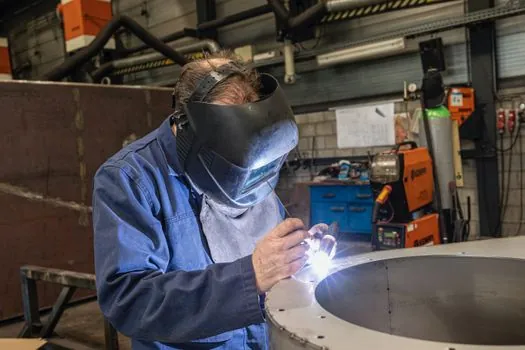
Four realistic picks cover most concrete-site TIG work, and each is sized by the dominant base metal on the job rather than by brand: (1) DC-only 200 A at 40% duty, 230 V, HF or lift-arc start, foot pedal, for rebar and mild-steel embed only; (2) AC/DC 200 A at 40% duty, HF start, AC balance and frequency adjustable, for mixed rebar plus aluminum embed plates, the most common all-rounder on a structural concrete site; (3) AC/DC 250 A at 40-60% duty, pulse, HF start, for shops that also do thin-wall stainless and want headroom on thicker embed plate; (4) DC-only 160 A at 30% duty, 110 V, lift-arc, only for trim and thin-wall cosmetic embed under 3 mm, and not for rebar splices [S1][S4][S5].
Two groups should not buy a TIG at all for concrete work. A crew whose work is dominated by 20 mm and larger rebar splices is better served by a stick welder, because TIG heat input is too low to fully fuse heavy bar at production speed and the cost of argon shielding adds nothing on a structural splice; the rebar coupler selection for tunnel construction spec map covers the mechanical-splice alternative in more detail. A crew doing only repetitive short beads on thin sheet is also wasting a TIG, because a MIG machine with a spool gun will run three to four times faster with acceptable quality on those joints [S3].
On-site constraints and failure modes
Three failure modes show up repeatedly on concrete sites. First, undersized input power: a 200 A TIG on a 110 V outlet will not deliver rated current and the arc will go soft on the first rebar; the fix is single-phase 230 V at 30 A or better, or a step-up transformer. Second, argon contamination: a 25 CF argon cylinder at 15-20 CFH flow lasts roughly 8-10 hours of actual arc time, and crews that forget to close the valve at breaks waste shielding gas and pick up porosity in the bead, which then leaks into the concrete surface if the embed is exposed [S1]. Third, wrong tungsten for the current type: a pure tungsten or zirconiated electrode works for AC aluminum, a 2% thoriated or ceriated electrode works for DC steel, and mixing them up gives arc wander and tungsten inclusion in the weld [S5].
For the broader tooling context around embed plates, the concrete groove cutter selection for masonry guide covers the cutting side of the same workflow, while the rebar bender selection for concrete work spec map covers the bar-prep side. If the TIG machine is going to feed a TIG welder torch, plan a water-cooled torch on any machine over 200 A used for more than a few minutes per bead, because air-cooled torches overheat at sustained 200 A output and that is the next failure mode after the argon runs out [S1].
Track two signals before the next pour: the duty-cycle rating at your real working amperage, not the marketing peak, and the argon cylinder consumption per shift.
The underlying component specifications are covered under welding cutting tool, and aerial work platform.