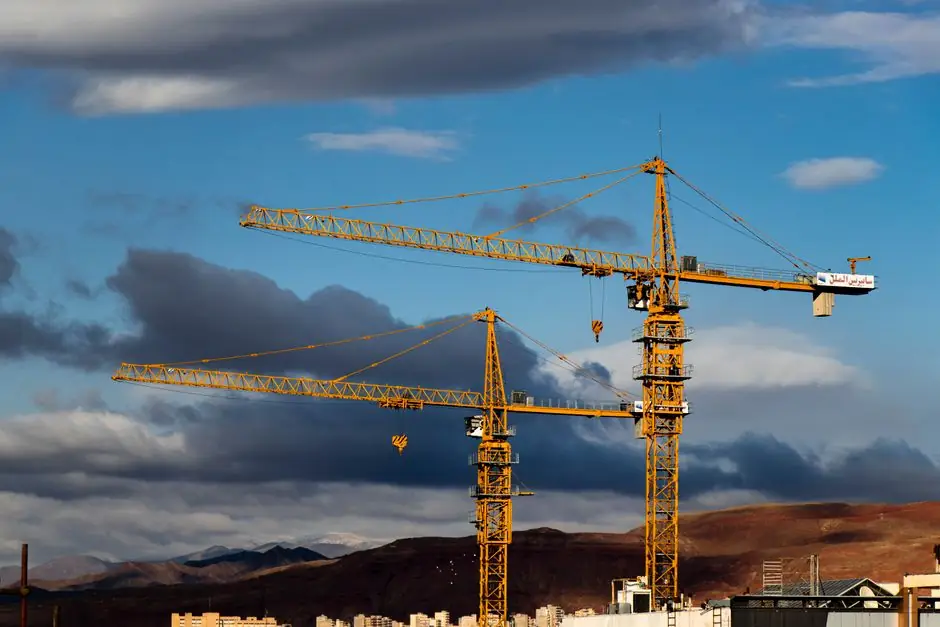
Pipeline-spread tower crane duty differs from high-rise work: the radius is long, the load at radius is modest, and the crane relocates every few weeks along the right-of-way rather than climbing a single mast for months [S1].
Common selections sit in the 6-16 t maximum lift class with 50-80 m jib length, configured as flat-top or luffing-jib units, with the jib chosen for either reach (flat-top) or tight multi-crane clearances (luffing) [S2]. Mast sections such as the L44 and L66 standard formats remain the dominant modular system, allowing shippable 20 ft container loads between pipeline spreads [S3].
Load Spectrum: Spools, Valves, and Trench-Side Lifts
Pipeline right-of-way work concentrates around three lift profiles: prefabricated pipe spools at 2-8 t, valve assemblies and skid-mounted manifolds at 4-10 t, and occasional heavy items such as scraper traps or metering skids reaching 12-16 t at low radius. The tower crane class must cover the worst single lift at the worst radius, not the average, because the schedule-driving lifts define the equipment. [S2]
Spool-handling work rarely demands 2-hook duty; single-line 4-fall reeving with a 2-4 t auxiliary hoist is the typical configuration on a 10 t-class machine. Operators should size the crane to lift the heaviest skid plus rigging (typical 10-15% allowance) at the maximum working radius dictated by the trench standoff, then verify the OEM load chart at intermediate radii for daily-cycle lifts. The standard 1.5-3.0 t lift at 60-70 m radius that fills most days must sit well inside the chart, not on its boundary.
Flat-Top vs Luffing-Jib vs Self-Erecting: Which Fits a Pipeline Spread
Flat-top (hammerhead) units give the best reach-to-cost ratio for long, straight pipeline corridors where overhead airspace is open, with typical jibs of 50-80 m on a 6-13 t base machine. They assemble quickly from 20 ft container sections and are the default choice for green-field cross-country pipelines [S2].
Luffing-jib tower cranes, with jib inclination adjustable from 15 degrees to 85 degrees, suit congested spreads such as compressor stations, tank-farm tie-ins, or sites with multiple cranes and overhead power lines, where a flat-top's horizontal jib would foul neighbours [S2]. The trade-off is a heavier counter-jib, higher cost per metre of reach, and a smaller load chart at the upper inclinations, so they are specified only when radius collisions force the issue.
Self-erecting cranes with 25-40 m jib and 2-4 t capacity are useful for short-duration valve-station work, but the standard pipeline-spread daily cycle of 30-50 lifts at 50-70 m radius over-powers their envelope, so they are deployed as support machines, not primary lift. A useful decision rule: flat-top for unobstructed right-of-way, luffing for tight stations and crossing spreads, self-erecting for short auxiliary work and confined compound lifts.
For remote or mining-adjacent pipeline work, the tower crane spec gates for mining sites 2026 selection map covers the higher wind-class, higher-cyclic-duty sub-case and complements this spread-duty view.
Foundation and Outrigger Pads: The Field Reality
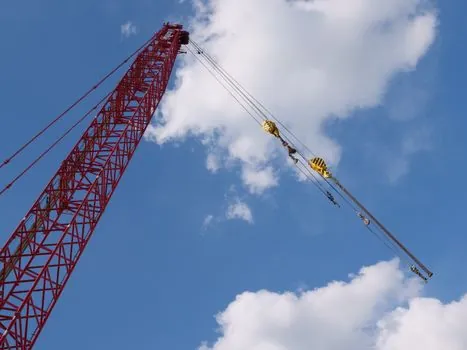
Permanent concrete foundations are rare on a pipeline spread; the crane sits on cross-timber mats or pre-cast outrigger pads sized for the worst reaction load. Base reactions on a 10 t-class tower crane at full ballast commonly reach 80-150 kN per outrigger, and the allowable ground bearing pressure on a prepared gravel pad is typically 100-200 kPa, so a 2.5 m x 2.5 m pad per corner is a reasonable starting point pending a site-specific geotech check. [S4]
Freestanding height of a flat-top tower crane is generally 40-60 m before tie-ins or a stronger base machine is required, which matches most pipeline lift heights (valve stands, pig-launcher trestles, vent stacks) without forcing tall tower configurations. When the lift height exceeds the freestanding limit, the operator has three options: a larger base machine with a heavier ballast, a tied mast to a permanent structure, or a hydraulic climbing frame on a concrete pier, with the third option rarely justified on a linear spread [S1].
Wind, Reeving, and Safety Devices
Tower cranes working in open terrain, common on cross-country pipelines, are exposed to higher wind speeds than enclosed-construction equivalents, and out-of-service wind limits (typical 72-90 km/h, per OEM rigging manuals) regularly bind out the schedule. The crane OEM-supplied anemometer, slew-limiting device, anti-two-block on both main and auxiliary hoists, and overload limiter are the four non-negotiable safety devices; nothing else substitutes for them. [S1]
Reeving choice drives both capacity and speed: 4-fall on the main hoist for 8-16 t work, 2-fall for 4-8 t work with faster line speeds, and 1-fall for the auxiliary hoist typically capped at 2-3 t. A common operator error on pipeline work is leaving 4-fall reeving engaged for 2-3 t daily-cycle lifts, which halves line speed and burns fuel with no benefit. Cross-referenced with the construction tools and rigging hardware reference, the rule is to match falls to the typical load, not the maximum.
Sourcing, Standards, and Documentation

Pipeline-spread tower crane packages are typically sourced as new factory units (Qingdao Tanzon and Weihai Huata, among others, supply ISO 9001-certified manufacturing with TC6010/TC6013/TC5613 class flat-tops) or as refurbished ex-rental fleets from Spanish and German resellers with Spain-based spare-parts divisions [S3][S6][S7]. Used 5-10 t flat-tops from European fleets remain the most cost-effective option for short-cycle spreads of 6-12 months, provided the buyer inspects the mast sections (L44, L46, L66, L68 common formats) for weld fatigue and verifies the load-chart documentation against the as-built configuration [S2][S3].
Operating documentation must include the OEM-issued load chart for the as-configured jib length and reeving, the foundation reaction report, the rigging study for the heaviest planned lift (typically a prefabricated pipe rack or scraper launcher), and the OEM wind-speed matrix. Mast sections for pipeline work should be specified to the tower crane modular section standard (typically 1.6 m x 1.6 m or 2.0 m x 2.0 m footprint, with bolted fishplate connections) so that spare sections can be cross-deployed between cranes on multi-spread projects [S1][S3].
Common Failure Modes on Pipeline Work
Three failure patterns dominate the incident history: overload at radius when a spool lift exceeds the chart on a long-radius pick, outrigger punch-through on a poorly prepared pad after rain, and two-block on the auxiliary hoist when reeving changes mid-shift. The first is mitigated by a pre-lift chart review for every lift over 70% of the rated load at that radius; the second by a daily pad inspection and a no-lift rule after rainfall until re-compaction is verified; the third by physical anti-two-block switches and a lockout preventing reeving changes during operation. [S3]
Capacity, radius, and reeving are the three knobs an operator actually controls on pipeline work, and the spec chosen at procurement dictates how much margin remains on each. A 10 t / 65 m flat-top with 4-fall main reeving, freestanding to 50 m, on 2.5 m square outrigger pads, with OEM anti-two-block, slew limiter, anemometer, and overload limiter, is a defensible default for most cross-country pipeline spreads between 6-12 months' duration.
Track the next two signals: the OEM wind-speed matrices being published for the IEC 61439 wind-class updates relevant to open-terrain tower crane work, and any move by Chinese flat-top manufacturers (TC5610, TC6013, TC6015 classes) into direct European rental fleets that would compress the used-crane supply chain [S3][S7].
The underlying component specifications are covered under pipeline pump.