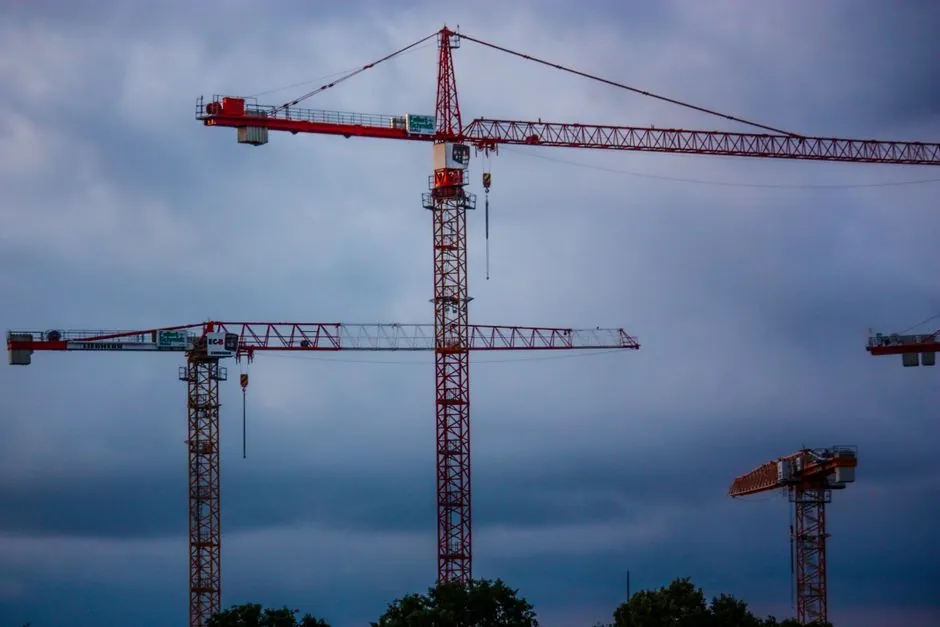
A tower crane is a static, mast-and-jib machine anchored to a foundation or to the structure it is erecting, with a typical free-standing hook height up to 70 m [S1].
A truck-mounted crane integrates a boom on a road-going chassis, drives under its own power to site, and is usually limited to a maximum lift height near 16.5 m because stability is governed by on-board counterweights and outriggers rather than a fixed foundation [S1].
Height, Reach, and Slewing Geometry
Hook height is the first discriminator: tower cranes cover the 30-70 m vertical-lift band that defines mid- and high-rise builds, while truck cranes serve the 0-16.5 m envelope typical of low-rise structures, infrastructure repair, and industrial maintenance [S1].
Slewing is also different. A tower crane’s jib rotates 360° around a fixed vertical mast, so the load radius is set by the trolley position on the jib and is independent of vehicle travel [S3]. A truck crane slews on a turntable, but its effective radius shrinks as boom length extends, and travel between lifts is done by driving the carrier [S2].
For deeper spec context on bridge and gantry alternatives that share the same fixed-path logic, see Overhead Bridge Crane Selection for Tunneling: Duty Class, Span, and Service Pattern.
Load Capacity, Counterweight, and Foundation
Tower cranes lift far greater payloads at radius than truck cranes because the overturning moment is reacted by a structural foundation or by being tied to the building under construction, rather than by the truck’s own wheelbase [S1]. Truck cranes are bounded by chassis counterweight and outrigger spread, so heavy lifts demand short radius, multiple lines, and careful ground-bearing checks [S1][S2].
Foundation work is the line item that swings total cost. A tower crane needs engineered base, anchor cage, and often tie-ins into the floor slab as the building rises; a truck crane needs only outrigger pads on a level surface [S1].
Mobility, Setup Time, and Site Footprint

Truck cranes dominate on mobilisation: they can be driven to site, set up on outriggers, and lifting within an hour, with no assembly crew [S1]. Tower cranes need a planned erection sequence, a larger clear footprint for the mobile assist crane that climbs them, and dedicated space for the base and counter-jib swing radius [S1][S3].
For tight urban infill, bridge repair, or utility work, the truck crane’s compact footprint is the deciding factor; for a 40+ storey core, the tower crane’s vertical reach and dwell time on site justify the foundation cost [S1][S4].
Use-Case Fit: Who Should Specify Which
Specify a tower crane when the project is multi-month, vertical-lift-heavy, and sits on a competent foundation, with hook duties repeatedly above 5 t at radii beyond 20 m [S1][S5].
Specify a truck-mounted crane when lifts are intermittent, scattered across multiple sites, below the truck’s charted capacity, and on ground that will not support a tower base, or when no foundation engineering budget is available [S1][S4].
Port and intermodal handlers comparing mobile lift options against rail-mounted or gantry choices can cross-check with Truck and Port Crane Selection for Terminal Operations: 2026 Spec Map.
Operating Cost, Rental Model, and Operator Training

Rental economics diverge sharply. Truck cranes cost less per shift because mobilisation is a single truck move with minimal labour, while tower cranes carry separate charges for engineering, erection, climbing, and dismantling in addition to the monthly rental [S1].
Operator certification tracks the machine class: mobile crane credentials cover boom trucks, all-terrain, and rough-terrain units, while a separate tower crane credential is required for static, slewing jib operation above a defined height threshold [S5].
Limitations, Failure Modes, and Siting Constraints
Tower cranes cannot be used where ground is soft, where overhead airspace is restricted near airports, or where the swing radius crosses active traffic or adjacent property without coordination, since the load path is fixed and cannot be relocated mid-project [S1].
Truck cranes lose capacity rapidly as radius increases, and are vulnerable to overturning if outriggers are set on weak soil or on a slope beyond the chart limit; their working height is also capped by the boom geometry, not by the building [S1][S2].
Decision Matrix: Tower Crane vs Truck-Mounted Crane
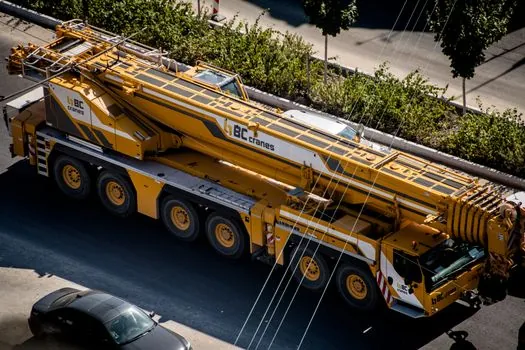
Height: tower crane up to 70 m free-standing, truck crane typically capped near 16.5 m [S1].
Mobility: tower crane is static once erected, truck crane is road-going and self-deploying [S1][S2].
Capacity at radius: tower crane reacts moment through foundation and can lift far greater loads, truck crane is limited by on-board counterweight and outrigger spread [S1].
Setup: tower crane requires engineered base, climbing, and dismantling, truck crane sets up on outriggers within an hour [S1].
Best fit: tower crane for sustained high-rise vertical work, truck crane for short-cycle, multi-site, or restricted-access lifts [S1][S4][S5].
Standards, Sourcing, and Trackable Signals
Selection should reference the manufacturer’s load chart for the specific configuration and the project’s geotechnical report for tower base design, with operator certification aligned to the local crane-safety regulator [S5].
Track these signals before committing: the published ground-bearing pressure under each outrigger pad for the truck crane, and the climbing schedule plus tie-in forces for the tower crane, both of which drive site logistics more than headline capacity [S1][S3].
For a broader spec match across the mobile-lift family, see Truck Crane vs Tower Crane: Spec-Driven Selection for 2026 Job Sites.
For component-level specifications, see signal tower light.