Overhead bridge cranes in tunnel construction are predominantly sized around segment handling, TBM back-up car transfers, and precast invert placement, with working loads commonly landing in the 10 to 40 t range per [S1] and [S5].
The build environment is unusually constrained: rail gauge inside the tunnel, limited vertical clearance, humidity above 85% RH, and a duty cycle that rarely exceeds Class D [S3], which forces different decisions than a shop-floor bridge crane. Specifiers need to lock the CMAA class, span, and headroom before quoting a hoist.
Define Duty Class and Lift Frequency First
CMAA classifies cranes from Class A (standby, 2 to 5 lifts/hour average) through Class E (severe service, 20+ lifts/hour, up to 65% at rated load), and the choice cascades into wire-rope, gearbox, and brake sizing [S3].
Under-specifying duty is the most common failure mode: a Class C hoist pushed into a segment-handling pattern drifts toward Class E within one shift, and the brake, contactor, and rope then fail in series. Buyers should map peak lifts/hour, average lift height (commonly 4 to 6 m in a TBM back-up area), and the share of lifts at full rated load before requesting a quote [S7].
Match Girder Count to Span and Capacity
Single-girder top-running and under-running cranes cover up to 15 t and span up to 80 ft (about 24 m) per [S2] and [S3], while double-girder top-running covers spans to 120 ft (about 36 m) and is the default above 15 t or where the segment lifter needs a hoist riding between girders for extra hook height [S2].
Tunnel cross-sections for metro and rail bores sit in the 6 to 13 m diameter band, so single-girder top running with a four-sided box configuration is the common fit for back-up gantries; double girder only earns its premium where precast segments are stacked on racks wider than ~20 m or where a segment erector dumps onto the bridge. The trade-off is concrete: a single-girder box typically costs 20 to 30% less than a double girder of equal capacity, but the headroom gain on the double layout can be the difference between fitting a TBM segment feeder underneath the bridge or not [S5].
Top Running vs. Underhung in a Tunnel
Top running travels on rails mounted on top of runway beams and offers higher lifting capability plus easier maintenance access, but it needs structural support at the gantry cross-beam; underhung suspends from the bottom of the runway and is faster to install on existing tunnel steel [S5]. Inside a bored tunnel, underhung systems ride the segment-to-segment steel or the TBM back-up gantry, which keeps the cross-section free for muck cars and ventilation duct.
For portal yards and shaft tops, top running wins because the runway can be tied into the headwall steel and the crane can run the full 60 to 120 m along the launch adit. Under running patented-track cranes can interlock with adjacent bridges, letting the trolley transfer between bays and expand coverage without rehandling segments [S2].
Hoist, Brake, and Control Package
Wire-rope hoists dominate above 5 t, with electric chain hoists confined to tool-room and form-stripping duty. A two-speed or VFD-controlled hoist is the right starting point; pendant or radio control is preferred over cab in tunnel service because cab visibility is poor with ducting and ventilation [S7].
Specify a redundant holding brake, upper/lower limit switches, overload limiter set at 110% of rated capacity, and phase-failure relay as a minimum. The hoist on a segment lifter typically travels at 4 to 8 m/min main lift and 1 to 2 m/min creep for final placement; a VFD on long travel reduces swing load on the segment, which is what actually prevents epoxy damage on the ring build.
Compare the Common Configurations Against Tunnel KPIs
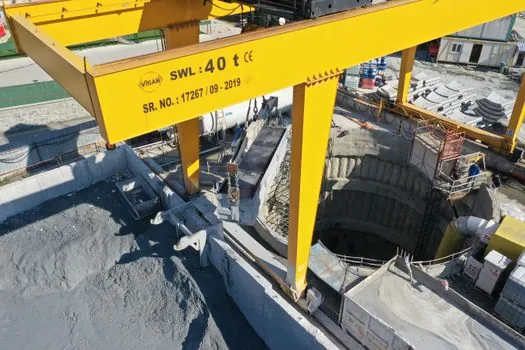
When the lift is below 15 t and the span is under 24 m, single-girder top running delivers the lowest installed cost and the lightest runway load, which matters when the gantry steel is hanging off the TBM back-up. When the lift is 15 to 40 t or the span pushes past 24 m, double-girder top running is the only safe answer because the hoist sits between the girders, freeing vertical hook path and letting the trolley carry a heavier segment erector head [S2][S3].
Underhung single-girder fits the inside-tunnel transfer case where the runway is already in the steel and the segment lifter is light, but it is the wrong choice for portal yards where the crane runs outdoors in rain and dust. For portal-side segment storage, a gantry crane on rails is often paired with an overhead bridge crane on the shaft top so that one handles yard stacking and the other feeds the shaft. A crane scale hung between the hook and the segment sling closes the load-verification loop and should be specified for any 10 t and above lift, because overload protection alone does not log the actual lifted mass [S7].
Environment, Power, and What the Spec Often Misses
Tunnel humidity routinely runs 80 to 95% RH, so hoist enclosure, brake covers, and control panel rating should be IP55 minimum, with stainless or hot-dip galvanized wire rope recommended for the segment-lifter hoist [S7]. Power is usually 400 to 480 V three-phase from the TBM substation, and a crane-side isolation transformer plus a phase monitor is cheap insurance against the voltage dips that fire when the TBM cutter head stalls.
Buyers commonly overlook runway alignment tolerance (typically ±3 mm across the span), the need for buffer end-stops at both runways, and the fact that radio control antennas suffer inside a curved tunnel, which pushes operators back to pendant control for the first 200 m of bore. Lighting below 50 lux at the hook is another recurring miss: a LED hook-side lamp rated for tunnel humidity costs almost nothing and prevents the most common dropped-segment cause, which is operator misjudgement under low light [S7].
Trackable signals over the next quarter: tenders for double-girder top-running bridge cranes paired with segment feeders on metro and high-speed rail bores, and an uptick in retrofit jobs adding VFDs and overload data loggers to existing underhung cranes inside operational tunnels. For related kit on the same jobsite, see tank container selection for tunneling slurry and grout and the broader overhead conveyor reference for spoil-handling layouts.