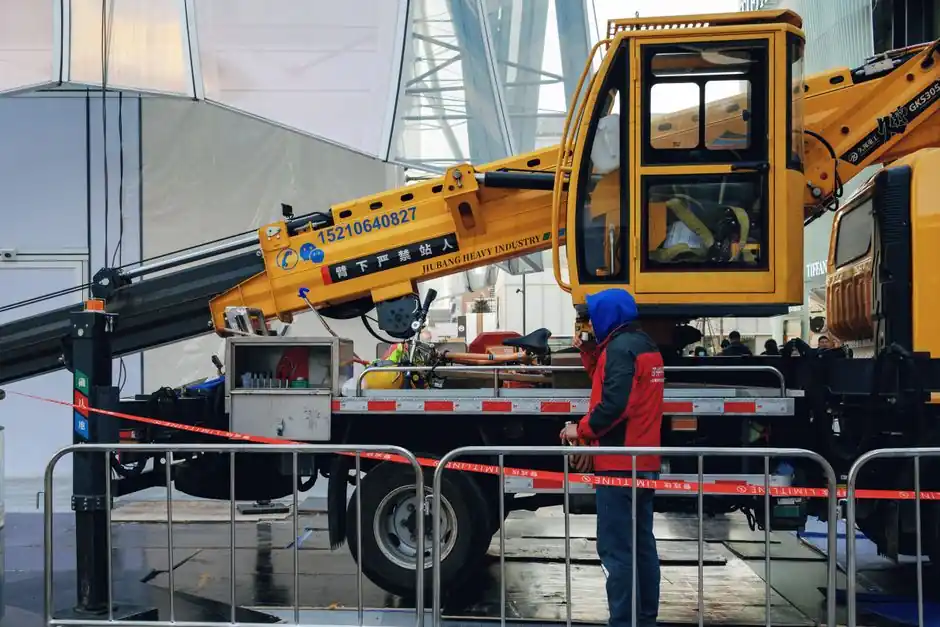
The defining split between truck-mounted (mobile) cranes and crawler cranes is the undercarriage: steel crawler tracks versus rubber tires on a truck chassis, and that single design choice drives everything else from capacity to mobilization cost [S1][S2].
Published capacity bands put crawler units at roughly 50–3,000+ tons and truck-mounted units at 25–1,200+ tons, with the upper end of each class reserved for lattice-boom configurations used on infrastructure and energy projects [S1]. The 2024 lattice-boom comparison from operator-school.com highlights a 1,000-ton crawler (Liebherr LR 11000) with 11 m minimum radius and 168 m maximum boom length, numbers that exceed any road-going truck crane in production today [S5].
Undercarriage and Ground Pressure
Crawler cranes distribute load through steel track shoes, keeping ground bearing pressure low enough to operate on soft, muddy, or unprepared ground without sinking, and they walk around the jobsite under their own power without outriggers [S1][S4]. Truck cranes, by contrast, sit on rubber tires and must deploy hydraulic outriggers before any rated lift, with the outrigger pads dictating the actual ground-bearing requirement on every setup [S1][S2]. The structural logic is straightforward: crawlers pour mass into a wide track frame for stability, truck cranes pour mass into a road-legal axle configuration for transit [S1].
All-terrain truck cranes fall into the same mobility bucket as standard truck-mounted units for road travel, but add multi-axle steering and higher axle loads so they can both drive on highways and enter rough pads, a capability that does not close the gap to a track-mounted machine for true off-road lifting [S2].
Capacity, Reach, and Boom Architecture
Crawler cranes almost always run lattice booms (pin-connected steel sections), which is what allows the LR 11000 to reach 168 m and lift 1,000 t at short radius [S5]. Truck cranes more typically run telescopic hydraulic booms because the boom has to fold inside a road-travel envelope, with lattice options reserved for the largest all-terrain or heavy-duty truck models [S1][S5]. A practical consequence: the longer and heavier the boom configuration, the more a crawler is favored, because truck-crane telescopic sections add weight high in the air that penalizes capacity charts at long radius [S1].
Crawler side-by-side data: LR 11000 example reaches 168 m on a lattice boom and lifts 1,000 t at 11 m, with a slewing bearing, dual track rolls, and a EURO III diesel powerpack [S5]. Truck-mounted lattice booms from Link-Belt sit in a lower capacity class, offer shorter boom lengths, can travel on roads without special permits in most jurisdictions, and on selected models add hybrid diesel-electric drive [S5].
Mobilization, Setup, and Cycle Time

Truck cranes are the obvious winner on mobilization: they self-drive to site at highway speed, position with outriggers, lift, retract, and drive to the next call, all in the same shift [S1][S2]. Crawler cranes cannot legally or practically travel on public roads at speed, so they ship on low-bed trailers, assemble on site with a crawler-mounted or auxiliary crane, and then need a teardown sequence for the next move, which is why they are described as slower to mobilize and more time-consuming to set up [S1][S4].
The setup cost asymmetry is one of the few places the truck crane is the more economical unit despite its lower capacity, and is the main reason short-duration, multi-site work routes to truck-mounted machines while multi-month site stays route to crawlers [S1][S5].
Ground Adaptability and Soft-Site Performance
On soft, uneven, or prepared subgrade, crawlers walk a load with the tracks engaged and stay stable; the wide track base is the stability system, not a deployable one [S1][S4]. Truck cranes must find level, firm footing for outrigger pads; soft or saturated ground forces the operator to use mats, cribbing, or to refuse the lift, because the outrigger pad can punch through under a heavy load [S1]. All-terrain truck cranes improve on rough-pad access but still need outrigger deployment for the rated lift, so the fundamental soft-ground penalty remains [S2].
For wind-farm construction, bridge piers, and large industrial plant work, this soft-ground advantage is decisive, which is why crawler cranes are the default for those sectors [S1][S4].
Decision Matrix: Crawler vs Truck Crane
Use the four-criterion cut below to shortlist before looking at specific model charts: [S4]
1. Capacity requirement above ~1,200 t: crawlers only, because no production truck crane matches the top of the crawler range [S1]. 2. Frequent relocation between sites in a working week: truck crane, because self-drive capability cuts mobilization to a road trip instead of a multi-trailer convoy [S1][S2]. 3. Soft, muddy, or unprepared ground for the full project duration: crawler, because it walks the load with no outrigger setup [S1][S4]. 4. Long reach above 100 m on heavy lifts: crawler lattice boom, with the LR 11000 class demonstrating 168 m reach at scale [S5].
If a project hits criteria 1, 3, and 4 together, a crawler is essentially mandatory; if it hits criterion 2 only, a truck-mounted or all-terrain unit is the lower-cost answer [S1][S5].
Who Should NOT Pick a Crawler Crane
Short urban lifts, municipal utility work, and any job that needs the crane to arrive, lift, and leave inside a single shift penalize crawler economics hard, because the disassembly-reassembly cycle wipes out the per-day lift-cost advantage over a truck crane [S1][S4]. The same logic applies when road access is the only way onto site, since low-bed trailers and the permit choreography they trigger add days that a self-driving truck crane avoids [S1][S2].
Limits, Failure Modes, and Sourcing Signals
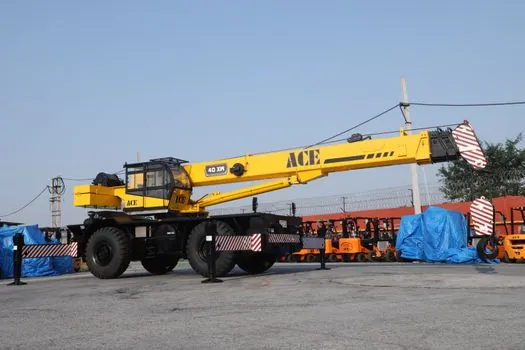
Operator guidance and OEM comparison pages both flag the same failure mode for truck cranes: outrigger pad punch-through on poorly prepared ground, and tire or axle load limits that constrain road travel below the rated lifting capacity [S1]. For crawler cranes the flagged risk is mobilization cost and time when the project duration drops below roughly 1-2 months, where the fixed setup overhead is not amortized [S4][S5].
For project engineers working on wind-farm and infrastructure sites, the Wind Turbine Blade Cost Breakdown: Materials, Labor, Tooling guide maps the same crawler-heavy lift profile onto wind-installation economics, and the Skid Steer Loader vs Asphalt Paver comparison is a useful parallel for the dedicated-vs-carrier equipment decision that runs through this truck-vs-crawler choice as well. Truck-mounted units are also relevant to readers comparing them to the broader truck-mounted crane and crawler crane categories in the spec encyclopedia, since the trade-off covered here is the central spec axis on both product pages.
Trackable signals over the next planning cycle: (a) hybrid and electric drive options on truck-mounted lattice units expanding beyond Link-Belt's current offering, as flagged in the 2024 comparison [S5]; (b) any expansion of crawler capacity beyond the 3,000+ t ceiling as wind-installation and large-module construction projects continue to scale [S1].
Detailed specification references: dump truck.