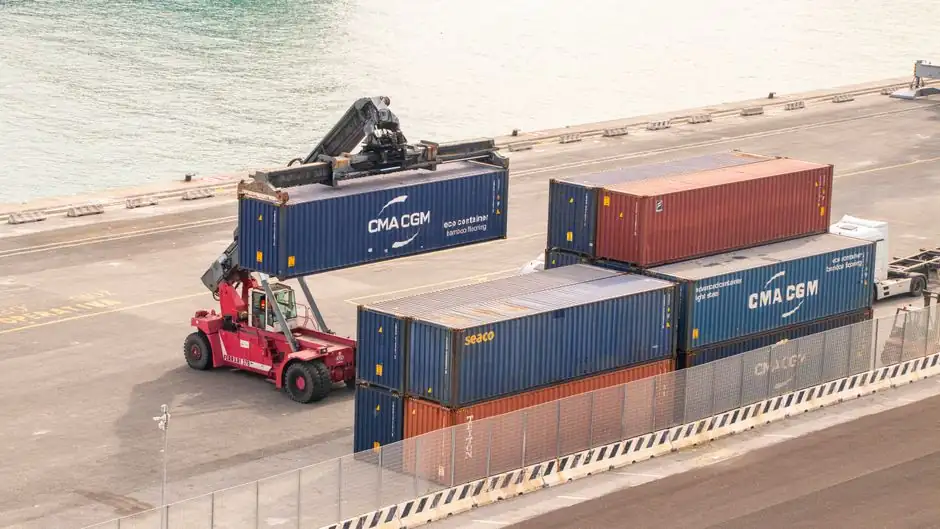
For port and terminal buyers, a truck-mounted crane is most often chosen for two operational slots: feeder berth or multi-purpose quay work, and intra-terminal / intermodal yard support. Mainstream knuckle-boom and telescopic-bom units in the 20 to 50 ton lifting class remain the workhorse, with straight-telescopic boom machines taking on the heavier 60 to 100+ ton class for project and break-bulk lifts [S3].
Specifications and lifting claims referenced in this article draw on the 2026 manufacturer and integrator literature for STS, RTG, RMG, mobile harbor and grab-style cranes [S2][S3][S4], where cycle-time and capacity benchmarks for adjacent equipment set the throughput ceiling that a truck-mounted unit is expected to feed or relieve. Operators planning new feeder berths, mixed-cargo quays, or auxiliary yard fleets should treat chassis class, boom geometry, outrigger spread, and counterweight removal as primary selection variables.
Where a truck-mounted crane fits in the port equipment mix
Truck-mounted cranes do not compete head-on with ship-to-shore (STS) container cranes: STS units deliver 25 to 40 moves per crane hour with 30 to 75 ton hoists and 60 to 72 meter outreach across ULCV beams, work that a mobile boom on a truck chassis cannot replicate [S2][S4]. Their role is downstream, where 1 to 4 cycles per minute on short radii pay for the asset.
Typical positioning roles: handling single boxes on feeder loops where STS dwell time is too costly to allocate; supporting ro-ro and break-bulk berths where reach 8 to 22 m and pick weight 10 to 35 tons cover most unit lifts; and yard support between container yard equipment and stack faces, where a 3- or 4-axle carrier can reposition without rail or dedicated gantry infrastructure [S3].
Boom type and capacity class: knuckle vs telescopic
Knuckle-boom (articulating) truck-mounted cranes dominate the 20 to 50 ton class because the folded geometry allows a short wheelbase chassis to deliver 18 to 28 m of working radius while parking inside a 20 to 25 ft container footprint, useful on congested quay aprons. Telescopic boom units take over above 50 tons, where straight-boom rigidity under full-extension load charts beats an articulated rig on heavy project lifts [S2].
For container handling, the most commonly specified truck-mounted configuration in current manufacturer literature is a 3-axle carrier with a 30 to 40 ton knuckle boom, paired with a hydraulic container spreader or hook block. For bulk and bagged cargo, the same chassis can be reconfigured with a grab or clamshell bucket rated to roughly 40% of the crane's maximum lift, matching the grab-crane duty cycles documented at bulk terminals [S4].
Selection criteria: chassis, outriggers, reach, and cycle
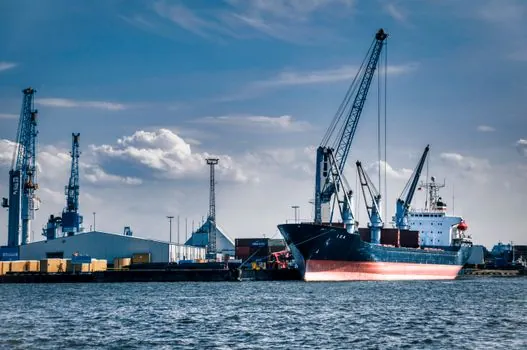
Four engineering gates drive a port-spec truck-mounted crane order. First, chassis class: a 4-axle carrier is generally required above 40 ton lift to keep axle-load limits inside road and quay-apron regulations. Second, outrigger spread: full-span outriggers at 7.0 to 8.5 m are typical in this class, and any radius chart the buyer accepts must be tied to a specific outrigger configuration, not a generic maximum. [S2]
Third, working radius and lift at radius: a 20 m radius with 8 to 12 ton residual is the practical minimum for STS-support work; for multi-purpose berth duty, 28 to 35 m radius charts above 4 tons are more typical. Fourth, duty cycle and hoist line speed: 80 to 120 m/min main hoist with two-speed or variable-frequency control is the current baseline, while slow-speed precision modes below 10 m/min are needed for tandem or personnel-rated lifts [S2][S3].
Comparison: knuckle boom vs telescopic boom vs MHC support role
Against the 3 main options port buyers weigh, the trade is sharp. Knuckle-boom truck-mounted (20-50 t class): low stowed height, tight apron footprint, strong at 10-22 m radius, weaker above 28 m; price and operating cost lower than telescopic in the same class. Telescopic-boom truck-mounted (50-100+ t class): straight long-reach charts, best for project and break-bulk lifts, larger parking footprint, higher mobilization cost per move. [S3]
Mobile harbor crane (MHC) on dedicated crawler or wheeled portal (40-125 t class [S2]): higher continuous-duty rating, ship-side reach often 30-40 m, but the unit is not a road-going truck and cannot be repositioned between berths at highway speed. For terminals with frequent berth-to-berth redeployment, a truck-mounted crane is the more flexible tool; for sustained berth duty, an MHC is the heavier-duty investment [S2][S4].
Operational constraints and failure modes in terminal service
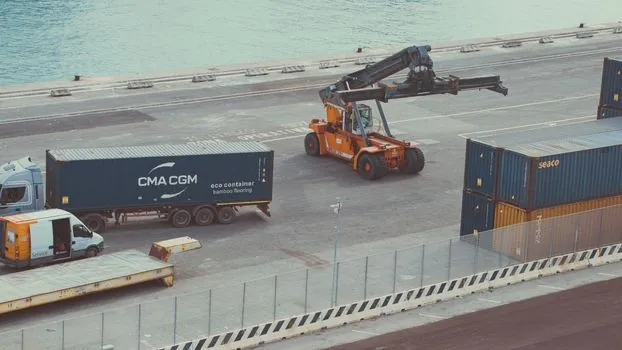
Two failure modes are common in port-deployed truck-mounted cranes. Outrigger settling on resurfaced or asphalt-surfaced quay aprons produces load-chart drift mid-lift; operators report this in third-party incident reviews on mixed-cargo berths, and the fix is either load-spreading mats or a hard-standing outrigger pad plan. Second, hydraulic contamination from salt-air exposure accelerates boom-cylinder seal wear, which shortens the typical 8-12 year service life that operators budget for in this class [S4].
Wind and visibility limits are stricter in port environments than in general construction. Most OEMs derate above 20 m/s (72 km/h) gusts and many terminals impose their own stop-work threshold at 15-17 m/s. Lighting and operator-cab glazing must be rated for marine glare, which is why port-spec cabs differ from general construction machinery and equipment cabs even on the same chassis [S2].
Standards, sourcing, and procurement checks
Port-side truck-mounted cranes should be ordered to a recognized crane-design standard (FEM 1.001 / EN 13000 for the crane, with the carrier chassis to its own commercial-vehicle type approval) and to a recognized safety standard such as ISO 4309 for in-service inspection. Buyers should also insist on manufacturer load-chart documentation for every outrigger configuration the unit will be operated in, since generic charts are a common procurement pitfall [S3].
For terminals with existing fleets, the most useful procurement data point is the cycle-time map: a 30 ton knuckle-boom unit, properly charted, should sustain 4-6 lift-and-place cycles per hour at 15 m radius in single-box container duty, which is the realistic benchmark when sizing auxiliary fleets against STS core capacity [S2][S4].
Use cases that fit and use cases that do not
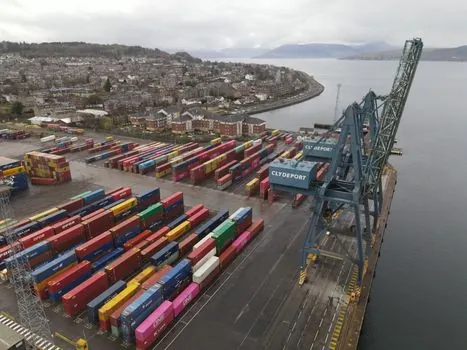
A truck-mounted crane earns its place in: feeder berth and small-craft container handling; ro-ro and general-cargo quay service; intermodal yard support; and project-cargo work where a single unit is cheaper to mobilize than a full MHC. It does not replace STS on a ULCV berth, does not match a rail-mounted gantry on yard density, and is a poor substitute for a mobile harbor crane on sustained bulk grabs [S2][S4].
Buyers weighing an order should also cross-reference adjacent equipment guidance: this site covers truck-mounted concrete pump selection for yard civil works, and the recent port-side backhoe loader buying map is a useful comparator for auxiliary carrier-class machinery at the same berths. If the work profile leans toward milling or pavement repair on quay aprons, the port cold milling machine selection guide addresses a closely related specification path.
Trackable signals for the next 6 months
Two procurement signals are worth watching. First, manufacturer release of 2026 model-year knuckle-boom load charts at the 25-30 m radius band, which is where most port-spec orders currently fall short of published maximums. Second, terminal-side RFP activity around 4-axle carriers in the 40-50 ton class, since that chassis class is the capacity ceiling at which most European port operators' axle-load regulations still permit unrestricted road movement. [S2]