
Wall saws and wire saws fitted with diamond-segmented blades carry the structural cutting load in modern tunnel construction, with handheld circular saws reserved for invert trimming, utility penetrations, and timber formwork [S1].
Specifiers should treat the circular saw as part of an integrated cutting, crushing, and splitting workflow rather than a standalone tool, because the sequence of saw cut followed by controlled demolition dictates both kerf quality and downstream equipment sizing [S1]. For broader context on tool categories used underground, the construction tools reference frames where circular saws sit against pulverizers, splitters, and rock drills.
Tunnel Workloads That Actually Need a Circular Saw
Tunnel circular saw applications split into three load profiles: structural openings (cross-passages, niche cuts, door frames), invert and crown trimming after TBM or drill-and-blast advance, and utility/service penetrations for drainage, ventilation ducts, and cable trays [S1]. Structural openings demand dimensional accuracy and clean kerfs, because overcut translates directly into extra shotcrete volume and rebar congestion.
Trimming after advance is throughput-driven: crews want aggressive cutting speed in reinforced concrete segments and sprayed-concrete linings, with controlled spalling on the visible face. Utility penetrations are repeatability-driven, with dozens of small-diameter cuts per shift where handheld or small track-mounted saws outperform wall saws on cycle time [S1].
Cordless handheld circular saws in the 5-1/2 in to 7-1/4 in class typically deliver blade speeds and cut depths suitable only for formwork timber, plywood, and thin steel; they cannot meet tunnel-section kerf tolerances in mineral material [S2][S3]. For TBM segment trimming and invert rebar cuts, the spec ceiling is a rail-guided wall saw with water-fed diamond segments.
Diamond Wall Saws vs Wire Saws vs Handheld: Spec Comparison
Wall saws (rail-guided, track-mounted) offer the best combination of cut depth, squareness, and repeatability for tunnel structural openings, with typical cut depths of 250-500 mm per side on standard units and deeper with staged passes [S1]. Wire saws handle large cross-section cuts (full tunnel profile removal in caverns) where wall saws cannot reach; they pull a continuous diamond-impregnated wire through pilot-drilled channels and cut by abrasion rather than chip formation.
Handheld circular saws, even the 7-1/4 in corded sidewinder class (for example the Skil 5280-01 at 2.5 hp / 8.1 lb, 0-45 deg bevel with positive stop) are limited to roughly 2-5/8 in cut depth at 90 deg, which covers formwork and rebar stub trimming but not primary structural cuts in tunnel concrete [S3]. A criteria-based comparison follows:
Decision matrix (criteria 1-4): (1) Maximum cut depth per pass: wall saw 250-500+ mm, wire saw unlimited (cable-pulled, not stroke-limited), handheld 60-70 mm at 7-1/4 in blade. (2) Kerf squareness on long cuts: wall saw best (rail-rigid), wire saw good (guided by pilot holes), handheld weakest (operator-dependent). (3) Setup time per cut: handheld lowest, wall saw moderate (rail mount), wire saw highest (pilot drilling + rigging). (4) Cost per linear meter of cut in reinforced concrete: handheld lowest for shallow cuts, wall saw mid, wire saw highest but justified for full-section removals [S1][S3].
For deeper context on how the wall saw class compares to other heavy cutting equipment used in civil works, the construction machinery and equipment reference covers adjacent categories such as rock splitters and pulverizers that typically follow the saw cut.
Blade Bond, Segment Height, and Aggregate Matching

Bond hardness must be matched to aggregate abrasion: softer bonds for hard, dense aggregates (silica-rich granite, basalt), harder bonds for abrasive, soft aggregates (limestone, lightweight concrete) [S1]. A misapplied bond either polishes (bond too hard, diamonds glaze over) or wears rapidly (bond too soft, segment collapses), both of which kill cutting rate and segment life in tunnel service.
For heavily reinforced tunnel segments and invert rebar mats, segment-protecting shoulders and high-temperature-resistant bonds extend blade life, because steel contact spikes segment temperature and accelerates diamond pull-out [S1]. Segment height is the wear reservoir: typical tunnel-spec diamond segments run 8-12 mm new height, with set-down limits at 2-3 mm to prevent segment-base damage to the steel core.
Carbide-tipped blades are reserved for timber formwork, plywood, and thin-gauge steel strapping; they are not specified for mineral cutting in tunnel service [S5]. Standard framing blades bundled with consumer circular saws are tuned for fast rip cuts in dimension lumber and produce unacceptable edge quality in concrete or stone [S2].
Power Source: Hydraulic, Electric, or Cordless
Hydraulic-driven wall saws are the tunnel default because the carrier excavator or power pack already supplies high-flow hydraulics, eliminating the need for separate electric service in the heading and allowing intrinsically safe operation in gassy classifications [S1]. Electric wall saws (3-phase, 400 V) are common in finished tunnel sections during fit-out, where dust and noise constraints favor lower-vibration operation and mains power is available.
Cordless handheld circular saws in the 18-20 V class (for example the 5-1/2 in Ryobi PCL500B at 8.0 / 10 cross-cut score, battery-powered with up to 1-11/16 in depth at 90 deg) are useful for formwork and trim carpentry but lack the sustained torque for continuous mineral cutting [S3]. In the 7-1/4 in corded sidewinder segment, brushless motors and blade brakes are still not universal; the Skil 5280-01 reviewed in February 2026 ships with a brushed motor and no blade brake, indicating where the entry-level price point sits [S3].
For typical formwork and finishing applications, the circular saw page in the encyclopedia covers blade geometry, bevel range, and shoe material options that matter for handheld selection.
Water Management, Dust, and Slurry Control

Wet cutting is mandatory in tunnel concrete and stone: it cools the diamond segments, binds respirable crystalline silica dust, and carries fines out of the kerf as slurry [S1]. Water flow must be matched to blade diameter and feed rate; insufficient flow glazes the segment, while excess flow wastes slurry capacity and floods the worksite.
Slurry routing and retention must be planned into the cut sequence, because the resulting water-cement-fines mixture is a waste stream with disposal cost and pH concerns in many jurisdictions [S1]. Wall saw heads and wire saw guides are designed to retain slurry at the cut face, while handheld dry-cutting is restricted to wood and steel applications.
For handheld dry cutting of steel, the circular saw trade-offs reference covers blade selection and dust extraction interface points that apply to fit-out crews cutting unistrut, conduit, and small-section steel in finished tunnel zones.
Specifying Cut Depth, Bevel, and Rail Guidance
For wall saws, cut depth per side is governed by blade diameter and head stroke, with 800-1600 mm blades common for tunnel cross-passage work. Pass planning on thicker sections stages multiple cuts to maintain segment cooling and avoid core jamming. Bevel cuts are achievable but require angle-indexed rail mounts; the 0-45 deg positive stop found on handheld saws is not a substitute for rail-indexed accuracy on structural cuts [S3][S4].
Handheld bevel capacity above 45 deg is rare; standard units stop at 45-50 deg with positive detents at 0, 15, 22.5, 30, and 45 or 52 deg, while entry-level battery saws sometimes cannot complete a 45 deg pass through 2-by stock at full depth [S3][S4]. Shoe material (steel, aluminum, magnesium) affects weight and flatness retention; magnesium shoes hold accuracy better after drops but cost more, while steel shoes can bend on impact and throw the saw out of square [S4].
For follow-on cost analysis that goes beyond the purchase price, the circular saw TCO breakdown covers blade replacement frequency, slurry disposal, and downtime allocation in fleet budgets.
Limitations and Failure Modes to Spec Against
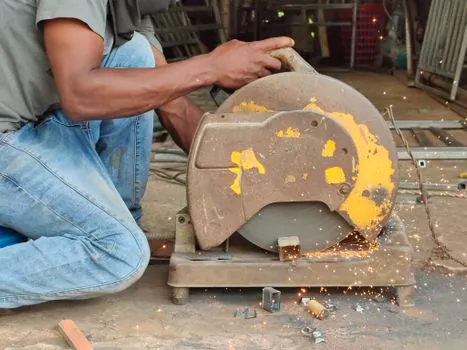
Handheld circular saws fail in tunnel service when the workload exceeds their thermal and torque envelope: stalled motors, glazed blades, and segment delamination are the common signatures. Operators compensate by feeding too slowly, which burns the segment bond without cutting, or by forcing the cut, which bends the blade and ruins squareness [S1][S4].
Wall saw and wire saw failure modes center on segment life: under-watering, mismatched bond, contaminated cooling water, and excessive feed force all collapse segment life well below manufacturer curves. Pilot-hole misalignment on wire saws causes wire breakage, a high-cost event that pulls the cut offline and damages adjacent concrete.
Where handheld saws are the only option, the marble cutter types reference is relevant for finish crews cutting tile, stone cladding, and architectural finishes inside the tunnel envelope.
For procurement teams building a fleet spec, the next node to track is the shift toward higher-amp brushless motors in the 7-1/4 in cordless class, where voltage and battery cell chemistry now rival 15-amp corded units on rip cuts. A second trackable signal is the wider adoption of Ethernet-APL and IO-Link wireless telematics on hydraulic wall saw heads, which let site engineers log kerf depth, water flow, and segment wear in real time and predict blade change-out before segment-base damage.