Upstream of any industrial UPS sits a narrow chain of power-electronics subassemblies — IGBT modules, lithium-ion or VRLA cells, magnetic cores, DSP control boards — and a wider set of downstream verticals that consume the conditioned output. ABB positions modular UPS architectures specifically for 24/7 control rooms and plant-level digitalization environments where distributed control systems (DCS) drive continuous operation [S1].
The term "upstream and downstream" carries different weight in different fields; in agricultural economics it describes land/labour substitution (Springer, 1989) [S2], and in NGINX it denotes a server-pool directive with a `slow_start` parameter, which is invalid in hash and random load-balancing modes [S3]. In a power-quality context the same logic applies — UPS is the buffer that decouples grid-side hardware (upstream) from critical loads (downstream).
Upstream Layer: Power-Electronics Component Supply
The upstream chain for a modern double-conversion UPS starts at the semiconductor level: 600–1700 V IGBT modules from Infineon, Mitsubishi, Fuji, and STMicroelectronics, with SiC MOSFETs appearing in the >20 kW efficiency tier. Below the inverter bridge sit DSP control boards (typically TI C2000 or Infineon Aurix), toroidal or cut-core transformers sized in kVA, and an energy-storage string — historically VRLA 12 V blocks in series strings of 32–40 units for a 384–480 V DC bus, increasingly replaced by lithium iron phosphate (LFP) racks with BMS and CAN-bus telemetry. ABB's modular UPS line is a representative downstream consumer of these upstream subassemblies, and is sold into 24/7 control rooms alongside the vendor's Distributed Control System portfolio [S1]. Module-level parallelability (N+1 redundancy at the frame, not the whole UPS) is now the procurement norm for data-center and process-control buyers; that one architectural choice reshapes the upstream BOM because each module carries its own static bypass, controller, and battery breaker.
Downstream Layer 1: Data Centers and Edge Compute
Data halls remain the largest single downstream sink by revenue. Tier III/IV designs require concurrently maintainable UPS topologies with 99.999% availability targets, which translates into 2N or N+1 module-level redundancy and a minimum 12-minute battery autonomy at nameplate load. The same modular philosophy that ABB applies to control-room UPS [S1] is now standard for colocation, hyperscale, and on-premise edge builds.
Downstream Layer 2: Industrial Process, Manufacturing, and ASRS
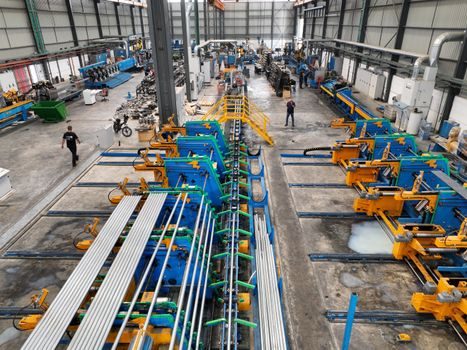
Process plants and discrete-factory lines form the second major downstream lane. ASRS systems — automated storage and retrieval stacks for high-bay warehouses — are particularly load-sensitive: a 100–500 ms sag during a shuttle transfer can drop a tote, corrupt a pick transaction, or trigger a stacker-crane E-stop. Specifying UPS for these cells typically means online double-conversion (VFI-SS-111 per IEC 62040-3 class language) with ride-through of at least 10 cycles plus a generator handoff window. Shuttle systems inside tote flow racks demand the same ride-through because the rack rail's busbar commutation cannot tolerate a brownout. Procurement teams should look for the IEC 62040-3 classification line on the nameplate, not just the kVA rating. [S2]
Downstream Layer 3: Logistics, Sorting, and Fire Infrastructure
Parcel and e-commerce fulfillment is a fast-growing downstream vertical. Sorting systems — cross-belt, shoe, and tilt-tray sorters — are driven by servo inverters that fault on undervoltage excursions below about 85% nominal, so the UPS must hold the conveyor and sorter bus steady through grid events. Adjacent to these, sprinkler system pump rooms, fire-alarm panels, and smoke-control dampers are mandatory downstream loads governed by local fire codes (typically NFPA 20 in the US, EN 12845 in Europe); these are usually backed by a separate, smaller, very-long-autonomy UPS, not the main process UPS. Mixing fire-life-safety and process loads on one UPS is a common spec mistake because battery sizing, autonomy, and maintenance windows diverge. [S1]
Component, Topology, and Autonomy Comparison
Three sub-questions drive most UPS specs. First, topology: online double-conversion (VFI) gives zero transfer time and is mandatory for IT/ASRS/sorter loads; line-interactive is acceptable only for office-grade or non-critical control panels. Second, energy storage: VRLA is the low-cost default, LFP wins on footprint and 10-year TCO, and nickel-zinc or supercap hybrids cover sub-cycle ride-through for laser tools and semiconductor fab tools. Third, autonomy: 5–15 minutes for generator-handoff applications, 30 minutes to several hours for fire pumps and remote telecom sites. The wrong pick on any of these axes shows up as either a nuisance trip (overspec'd topology) or a thermal runaway / dropped-load event (underspec'd storage). [S2]
Limitations, Failure Modes, and Sourcing Constraints
Three failure modes dominate the field. First, battery mismatch — mixing old and new VRLA blocks in a string causes the weakest cell to dictate runtime, and a single reversed cell can take down the whole string. Second, fan and electrolytic-cap aging — UPS fans are typically rated 5–7 years, electrolytics 7–10 years, and missing the replacement window is the most common root cause of a 7-year-old UPS failure. Third, the "hidden" downstream load — facility teams add a new server rack or a new condition monitoring system node without re-validating UPS sizing, and the nameplate is silently exceeded. On the supply side, lead times for large three-phase frames stretched into 30–50 weeks during the 2024–2025 component crunch, and that pressure has not fully receded. [S1]
Standards Governing the Interface
The interface between UPS hardware and its load is governed by a small set of standards. IEC 62040-3 defines the UPS performance classification (VFI, VI, VFD) and the test method for output under dynamic load. IEEE 1188 and IEEE 1187 cover VRLA battery installation and maintenance. NFPA 20 and EN 12845 govern fire-pump power supplies. UL 924 covers emergency lighting equipment. For hazardous-area process plants, ATEX 2014/34/EU and the IEC 60079 series apply to the UPS enclosure and any associated cabling glands. The procurement question is not whether the UPS carries these marks, but whether each downstream load sub-system references the correct sub-clause. [S2]
Two trackable signals will shape the next planning window. First, lithium-iron-phosphate cell pricing and the 2026 update of the IEC 62619 industrial lithium standard, which several cell vendors are aligning to. Second, the rollout of grid-forming inverter behavior in UPS firmware, which lets a single UPS island a load segment during a grid event — a feature most modern modular frames now expose as a firmware option. Buyers comparing 2026 quotes should confirm both the cell chemistry on the BOM and whether grid-forming firmware is licensed on the controller.
Background reading: UPS System Supply Chain 2026: Tariff Refunds, ICS2 Release 3, and Logistics-Tech Sourcing.