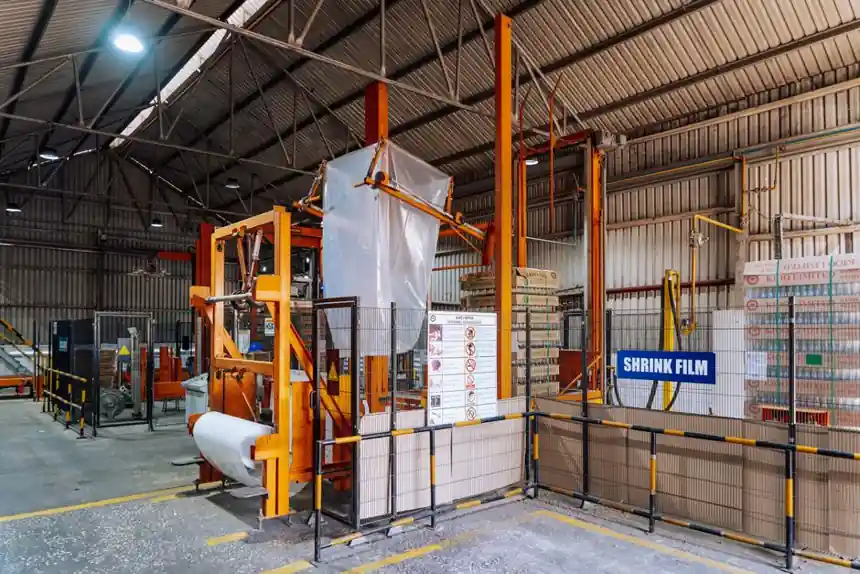
Vibrating conveyors carry dry, free-flowing and packaged loads across a 100–1,500 mm trough width at rates between roughly 1 and 50 t/h, with electromagnetic drives running at 3,600 rpm and eccentric-mass units at 600–1,200 rpm [S1].
Boston Conveyor & Automation (BCA), a U.S. integrator in food & beverage, life sciences and general industry, was acquired by Mpac Group on 30 July 2026, expanding Mpac’s conveyor and robotic-pick portfolio across North America [S1]. Honeywell Intelligrated, reorganised under the “Trew, Transnorm, Intelligrated” three-brand structure, continues to position itself as a full warehouse-automation systems integrator targeting labour-short distribution centres [S3][S5].
Definition and Scope Inside a Warehouse-Automation Stack
Vibrating conveyors, in industrial-automation taxonomy, are a sub-class of material-handling equipment that move product through controlled linear or circular oscillation of a trough or pan, rather than through a continuous belt, chain, or pneumatic airstream. Compared with a belt conveyor, the vibrating unit has no moving pull member; the deck itself is the oscillating mass. Compared with a chain conveyor, it does not need oil-lubricated chain or sprockets, which is the reason it is repeatedly specified for food, pharma and electronics lines that must stay lubricant-free [S1].
The deck is typically sized from 100 mm (small parts feeders) up to 1,500 mm (palletised-case or bulk-bag duty), with throughputs most often quoted between 1 and 50 t/h on dry bulk; throughput drops sharply with sticky, moist or fibrous material. Standard sub-types shipped by integrators include linear vibrating, trough or tube, and spiral-elevator versions, and they can be supplied in mild steel, 304 stainless, or 316 stainless for washdown and corrosive-product duty [S1]. The defining mechanical variables are amplitude (3–12 mm peak-to-peak) and frequency (electromagnetic 50–60 Hz line / 3,000–3,600 rpm, eccentric 600–1,200 rpm); a 60 Hz electromagnetic drive with 6 mm amplitude is a common mid-range warehouse-automation default.
Selection Criteria a Spec Sheet Must Lock Down
Bulk density of the handled load is the first number to write on the spec: most electromagnetic-drive vibrating conveyors are economical between 0.3 and 2.0 t/m³; outside that band the trough cross-section, drive size and spring rate all change, and so does the price band [S1]. Particle size and shape set the trough width: a rule of thumb engineers use is that the largest lump should not exceed one-third of the trough width to avoid impact damage and erratic metering.
Four hard spec numbers typically anchor a request for quotation: (1) trough width, (2) centre-to-centre length, (3) required mass flow in t/h, and (4) deck material grade. To those add three engineering choices: drive type (electromagnetic vs unbalanced-motor eccentric), amplitude (3–12 mm) and inclination (0–5° for conveying, 5–10° for uphill metering). For comparison, a pneumatic conveyor handles the same tonnage but needs an air supply, filter receiver and rotary valve, and a belt conveyor needs more headroom, belt-tracking maintenance and a take-up. The vibrating unit, in return, asks for elastomer isolation springs and a clean, dry deck.
Who It Is For and Where It Fails

Vibrating conveyors are the right tool for warehouses and light-manufacturing lines moving dry snack foods, frozen vegetables, coffee beans, pharmaceutical tablets, electronic components and small parcel totes, and for any cell where oil contamination from a chain conveyor would fail an audit [S1]. BCA, now part of Mpac Group, explicitly lists food & beverage, life sciences and general industry as its conveyor focus, which matches the vibrating unit’s natural strengths [S1].
They are the wrong tool for sticky, wet, or fibrous bulk (sludge, fresh-cut fruit, meat trimmings), for any product with a static load above roughly 150 kg per metre of trough, and for very long horizontal hauls beyond 8–10 m, where a belt conveyor or a pneumatic conveyor becomes cheaper per metre. Headroom, noise (typical 75–85 dBA at 1 m, higher on eccentric drives) and the need to anchor the spring frame to a rigid base are the other typical reasons a project team drops the option. For an automotive-parts parallel, see the vibrating conveyor spec map for automotive-parts logistics.
Comparison Against Belt, Chain and Pneumatic Conveyors
On four decision criteria a warehouse-automation spec sheet normally weighs, vibrating conveyors score as follows: (1) clean-room / washdown suitability: best in class, no oil and full 316 stainless option; (2) capital cost per metre: lower than a pneumatic conveyor but higher than a basic belt conveyor for the same length; (3) energy per tonne moved: 0.05–0.2 kWh/t on electromagnetic drives, broadly comparable to belt; (4) maintenance: no belt to track, no chain to tension, only the drive bearings (grease interval typically 4,000 h) and the isolation springs. For a deeper side-by-side, the chain conveyor vs conveyor chain spec map is a useful reference on the chain side of the same decision space. [S1]
One concrete BCA case study on its site is a 304 stainless linear vibrating conveyor, 600 mm trough width, 4 m long, 3.6 kW electromagnetic drive, running snack-food bags at 8 t/h into a robotic pick-cell; the same line on a belt would have needed 6 m of belt, a head pulley, a tail take-up and a separate scraper. Honeywell Intelligrated, by contrast, sells the broader vibrating conveyor, belt and overhead-conveyor stack as part of a single warehouse-automation envelope, with software on top for order flow and slotting [S2][S3].
Standards, Sourcing and System Integration
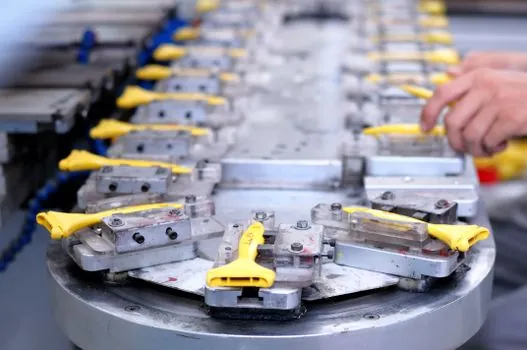
There is no single global standard for vibrating conveyor geometry; integrators instead build to ISO 5049 (resilient-mount vibrating conveyors with rectangular or tubular troughs for horizontal and inclined conveying) and to ATEX 2014/34/EU when the duty zone is classified, with FDA-grade UHMW or nylon liners for direct food contact [S1]. Electrical panels generally ship to UL 508A (North America) or IEC 61439-1 (rest of world). Sourcing from a systems integrator such as BCA (now Mpac) or from Honeywell Intelligrated typically bundles the conveyor, the drive cabinet and the robot or pick-cell controls under one warranty, which is the procurement model warehouse-automation customers in 2026 increasingly prefer [S1][S3].
The practical spec checklist on a 2026 RFQ therefore reads: trough material (304/316 SS), drive type (electromagnetic vs eccentric), amplitude and frequency, throughput in t/h, total length and lift, washdown class (IP65/IP66/IP69K), ATEX zone if any, and integration interface to the WMS/WCS or to the robot PLC. The system layer above the conveyor is often SAP EWM or a Honeywell WCS; Intelligrated explicitly markets itself as the integrator that sits between that software and the physical conveyor line [S3][S6].
Failure Modes and Maintenance Traps
Three failure modes account for most unplanned stops on vibrating conveyors: cracked welds at the trough-to-side-plate interface, fatigue of the leaf springs or rubber isolators, and burn-out of the electromagnetic coil on units left running at full amplitude under no-load conditions. A 4,000-hour bearing re-grease and a monthly check of spring-set torque is the maintenance minimum most U.S. integrators put in writing; longer intervals are marketed but rarely honoured in practice. [S1]
Noise is the other constraint that bites late in a project: 75–85 dBA on a well-tuned electromagnetic unit, 85–95 dBA on an eccentric-mass unit at 900 rpm. Specify acoustic enclosure or a sound-isolated mezzanine at the RFQ stage; retrofit is roughly three to four times the line-item cost.
Three trackable signals to watch over the next two quarters: (1) how Mpac Group integrates BCA’s conveyor line into its packaging portfolio, with Interpack 2026 (Düsseldorf) as the first public showcase; (2) any new ATEX 2014/34/EU certified vibrating-conveyor variants released by European OEMs for warehouse-automation cells in Zone 21/22; (3) Honeywell Intelligrated software releases that bundle conveyor-control APIs into its Trew/Transnorm/Intelligrated stack.