Engineers routinely conflate the system (chain conveyor) with the component (conveyor chain), and the cost of that confusion shows up as a mis-specified trough geometry on one hand, or a wrong chain pitch on the other. Treating the two as separate spec objects is the first gate to get right, because the system sets the bulk-material duty envelope (tonnage per hour, lump size, temperature, dust) while the chain has to survive the speed, pull, and environment inside that envelope [S1][S2].
The bulk-material machine segment is dominated by heavy engineered units such as the AUMUND Armoured Plate Conveyor type PKF and Drag Chain Conveyor type LOUISE TKF, with closed-trough conveying, FGD gypsum and hot boiler ash duty, and shock-pressure ratings to 3.5 bar [S1]. The component segment, by contrast, is a high-volume catalog market where the same model codes (08B, 10B, 12B, 16B) reappear across automotive, metallurgy, cement, sugar, mining, power, and port machinery, with Vision Group and similar Chinese makers quoting ANSI roller chain at US$1.5-2 per meter on a 10-meter minimum order, and Shinelink shipping to Ethiopia's Beles-1 sugar project under engineering-class chain supply contracts [S2][S5][S7].
Definition and scope: the machine versus the part
A chain conveyor is a type of conveyor system that moves material through production lines or bulk-handling circuits using one or more endless chains as the pulling element, typically inside a trough, casing, or pallet fixture [S8]. AUMUND frames its PKF and TKF machines as continuous conveyors for cohesive and dusty bulk solids (chalk, gypsum, clay, raw coal, filter dust, FGD gypsum, hot boiler ash, limestone), with a controlled single-chute feed and multiple remote-controlled discharge gates for silo distribution [S1].
A conveyor chain, by contrast, is the chain itself: a series of linked plates, pins, and (depending on type) rollers, bushings, flights, or attachments. Catalog grades from Chinese suppliers span solid pin, hollow pin, side-flexing, supergrip tabletop (HFP882TAB-K750/K1000/K1200), and foot-chain variants, and are typically ordered against GB/T, DIN 8187, or ANSI B29.1 standards at common pitches of 08B (12.7 mm), 10B (15.875 mm), 12B (19.05 mm), and 16B (25.4 mm) [S2][S5][S6]. Suzhou Junling Intelligent Equipment integrates flexible chain conveyors, roller conveyors, and belt conveyors as a turnkey line-builder under ISO 9001, illustrating that the same end-user often buys both the machine and the chain from different suppliers [S3].
Selection criteria: 4 decision gates that separate a fit from a failure
Gate 1, material state. If the bulk is cohesive, dusty, or hot (raw coal, gypsum, FGD ash, hot boiler ash, limestone), the requirement is a closed-trough chain conveyor with a PKF armoured plate or TKF drag-chain design and a 3.5 bar shock-pressure rating on the coal-mill feed variant, not an open-frame chain conveyor [S1]. If the payload is discrete (bottles, cartons, pallets, refrigerator/freezer casings, automotive stampings), the requirement is a roller-chain or tabletop-chain conveyor line as built by Junling and Ganar Machine, often in stainless or food-grade materials [S3].
Gate 2, distance and pull. Long pitch, heavy-plate conveyor chains (M-series, 200-300 mm pitch and beyond) are required for cement, metallurgy, sugar factory, and port applications where the working load exceeds what standard 08B-16B roller chain can carry; Hengjiu Group explicitly markets these as a separate category, citing high-temperature, corrosion, impact, lubrication-free, and high-strength variants for steel, grain and oil, and cement plants [S2].
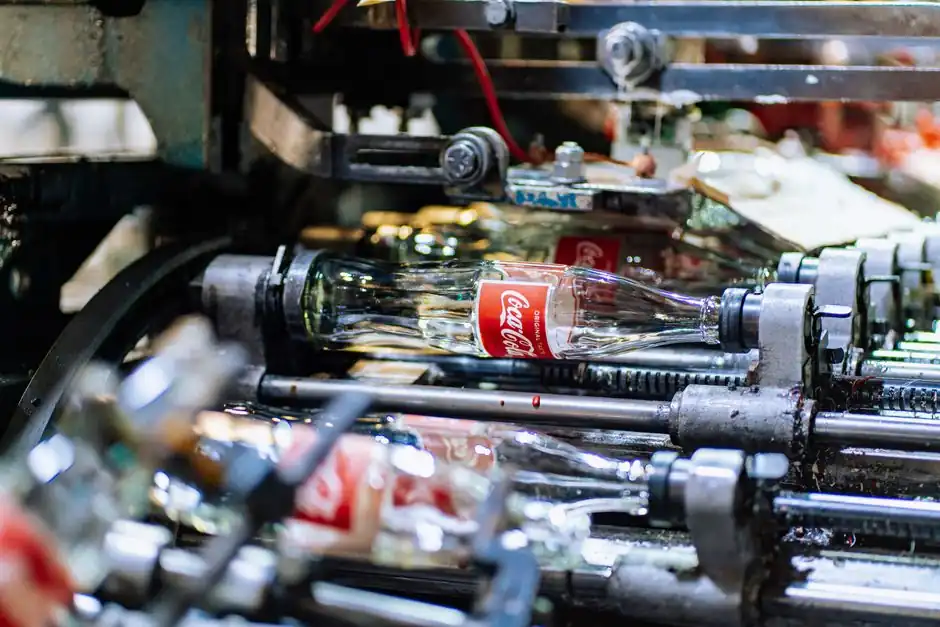
Gate 3, environment. Wash-down, food-and-beverage, and pharmaceutical lines (Juhang's Coca-Cola line equipment, side-flexing HFP882TAB supergrip plastic chain) require stainless or polymer flights; the catalog price spread is wide, with stainless-steel DIN A/B series chains carrying a clear premium over carbon-steel 08B-16B at US$1.5-2/meter [S4][S5][S6].
Gate 4, integration. Hollow-pin conveyor chain is the de-facto standard for conveyors with frequent attachment changes, because the cross-pin can be withdrawn without disassembling the chain; for an in-depth look at selection logic and a side-by-side comparison with belt conveyors, see the spec map on belt conveyor versus chain conveyor selection.
Criteria-based comparison: the four conveyor chain formats
Roller chain (DIN 08B-16B, ANSI 40-160). Standard carbon-steel transmission chain, lowest cost at roughly US$1.5-2 per meter on 10-meter MOQ, the default for general industrial lines and the workhorse of the Vision Group and similar catalogs [S5].
Solid pin conveyor chain. Higher working load than roller chain at the same pitch, used on slower, heavier-duty lines including cement and steel [S2][S5].
Hollow pin conveyor chain. The pin is a tube, allowing attachments (cleats, K-style attachments, side-flexing wings) to be bolted on and swapped without breaking the chain; commonly seen in 882-series and ISO-compliant variants, and the most flexible format for mixed-product lines [S4][S6].
Tabletop / plastic modular chain (HFP882TAB supergrip, side-flexing). Used in food, beverage, and packaging lines where stainless or polymer contact surfaces are mandated, with price points an order of magnitude above plain carbon-steel roller chain (US$45 per 10-meter MOQ on the HFP882TAB supergrip listing) [S6]. For abrasive bulk solids, however, none of these four formats substitute for a PKF or TKF armoured chain conveyor [S1].
Who the machine is for, and who the chain is for
The chain conveyor machine is FOR cement plants, power stations with FGD scrubbers, alumina and steel plants handling hot boiler ash and limestone, and bulk-handling terminals running cohesive or dusty materials at continuous duty [S1]. It is NOT for clean discrete-parts assembly, where the trough geometry, dust sealing, and heavy pull are wasted capex and a packaging-style conveyor is the right tool [S3].
The conveyor chain is FOR line builders (Junling, Ganar Machine, Cobrotech for grain, Xinxiang machinery) integrating a conveyor system, and for end-users specifying replacement chain on existing drives inside cement, sugar, steel, automotive, port, and mining operations [S2][S3]. It is NOT a stand-alone procurement: a chain purchase order always needs to declare the system context (drive type, sprocket pitch, lubrication regime, expected hours per year) or the part will be wrong on day one [S2].
Standards, sourcing, and supply-chain signals
Conveyor chain procurement typically cites GB/T, DIN 8187 (European), and ANSI B29.1 (US) standards, with catalog MOQ at 10 meters for plain carbon-steel and 50 meters for wing-attached or food-grade variants such as Juhang's 882 roller chain with wing attachments [S2][S4][S5]. Bulk-material chain conveyors are sold as engineered equipment, not as catalog items: AUMUND publishes machine-specific PDF datasheets for the PKF and TKF series, with shock-pressure-proof execution at 3.5 bar as the default for coal-mill feed [S1].
Supply-side signals out of China in mid-2026 include facility upgrades and capacity additions at Shinelink (transmission and conveyor chain), continuing engineering-chain export under contracts such as the Beles-1 sugar factory project in Ethiopia, and a sustained catalog price floor on 08B-16B carbon-steel chain in the US$1.5-2 per meter range on the Made-in-China marketplace [S5][S7]. For projects where pneumatic conveying is a competing option, the sizing logic and material gates differ significantly, as detailed in the spec map on cold-chain pneumatic conveying.
Failure modes and constraints
Common chain-conveyor machine failures: chain stretch on the return run when the discharge table is undersized for the peak load, sprocket-to-chain pitch mismatch on retrofit projects, and trough wear in abrasive duties that demands armoured plate execution rather than plain drag plate [S1]. Common conveyor chain failures: pin galling when lubrication is omitted on heavy-plate cement or steel lines, attachment loosening on hollow-pin chain when cross-pins are not locked, and corrosion pitting on 304 stainless parts in wash-down duty when 316 is specified [S2][S6]. For plants in high-dust sectors where pneumatic or vibratory conveying is also in play, the failure-mode profile is documented alongside the spec map on vibrating conveyor selection for automotive parts logistics.
Operating limits to declare in any RFQ: chain pull (kN), chain speed (m/s), ambient and material temperature, dust explosibility (ATEX zone), and required hours per year between planned maintenance stops. None of these are optional, and all of them are decided by the system duty before the chain catalog is opened [S1][S2].
Spec-level background on the components involved: chain conveyor, conveyor chain, and chain belt.