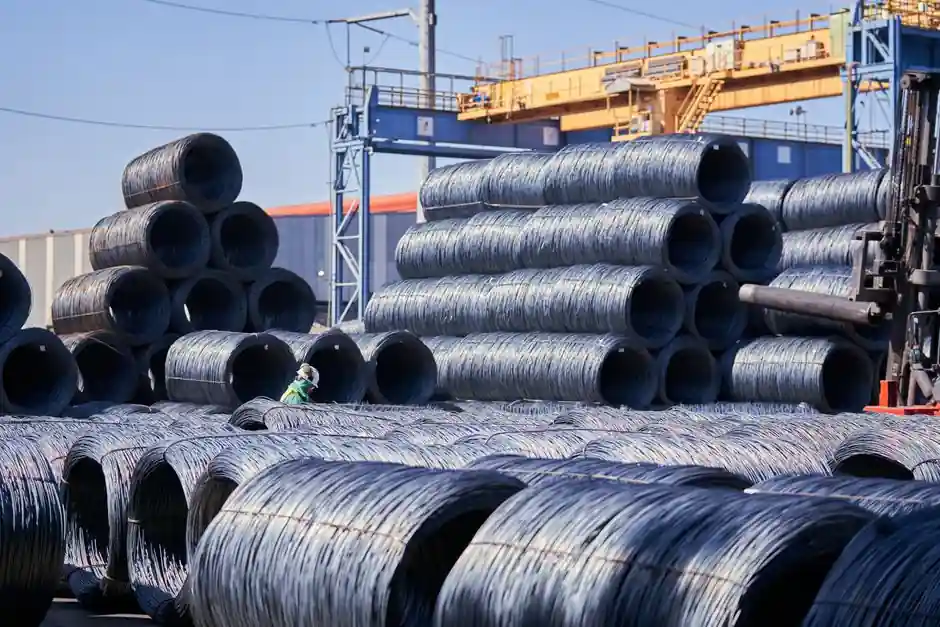
Warehouse floor slabs in U.S. distribution and e-commerce builds above 50,000 sq ft are routinely designed with 1×7 ASTM A416 Grade 270 seven-wire prestressing strand at 0.5 inch (12.7 mm) diameter, 1860 MPa tensile strength, in both bonded and unbonded configurations [S2].
Clear-span widths on pre-engineered metal warehouses now reach 300 ft (91 m), with prefab steel accounting for over 60% of new low-rise commercial construction in the United States [S3]. That span range, combined with racking live loads of 5-10 kPa typical in distribution centers, is what forces a real spec conversation on strand type, sheathing, and frame steel grade rather than a one-size pick.
Scope: where strand actually shows up in a warehouse
Within a typical pre-engineered metal building (PEMB) used as a warehouse, steel strand products are specified in three discrete locations: ground-supported post-tensioned slabs, suspended slab-on-metal-deck systems, and pre-stressed concrete tilt-up or precast wall panels. [S2]
Suspended slabs over metal deck use bonded 1×7 strand inside the deck flutes, and precast tilt-up wall panels typically employ 1×7 or 1×19 strand as longitudinal reinforcement [S2].
Bonded vs unbonded: a criteria-based comparison
Bonded 1×7 strand is supplied as bare ASTM A416 Grade 270 seven-wire, left-hand or right-hand lay, encased directly in concrete with full grout bond after stressing; unbonded strand ships as a monostrand with anti-corrosion grease plus a black HDPE sheath, free to slide inside its duct [S2].
On four decision criteria, the two formats trade off cleanly:
(1) Corrosion protection: unbonded HDPE + grease, typical sheath wall 0.8-1.2 mm, is the more aggressive environment barrier; bonded strand relies entirely on concrete cover (typically 25-40 mm) and crack-width control. (2) Field flexibility: unbonded monostrands can be pulled through tendon profiles after the concrete is placed and stressed from one end, while bonded strand must be placed, stressed, then grouted. (3) Inspectability: unbonded tendons can be re-stressed or replaced if anchors remain accessible; bonded tendons, once grouted, cannot be inspected or detensioned. (4) Code path: ACI 318 covers both, but ACI 423.7 is the unbonded monostrand reference, and ACI 423.6 covers grouted bonded post-tensioning, which is what most U.S. warehouse slab designers cite in 2026.
For a slab-on-grade warehouse floor subject to forklift point loads and abrasion, bonded strand in a thicker slab section is the conservative default. For post-tensioned parking or mezzanines inside a warehouse where crack control and tendon replacement matter, HDPE-sheathed unbonded monostrand is the typical pick [S2].
1×7 vs 1×19 construction

RuiTong's bonded and unbonded ranges are offered in both 1×7 and 1×19 constructions to ASTM A416, in the 250/270 grade family (Chinese wire-rod equivalents 82B/77B) [S2]. The 1×7 configuration, 6 wires helically laid around 1 straight king wire, is the workhorse at 9.53 mm (3/8 in), 11.11 mm (7/16 in), 12.7 mm (1/2 in), and 15.24 mm (0.6 in) diameters.
1×19 construction, 18 outer wires around a 1-wire core, is reserved for larger diameters (typically 17.8 mm and above) and for applications where multi-strand anchorage geometry demands a more flexible, larger cross-section cable. For warehouse slabs, 1×7 covers 95%+ of tendon requirements, with 1×19 only relevant where anchors cannot be spaced for multi-strand 1×7 layouts.
Frame steel and fabric reinforcement: a related decision
Beyond the strand itself, the primary frame is carbon steel sections, typically ASTM A36 plate, A572 Grade 50 (345 MPa yield) wide flanges, and A653 galvanized sheet for cladding and deck. Roof and wall panels are commonly G60 or G90 zinc-coated (Z180 or Z275 g/m²) for warehouses in humid or coastal service environments [S3].
A side decision the warehouse owner has to make: pair the strand supply with the same fabricator or split the scope. Bundling strand, rebar, and frame steel with one PEMB supplier simplifies QA traceability but locks the specifier into that vendor's preferred fabricator. Splitting strand procurement from a specialist mill (Chinese, Malaysian, Turkish, or domestic origin) and the PEMB kit from a U.S. building manufacturer is the more common path for builds above $5M. The alloy steel category rarely enters the conversation for warehouses; it is more relevant to crane runway girders on heavy industrial sites than to a Class B distribution slab.
Commercial and pricing context for 2026
The U.S. Department of Commerce published the final results of the antidumping duty administrative review on imports of prestressed concrete steel wire strand from Malaysia covering the 2023-2024 review period on 3 June 2026 [S1]. Importers handling Malaysian-origin PC strand should pull the per-producer dumping margins from that notice before locking the bill of materials, as the effective landed cost of a warehouse's 50-200 ton strand order can shift noticeably depending on whether the margin places the product under the order or a producer sells at normal value [S1].
Limitations, failure modes, and inspection
Unbonded HDPE-sheathed strand, with default black sheathing, requires sheathing integrity testing before concrete placement; any puncture compromises long-term corrosion protection and is grounds for rejection of that tendon per ACI 423.7. Bonded strand, once grouted, hides corrosion behind the grout column, so duct pressure-grouting records become the QA reference, not the tendon itself. Strand relaxation losses for ASTM A416 low-relaxation Grade 270 are bounded at 2.5% at 1000 hours under 70% initial load, but the designer still budgets 1.0-1.5% for long-term relaxation plus 4-6% for concrete shrinkage and elastic shortening combined. [S2]
For warehouses, the failure modes that hit inspectors most often are anchor-pocket corrosion on unbonded tendons, grease loss through HDPE pinholes, and inconsistent grout filling in bonded tendons at low points. End-user-procured tendons should ship with anti-rust export packaging, mill cert per ASTM A416, and a documented stress-strain curve, not just a generic test report [S2]. For specifiers working on adjacent renovation or adaptive-reuse warehouse projects, the Steel Strand Selection for Renovation guide covers the 1×7 vs 6×19 selection math and galvanizing class differences in more detail. A separate context for school and institutional buildings is laid out in Steel Strand Selection for School Buildings, which is useful when a warehouse campus includes adjacent admin or learning annexes under a single procurement package.
Track two signals over the next 90 days: any post-publication corrections to the 3 June 2026 Malaysian PC strand antidumping notice (deposit-rate revisions, scope rulings) and any updates to ACI 423.7 or ACI 360 affecting slab-on-grade tendon profiles in PEMB warehouses. Both will shift the cost-of-strand line in 2026 Q4 budget cycles for new warehouse starts.