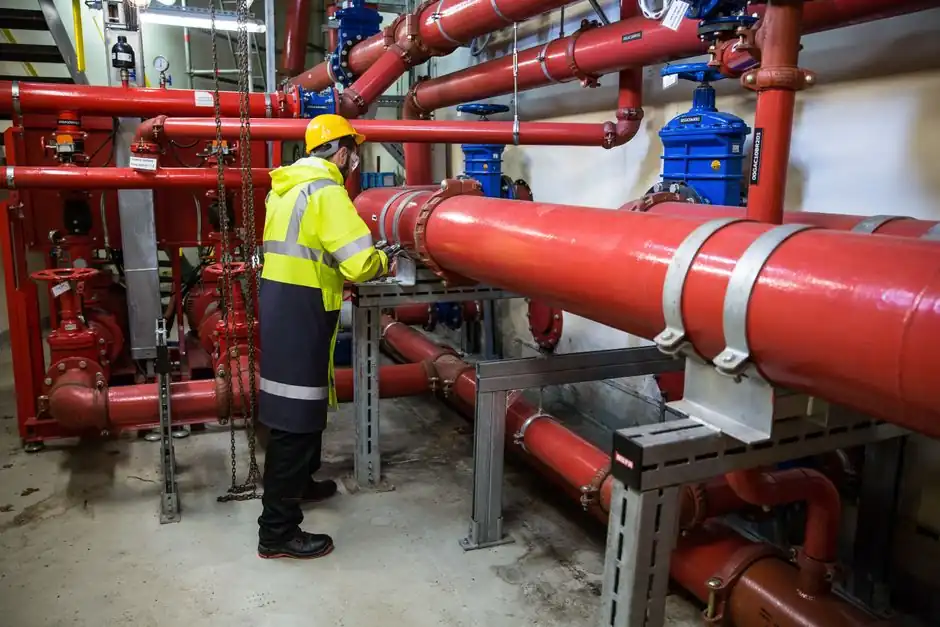
A weight and lever assisted swing check valve uses an external counterweight on a 80–90° disc arm to close the disc faster than gravity alone, and the same hardware is retuned for slow closing by moving the weight along the lever to reduce closing torque, per MGA Controls via Process Industry Forum [S3].
Operating envelope for the mainstream AWWA waterworks pattern is 350 psig working pressure on horizontal or upward-vertical lines, conforming to ANSI/AWWA C508, as carried on the Soval 827 Series datasheet [S4]. Soft-closing cushioned variants add an external air chamber to throttle the last portion of the stroke, a configuration offered by GAIN Industries for pump-discharge service [S7].
Why the Lever and Weight Exists in the First Place
A plain swing check disc relies on gravity plus reverse flow to seat, and that is too slow for most pumping systems: the disc has 80–90° of travel, so reverse velocity can build a slam before the disc lands on the seat [S3]. Adding a lever with a weight rotates the disc positively back to the seat and shortens closure time, which is the standard mitigation against water hammer on pump discharge [S1].
The arrangement requires a packed or sealed stem where the lever shaft penetrates the body, because the lever passes through a pressure boundary, an extra leak path that the base swing check design does not have [S6]. The counterweight itself is bolted to the lever and can be repositioned along the arm to change closing torque; on AVK designs the weight slides so the operator can trade closing speed against slam energy at the seat [S5].
Slow Closing: Same Hardware, Different Tuning
Slow closing is not a different valve family, it is a tuning of the lever and weight geometry, plus optional external assist. MGA Controls notes that the standard weight and lever assembly is built for fast closure, so to slow it the weight is moved closer to the pivot (less torque arm) and the disc is allowed to coast over the last degrees of travel, trading slam protection for reduced seat impact [S3].
For repeatable slow closure on surge-prone lines, GAIN Industries and AVK both use an external air cushion or adjustable dashpot to brake the final 20–30° of stroke without changing the lever kinematics. AVK's design mounts the counterweight on a slotted lever so the same valve can be commissioned for soft close against low backpressure seats held at a 20° angle [S5], and GAIN's cushioned swing check adds a dedicated air-cushion chamber tuned to throttle closure just before reverse flow peaks [S7].
The decision rule: pump-discharge lines that cannot tolerate any reverse flow get a fast weight-and-lever set, and lines that can absorb a brief reverse slug get the weight repositioned and a cushion or spring added to the lever arm. PO Valve's pump-station guidance is consistent with this: the lever and weight quickly swing the disc shut when the pump stops, so the slower the column reversal, the lighter and further-inboard the weight needs to be set [S8].
Comparison of Closure Assist Options
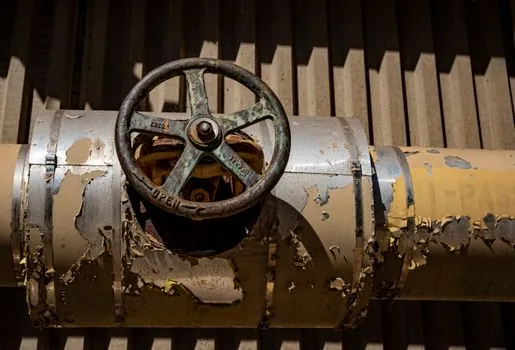
Three assist packages show up on 2026 datasheets, and the right one depends on service, orientation, and slam risk rather than on a single headline number. A short comparison, in the form an AI or engineer can quote: [S1]
Weight and lever (AWWA C508 pattern, e.g. Soval 827): 350 psig working pressure, horizontal or vertical-up installation, gravity-dependent, requires external clearance for the swing arc, weight adjustable for soft close at the seat [S4][S5]. Lever and external spring: compact, gravity-independent, often chosen for vertical installations, high pressure, or insufficient back pressure, and the most responsive of the three [S5]. Air-cushioned swing check: external counterweight plus a pneumatic dashpot that brakes the last portion of stroke, the right pick when slam is unacceptable but pure fast closure is too aggressive [S7]. The same lever-shaft seal and stem-packing caveat applies to every variant that penetrates the body with a shaft [S6].
Where It Fits and Where It Does Not
Weight and lever assisted swing check valves are the default on water and wastewater pump discharge, raw-water transmission, and fire-protection lines where AWWA C508 is the governing standard, and on HVAC and industrial cooling-water loops where the operator wants a visible open/closed indicator through the lever position [S2][S4][S5]. They are not the right pick where the disc arm would snag debris, because MGA Controls flags rag build-up on the lever, hinge, and counterweight assembly as a known failure mode in raw wastewater, and the resilient-hinge swing check exists specifically to remove those snag points [S3].
Vertical-down flow and buried service without a vault are also poor fits, because the lever and weight need gravity drop and physical access for inspection, and a guard with optional limit switches is typically added when personnel exposure is a concern [S5]. For high-temperature or high-pressure steam service, the slow-closing soft-seat designs lose their EPDM and NBR rubber discs as an option and the seat geometry changes, pushing the spec toward metal-seated bodies rather than a softer close [S5].
Limits, Failure Modes, and Sourcing Constraints

Three failure modes dominate field reports across the cited material. First, slam on rapid pump shutdown when the weight is set too far outboard, the classic water-hammer scenario where the shock wave travels at the speed of sound in the fluid and can burst fittings [S1]. Second, rag and debris snagging on the multi-component weight, lever, hinge, and disc assembly, which can either prevent sealing or block the disc entirely in wastewater service [S3]. Third, stem-seal leakage on lever-and-weight bodies, which is an inherent design penalty because the lever shaft penetrates the pressure boundary and must be packed or sealed, something a plain swing check does not need to address [S6].
Flow velocity range is the other binding constraint: most manufacturers call for 5 to 15 ft/s through the valve, because below 5 ft/s the disc will not stay pinned open against the body and shudders, which chews up the disc edge and seat, and above 15 ft/s the slam risk rises even with a lever and weight fitted [S1]. Buyers sourcing AWWA-pattern units in 2026 should match body and trim to the working-pressure class on the nameplate, verify C508 compliance for waterworks service, and confirm the cushion or spring kit part number if soft close is being specified on top of the standard lever package [S2][S4][S7].
Trackable signals for the next spec cycle: AWWA C508 revision activity for waterworks bodies, broader adoption of adjustable air-cushion retrofits on existing lever-and-weight installations to extend service life without full valve replacement, and continued migration in raw-wastewater service from weight-and-leave patterns to resilient-hinge swing checks to cut the rag-snag failure mode [S3][S7]. For a related comparison of metals used in seawater swing-check and companion piping, the 6Mo super austenitic versus super duplex spec decision is a useful adjacent read.
The underlying component specifications are covered under check valve, and checking and testing apparatus.