
Allied Market Research values the global robotic welding market at $5,450.5M in 2018 and projects $10,784.4M by 2026, implying an 8.7% CAGR from 2019 to 2026 [S5]. The same publisher sizes the wider industrial robotics market at $38B in 2020 with a $163B 2032 forecast at 12.6% CAGR [S4], confirming welding as a mid-growth sub-segment that scales with, but consistently under-tracks, total factory robotics spend.
Within the welding-robot category, SCARA and articulated arms share the duty cycle: SCARA payload tiers (up to 5 kg, 5.01–15 kg, 15 kg+) are explicitly segmented for assembly-adjacent welding/soldering use, with the 5.01–15 kg class showing the highest 11.7% CAGR through 2026 [S3]. For heavy fabrication, articulated robots dominate MIG/MAG and spot-welding cells in automotive body shops, while SCARA robots address smaller-payload precision welding and dispensing in electronics. Collaborative cells using collaborative robots are a separate, faster-growing slice but trade throughput for shared workspace.
Market Size, Forecast Range, and What 2026 Actually Marks
The robotic welding market's $5,450.5M (2018) → $10,784.4M (2026) trajectory corresponds to roughly a 1.98× expansion over eight years, or a near-doubling of installed cell value at 8.7% CAGR [S5]. Industrial robotics as a whole is forecast at $38B (2020) → $163B (2032) at 12.6% CAGR, meaning welding is set to grow slower than the headline robotics figure because the broader basket includes material handling, dispensing, and inspection robots that pull ahead on e-commerce logistics demand [S4].
Adjacent robotics adjacencies reinforce the same direction: the sealing-and-dispensing robots sub-market is sized at a $1.31B incremental opportunity over 2021–2025, accelerating through the forecast window [S6], and the linear motion systems market is projected at $11.74B in 2026 rising to $19.86B by 2033 at 7.8% CAGR, supplying the rails, ballscrews, and gantries that welding positioners and seam-trackers depend on [S7]. Practically, 2026 is a forecast midpoint, not a year of new specification upheaval — it is when a large share of the 2019–2026 backlog is being installed and commissioned, which is why TCO arguments, not market size, dominate spec meetings.
Cell Architecture: Articulated, SCARA, Collaborative, and Hybrid
A modern robotic welding cell is not one robot — it is an articulated robot arm, a positioner or linear track, a power source, a torch package, a seam-tracking sensor, and a safety/perimeter layer, all sized to the workpiece envelope. The articulated arm is the workhorse for 6-axis MIG/MAG, TIG, and spot welding; payload commonly spans 6–20 kg for thin-gauge autobody work and 20–100+ kg for heavy fabrication. SCARA arms address 4-axis low-payload spot and micro-TIG tasks where vertical compliance and high speed on short strokes matter; payload bands of up to 5 kg, 5.01–15 kg, and 15 kg+ are the standard segmentation pattern used by Allied Market Research [S3].
Collaborative welding cells using collaborative robots typically operate at 1–16 kg payload and at collaborative-mode joint speeds well below industrial-mode rated speeds, which caps cycle time but enables fenceless operation next to a human welder for short, variable weldments. SCARA robots overlap with collaborative arms in the low-payload precision tier but offer higher repeatability on vertical-axis pick-and-place of small parts into a weld fixture. Choosing between these is fundamentally a question of batch size, mix variance, payload, and whether the cell will be power-and-cycle-bound or changeover-bound.
Selection Criteria: Payload, Reach, Duty Cycle, and Process Fit
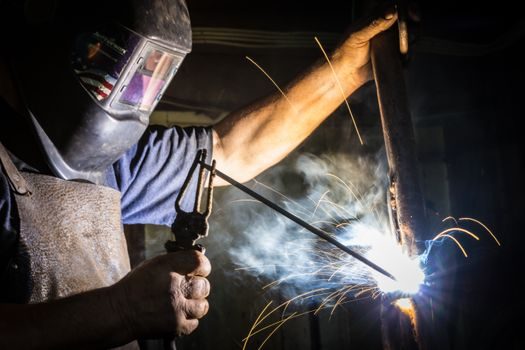
Four criteria dominate welding-robot selection in 2026: payload capacity, reach envelope, duty cycle (weld-on time per hour), and process compatibility. Payload must cover the torch, cable dress, and any integrated seam-tracking mass; a 6 kg MIG torch with cable management typically adds 4–7 kg to the effective end-effector load, pushing the spec from a 6 kg arm to a 10–12 kg class. Reach is dictated by the largest workpiece on the cell — autobody side panels commonly need 1.8–2.0 m reach, heavy structural parts push 2.5 m+ and may require a 7th-axis track. [S3]
Duty cycle is the silent killer in cell ROI: industrial articulated robots can sustain 90%+ weld-on time at rated payload, while collaborative arms derate sharply when run at industrial speed and are typically specified for 30–60% weld-on time in fenceless cells. Process compatibility means confirming the arm's path accuracy and stiffness support the chosen process — pulsed MIG, short-circuit MIG, TIG, plasma, and laser-hybrid all have different stiffness and reach-tolerance requirements, and a controller that supports seam tracking, touch-sensing, and arc-sensing is increasingly the gate that separates a 2026-spec cell from a 2018-vintage retrofit. For guidance on welding-machine spec trade-offs that drive the upstream decisions, this TCO breakdown of arc-welding machines is a useful cross-reference.
Cost, TCO, and the 2026 Decision Frame
Robotic welding cell TCO is dominated by the arm and controller (typically 35–45% of cell value), the power source and torch package (20–25%), positioner/track and fixturing (15–20%), integration and safety (10–15%), and ongoing service, spares, and consumables. The eight-year market doubling at 8.7% CAGR [S5] has not been matched by an equivalent drop in arm ASPs — the savings have come from controller consolidation, integrated vision/seam-tracking, and longer service intervals rather than headline price compression.
For low-mix, high-volume automotive and heavy-equipment production, a traditional articulated cell with 1.8–2.5 m reach, 20+ kg payload, and a 500–600 A inverter power source remains the lowest cost-per-weld. For high-mix, low-volume job shops and contract manufacturers, a collaborative robot cell with shared workspace can deliver better ROI despite a higher cost-per-weld-minute, because changeover cost is amortized across more part numbers. Process limits and the spec trade-offs for the upstream TIG machine choice are laid out in this TIG selection map, which is the natural complement to a robotic TIG cell spec-out.
Adjacent Automation Context: Why Welding Specifically
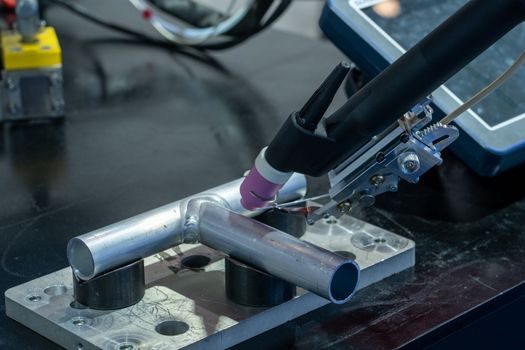
Welding remains one of the harder industrial processes to automate cleanly because of seam variability, heat distortion, fixturing tolerance stack-up, and the safety cost of a fenceless hot cell. The fact that the robotic welding sub-market grows at 8.7% CAGR [S5] while the broader industrial robotics market grows at 12.6% CAGR [S4] reflects this difficulty: dispensing, material handling, and inspection are easier wins and pull the headline number up, while welding lags but stays a large absolute market. The linear motion systems market growing from $11.74B in 2026 to $19.86B by 2033 at 7.8% CAGR [S7] is a leading indicator — welding positioners, tracks, and seam-tracker gantries consume a meaningful slice of that motion content.
For automotive and EV production lines specifically, welding is the single largest robotic work cell by installed count, and it is the gating process for body-in-white throughput. Layout and automation decisions in adjacent EV body lines are detailed in this EV production-line design spec map, and the upstream machine spec decisions (TIG/arc-welding) cascade directly into robotic cell sizing. A coherent 2026 cell spec therefore touches four documents: the arc-welding TCO, the TIG process limits, the EV line layout, and the robot selection itself.
Limits, Failure Modes, and What to Watch in the Forecast
The forecasts cited are publisher projections, not installed-base data: the 8.7% CAGR (2019–2026) and 12.6% CAGR (2023–2032) figures are model outputs and are sensitive to automotive production volume assumptions, EV mix, and capital-spending cycles [S4][S5]. A reader should treat them as a planning envelope, not a guaranteed run rate. Practical failure modes at the cell level include torch-cable fatigue (the leading cause of unscheduled downtime in high-cycle cells), seam-tracker drift in high-reflection aluminium welding, positioner backlash in heavy-payload cells, and arc-sensor noise in low-current pulsed TIG.
Watch nodes in the next 12–18 months: 2026 full-year automotive production volume data (the primary demand pull), inverter power-source ASP trend (the second-largest cost block), and 7th-axis track adoption rate in heavy fabrication. The linear motion market's 7.8% CAGR through 2033 [S7] is a clean leading indicator for the positioner and track content per cell, and Allied Market Research's 12.6% industrial-robotics CAGR through 2032 [S4] sets the upper bound for the welding sub-market's likely upside if welding's process gap continues to close. Robotics-adjacent component supply chains are tracked in this humanoid robot BOM map, which shares several actuators, reducers, and motion-control components with industrial welding cells.