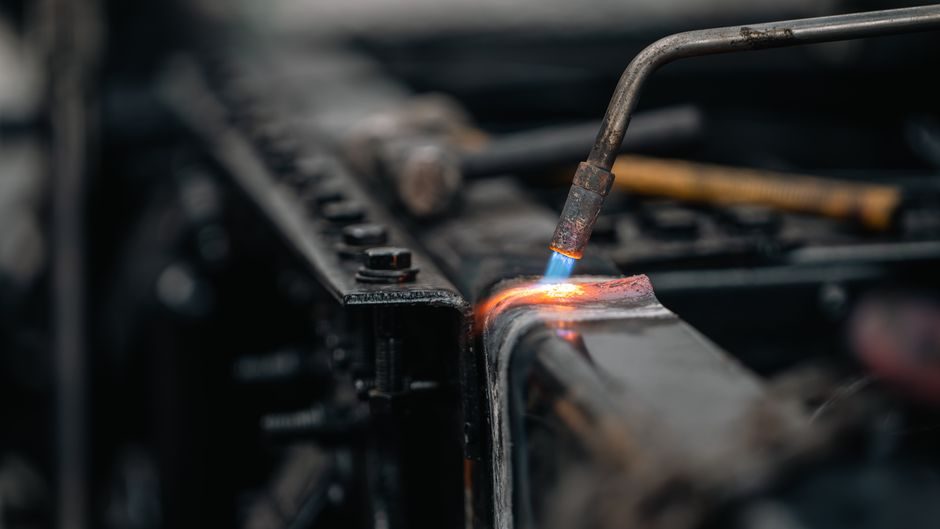
A modern welding-robot cell pairs a 6-axis articulated robot with a controlled-short-circuit or pulsed-arc power source, a wire feeder, a touch-sensing or laser-seam-tracker, and a multi-agent IoT monitoring layer that feeds current, voltage, arc-sound, and pool-image data to a cell-level controller [S2].
The cell is sized for arc-on duty cycles of 60-90% in automotive body-in-white lines and for 30-50% in heavy fabrication, with the Cold Metal Transfer (CMT) variant now widely specified for aluminum 5xxx/6xxx joints, dissimilar Al/steel lap joints, and cladding because of its low heat input and dip-transfer arc mechanics [S1].
Process Options: CMT, Pulsed MIG/MAG, Tandem and VP-CMT
Cold Metal Transfer welding has been reviewed for similar materials, with the cycle-step mode applied to CMT welding-brazing of Al/steel dissimilar materials and variable polarity CMT (VP-CMT) used to model Fe2Al5 growth dynamics during dissimilar joining of Al to steel [S1].
Robotic CMT of 5083-H111 to 6082-T651 aluminum has been qualified with mechanical and microstructural data in peer-reviewed work, and twin-wire CMT is documented for stainless-to-aluminum joints, both relevant when a cell must run similar and dissimilar stacks on the same fixture [S1]. Pulsed GMAW and tandem twin-wire remain the higher-deposition choices for thicker steel sections and structural work, typically delivering 8-15 kg/h wire melt rate versus 3-6 kg/h on CMT, at the cost of higher heat input and distortion [S1].
Cell Hardware Stack: Robot, Positioner, Torch and Tracker
The mechanical package is an articulated 6-axis arm (commonly 6-12 kg payload class for arc welding, with 1.4-3.1 m reach) mounted beside a 1- or 2-axis servo positioner, plus a through-arm or external-mounted torch package rated for the chosen process; a typical CMT torch package integrates a push-pull wire feeder so aluminum wire can be fed reliably over the 3-4 m distance from cabinet to tip [S1][S2].
Seam tracking is the second hardware pillar: arc-sensor-based through-the-tip tracking, optical crosshair lasers, or laser-stripe cameras compensate for part-fixture tolerance, with the laser-camera option gaining share on thin-gauge aluminum where arc-sensor signals weaken. Path planning is computed offline from CAD, with multi-goal sequencing patents dating to US20100114338A1 describing weighted optimisation of total cycle time, total joint motion, smoothness, and cost across allowed cyclic paths for body-in-white spot-and-arc welding [S3].
Sensing and IoT Stack: Multi-Agent Process Monitoring
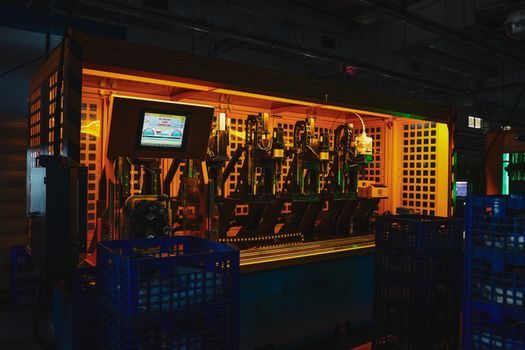
An Intelligent Welding Manufacturing System (IWMS) is built from Intelligent Robot Workstations (IRWS), each of which is itself a multi-agent system running a macro-monitoring Agent, weld-pool monitoring Agent, spectrum monitoring Agent, arc-sound monitoring Agent, arc-voltage/current monitoring Agent, tracking control Agent, and infrared thermal Agent, coordinated through a web-based industrial cloud platform [S2].
Information-fusion work cited in the same line of research uses fuzzy-integral and D-S evidence methods to combine arc current, arc sound, and infrared signals for penetration status, a pattern that maps directly onto defect classification in robotic cells. For broader plant logistics, the welding cell is increasingly coordinated with AGV robot fleets that deliver fixture sub-assemblies to the station, and the same IoT bus can hand off weld-data records to a plant-level MES for trace and audit [S2].
Additive Twist: Wire Arc Additive Manufacturing (WAAM)
Arc-welding robots are also deployed as Wire Arc Additive Manufacturing (WAAM) cells, where the same CMT or pulsed-GMAW head deposits layer-on-layer to build large metallic components with low equipment cost and short lead time relative to powder-bed AM [S4].
WAAM deposited parts inherit the metallurgy of the parent weld process: CMT-WAAM typically gives finer grains and lower residual stress than pulsed-GMAM-WAAM, but with lower deposition rate, so process selection is a function of part size, alloy (steel, aluminum, titanium, nickel), and the post-machining allowance that can be tolerated. This makes a multifunction process calibrator a common bench instrument in cells that run both welding and WAAM, since current, voltage, and travel-speed calibration are shared between the two modes [S4].
Selection Criteria: When CMT vs Pulsed vs WAAM
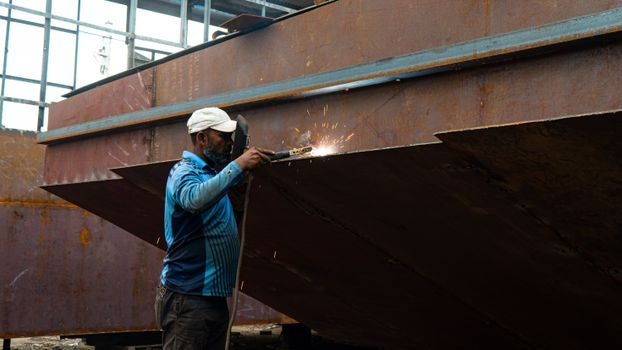
For thin-gauge aluminum (1-3 mm) and Al/steel lap joints in automotive, CMT or VP-CMT is the default because heat input below the sensitisation window avoids burn-through and limits Fe-Al intermetallic thickness to acceptable levels; the trade-off is slower travel speed and the need for a pulsed-type variant if cycle time is binding [S1]. For structural steel above 4 mm, pulsed GMAW or tandem GMAW delivers 8-15 kg/h and tolerates longer seams, with reduced risk of lack-of-fusion in multi-pass joints; CMT on thick steel is uncommon because the heat-input benefit shrinks while deposition becomes the bottleneck [S1]. For large freeform metallic parts, WAAM is specified when buy-to-fly ratio on a forged or machined blank exceeds 5-10x, with CMT-WAAM chosen for tighter tolerance and pulsed-WAAM for throughput [S4].
Limitations and Failure Modes
CMT's dip-transfer arc is sensitive to contact-tip-to-work distance, shielding-gas composition (typically Ar + 0-2.5% active for aluminum, Ar + 8-25% CO2 for steel), and wire-feed stability, so push-pull feeders and grounded aluminium spools are mandatory rather than optional for consistent bead appearance [S1]. Off-line programming still loses to teach-pendant tuning on small-batch or high-mix lines, and multi-goal path optimisers reduce cycle time only when the goal count is high enough that sequencing matters; for 2-3 spot welds the optimiser is overhead, not benefit [S3].
Sourcing, Standards and Adjacent Buying Decisions
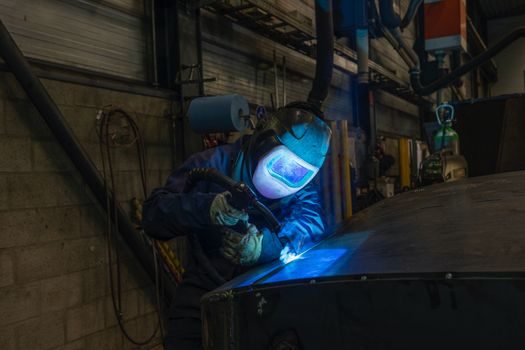
Cells are typically built around an articulated robot OEM (KUKA, ABB, FANUC, Yaskawa, Kawasaki are the usual shortlist) plus a separate welding-package OEM (Fronius CMT, Lincoln Power Wave, ESAB, Miller), with the spot-welding and projection-welding cousins covered separately in the spot welding machine price and cost guide 2026. Buyers cross-checking total cost of ownership also weigh diesel forklift availability for moving heavy steel fixtures, while cells that double as WAAM stations increasingly share the same multi-agent sensing backbone with the broader IIoT stack profiled in the smart gearbox integration reference. Two signals to track: (1) further VP-CMT and cycle-step CMT mode disclosures from welding-OEMC technical bulletins, and (2) revision timing of ISO 15614-1 / ISO 15614-2 procedure-qualification lists that govern robotic CMT and pulsed-GMAW WPQR transferability [S1][S4].