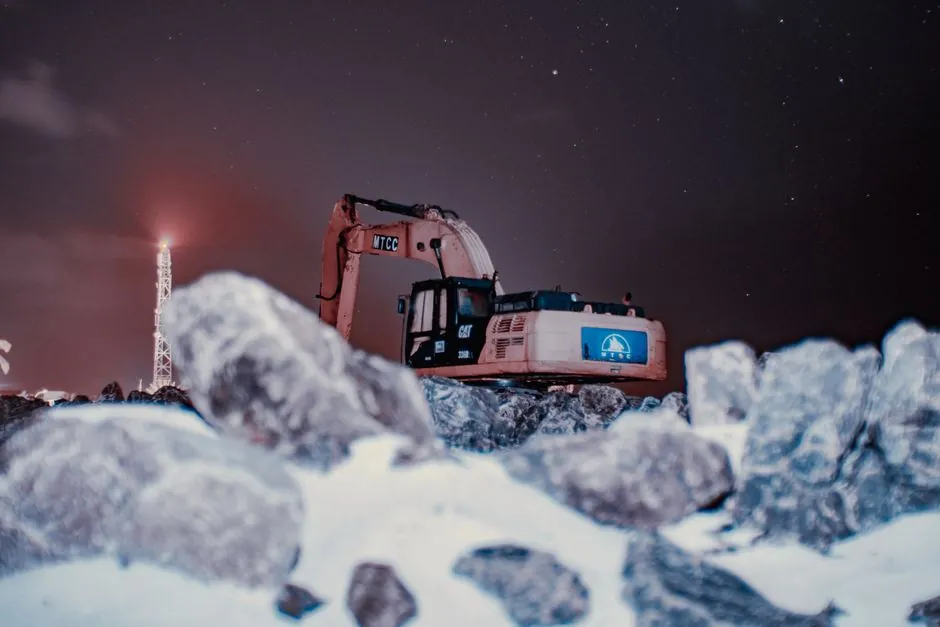
A wheeled excavator is a hydraulic digging machine carried on pneumatic tires instead of crawler tracks, retaining the 360-degree rotating upper structure, boom, stick, and bucket common to all hydraulic excavators [S7]. The defining trade-off versus a crawler is mobility on paved ground: wheeled models travel under their own power at roughly 32 km/h (about 20 mph), removing the need for a lowboy trailer for short intra-city moves [S5].
Wheeled excavators are commonly specified for urban utility work, road maintenance, bridge approaches, scrap yards, and material handling, with operating weights most often falling in the 8 to 25 metric ton class on European and North American fleets [S5][S2]. On the broader excavator family tree, they sit between the compact mini-excavator segment (under 8 t) and the heavier long-reach demolition class, filling the road-speed-and-mobility gap that crawlers cannot match.
Standard Wheeled Excavator: The Utility and Roadwork Workhorse
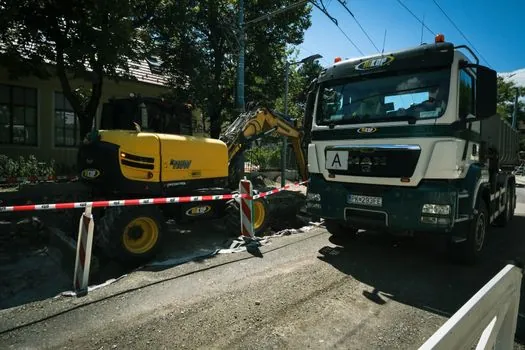
The standard wheeled excavator pairs a single-piece or two-piece boom with outriggers and a rear dozer blade, and is the configuration most commonly specified for highway maintenance, bridge work, and municipal utility installation [S1][S2]. With a two-piece articulating boom the machine can dig inside one lane of traffic, place concrete barriers, and switch attachments in minutes rather than hours, which is why fleets in cities like Toronto and Vancouver deploy them as default urban units [S4][S5].
Stability is achieved with four outriggers (or two outriggers plus the dozer blade), and OEM guidance from Volvo states that a properly outriggered wheeled machine is "every bit as stable as a comparable crawler" for digging tasks, with no meaningful penalty in breakout force, reach, or digging depth [S5]. Tilt rotators, such as the Steelwrist offered on Volvo wheeled platforms, add 360-degree attachment rotation and 45-degree lateral tilt, allowing a single stationary set-up to dig, grab a pipe, rotate 180 degrees, and backfill without repositioning [S5]. For procurement context, a wheeled unit's effective cost-of-ownership case rests on labor and transport savings, not on a lower purchase price.
Short-Swing and Compact Wheeled Excavators for Confined Streets
Short-swing wheeled excavators use a reduced tail-swing counterweight, allowing the machine to rotate within a single traffic lane, a feature explicitly called out for urban and roadside deployment [S5]. The reduced rear overhang is what lets contractors place the machine parallel to a curb and still slew through a full dig cycle without encroaching on the adjacent lane.
Compact wheeled units overlap the upper end of the mini-excavator weight band (generally 6 to 12 t) and are used where the job demands a road-legal chassis but a small footprint, such as residential gas-line replacement, sidewalk work, and last-mile fiber trenching [S4][S7]. A 360-degree rotating upper structure is preserved across this class, distinguishing these machines from backhoe loaders, which have a fixed mainframe and a side-shift boom only. In selection terms, the compact wheeled class is the direct replacement candidate for aging backhoe loader fleets in utility and municipal work, with one machine covering the same tasks at higher productivity and with full hydraulic-attachment flexibility [S5].
Special-Purpose Wheeled Excavators: Material Handling, Waste, and Scrap
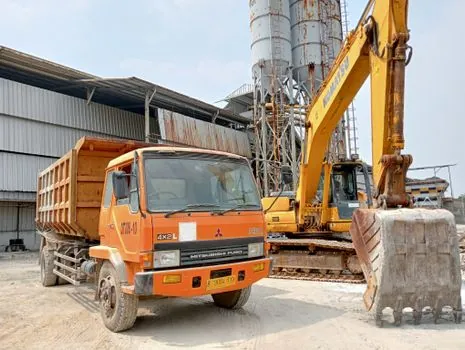
Wheeled excavators are reconfigured for material handling by fitting a hydraulically elevating cab and a grab arm with grapple, producing a mobile sorting machine for waste, recycling, and aggregate yards [S5]. The elevating cab gives the operator continuous line-of-sight over a high-side tipping body or over a stockpile, which is the principal ergonomic and safety difference from a standard digging configuration.
For waste and scrap, the same wheeled chassis is fitted with solid tires, a guarding package, and a ventilation system, making it suitable for transfer-station and scrapyard duty where punctures and debris are constant [S5]. With a rotation grapple in place of the bucket, a scrap-yard wheeled excavator can dismantle a car component by component while rolling between bays, a task that would require repositioning a crawler on rubber pads or concrete. These variants show that "wheeled excavator" is a chassis platform, not a single machine, and the same base unit can move between roadwork, utility, and material-handling roles simply by changing boom, cab, tires, and guarding.
Operating Weight, Reach, and Mobility Envelope
Operating-weight classes for wheeled excavators in regular commercial production extend from compact units around 8 t up to 20-25 t heavy urban machines, with a small number of 30-ton-plus utility and handling models [S1][S4]. The micro (<3 t) and 3-8 t mini classes are dominated by compact tracked excavators for ground-pressure reasons; the wheeled configuration becomes practical from about 8 t upward, where the tire contact patch and axle load can support continuous road travel [S4].
On-road travel speed for most wheeled excavators is in the 30-35 km/h band (the Volvo figure cited at "approximately 20 mph", roughly 32 km/h, is a fair representative value), and with overrun brakes on the tow hitch a single support truck can haul an 8.5-ton trailer of attachments and consumables behind the machine itself [S5]. Boom options are a one-piece for maximum lift height and a two-piece articulating boom for tight-quarter work; the two-piece is the dominant roadwork choice and is what enables single-lane dig and place cycles [S2][S5]. For comparison against other heavy equipment platforms, the wheeled excavator's mobility-versus-ground-pressure trade curve sits closer to a motor grader than to a crawler crane: high on paved flexibility, low on soft-soil flotation.
Selection Criteria: Terrain, Swing, Attachments, and Transport
Four selection criteria dominate wheeled-excavator specification: terrain, swing envelope, attachment family, and transport. Terrain: wheeled machines perform on hard, flat surfaces and on steep slopes where the tires can maintain contact, but they are not specified for soft mud, deep peat, or unprepared ground where a crawler's low ground pressure (typically under 50 kPa for standard crawler tracks) is required [S6][S4].
Swing envelope: a standard-tailed wheeled excavator needs free rear space equal to its counterweight radius, while a short-swing variant can rotate within its own wheelbase, the deciding factor on narrow urban streets and on bridge decks [S5]. Attachments: the practical working set spans buckets (ditching, grading, trenching), hydraulic hammers, tilt rotators, grapples, pavement millers, and compaction wheels, with quick-coupler swaps driven by the tilt rotator's 360-degree rotation and 45-degree tilt envelope [S5][S3]. Transport: under their own power, wheeled units reposition at roughly 32 km/h, avoiding a lowboy for sub-50 km moves; for long-distance moves they are still trucked, and overall width, height, and weight must fall inside regional road-permit envelopes, typically under 2.55 m wide and 4 m tall for unescorted moves in Europe and North America [S5].
Limitations, Failure Modes, and Common Spec Errors
Wheeled excavators underperform when specified for unprepared soft ground, where tire sinkage and loss of tractive effort erase the mobility advantage; a tracked excavator or a backhoe loader is the correct substitute in that envelope [S4][S6]. Tires are the wear and cost line that catches fleets off guard: a single pneumatic excavator tire at 10 t operating weight is a multi-thousand-dollar consumable, and puncture risk on demolition or scrap sites is why solid-tire conversions exist for those duties [S5].
A common spec error is using a wheeled excavator where the dig depth or lift height demands a long-reach boom; in that case the correct machine is a long-reach excavator, even on tires, because the geometry of the stick dictates the work envelope, not the undercarriage [S4]. Another recurring error is pairing a wheeled chassis with a hydraulic breaker rated for a heavier carrier, which over-tasks the boom pin and the slewing ring. The bias to watch in vendor literature is a generic "versatility" claim, useful in roadwork, materially overstated in mining, where cycle times and bucket-fill factors favor crawler-class machines.
Where to Verify Specs and Standards
For weight, reach, and engine emissions data, the OEM's product specification sheet is the primary source; the figures quoted in third-party blog guides should be treated as indicative only [S1][S2]. Operator safety on European fleets is governed by machinery directives including EN 474-1 (earthmoving machinery safety), and emissions by the EU Stage V regulation for non-road mobile machinery, with EPA Tier 4 Final as the U.S. equivalent for diesel engines above 19 kW.
For the broader machine taxonomy and for an engineering reference on related earthmoving platforms, the construction machinery and equipment encyclopedia entry collects the cross-platform comparison, while a field map of motor graders and a backhoe loader selection logic piece cover the adjacent equipment classes that wheeled excavators most often replace or complement. Two trackable signals for the next 6 to 12 months: Tier 4 Final to Stage V emissions parity in newly shipped North American wheeled excavator fleets, and the spread of tilt-rotator quick couplers from utility-class into standard roadwork-class machines, both already visible in current OEM literature.
The underlying component specifications are covered under lamps and light fittings.