Wind turbine gearbox suppliers are embedding IIoT sensor stacks, edge analytics, and digital-twin models into new planetary and helical drivetrains, with the global market projected to grow from $11.34 B in 2025 to $17.73 B by 2035 at a 4.57% CAGR, per a market sizing update dated 2026-08-24 [S2].
Industry 4.0 adoption spans four practical layers on the gearbox itself: vibration and oil-debris sensors, IIoT gateways with cellular or fiber backhaul, edge-computed remaining-useful-life models, and a cloud or SCADA layer that feeds fleet-level gearbox health dashboards. A gearbox replacement can cost up to 10% of the original construction cost, so the financial case for condition-based maintenance stacks is dominated by avoided downtime, not hardware savings [S6].
Market Sizing and Where the IIoT Spend Is Going
The wind-turbine gearbox market tracks in the $7-30 B range depending on the analyst, and the spread itself is useful: the lower-bound estimate puts 2025 at $7.47 B and projects $13.53 B by 2034 at 6.8% CAGR, while the upper-bound estimate values 2025 at $27.85 B and 2026 at $30.10 B with a 2034 figure of $43.19 B [S4][S7]. The widely cited MRFR series sits in the middle, with $11.34 B in 2025 rising to $17.73 B by 2035 at 4.57% CAGR [S2].
Two structural shifts are pulling Industry 4.0 spend into gearboxes specifically. First, capacity is migrating to above-3 MW onshore and 15 MW+ offshore units, where high-torque planetary and hybrid designs dominate and where unscheduled crane costs scale non-linearly with hub height [S4]. Second, drivetrain reliability targets have moved from 20-year to 25-30 year design lives, which is hard to achieve without continuous vibration, temperature, and oil-quality telemetry feeding predictive models [S4].
Regional concentration is a factor in retrofit ordering. Asia Pacific held 42.1% of 2025 revenue and China alone accounted for 24.3%, supported by reported annual wind installations above 60 GW through 2026; this is where most new-generation planetary and helical units rated 1.5-3 MW are being shipped [S4].
Sensor Stack and Protocols: What Actually Ships on a Modern Wind Gearbox
A baseline Industry 4.0 retrofit on an existing wind gearbox typically combines high-frequency accelerometers on the main bearing housings, embedded RTD or PT1000 temperature probes, and an oil-debris sensor on the lubrication loop; data leaves the nacelle through a hardened edge gateway that pushes to a cloud fleet manager. [S1]
Selection criteria for the sensor layer are well defined. For vibration, the relevant bandwidth is dictated by bearing and gear-mesh frequencies: planetary stages with 1.5-3 MW rotors generally need at least 10 kHz of usable bandwidth per channel to resolve inner-race and gear-mesh signatures, while a 10+ MW offshore unit with a planetary plus helical stage benefits from 20 kHz or more. For oil, two physical principles compete: inductive oil-debris sensors count ferrous particles in-line, and online oil-condition sensors use either FTIR or multi-parameter impedance to track water, TAN, and additive depletion. Both streams feed a flow-meter-style health flag, although the underlying physical quantities are different.
On the connectivity side, retrofit gateways typically expose Modbus TCP or OPC UA to the turbine controller and push MQTT or HTTPS to the cloud. New European offshore builds increasingly ship with Ethernet-APL, the intrinsically safe 10 Mbit/s single-pair physical layer used in Zone 1, which lets a single cable carry power and 10BASE-T1L data to the gearbox sensor manifold. Operators who already use HART for analog pressure-transmitter loops can add HART-IP data alongside the existing 4-20 mA wiring for low-rate health variables without re-pulling cable.
Gearbox Topology Comparison for IIoT Retrofit
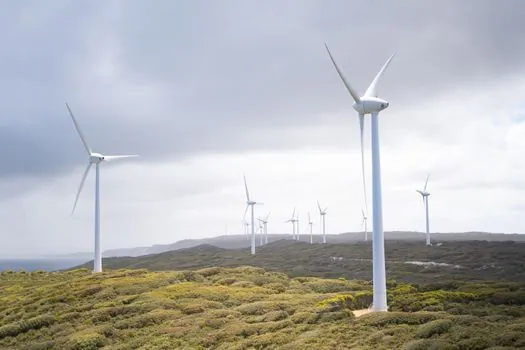
Three gearbox families dominate the wind fleet, and each maps to a different Industry 4.0 retrofit template. The table below lines up the three on four decision criteria that matter to a maintenance engineer, not a marketing brochure. [S1]
Planetary (single or two-stage): highest torque density, lowest nacelle mass per MW, common in 1.5-3 MW onshore and the new 10-15 MW offshore class. Carries the most sensors per stage, but planet-carrier access is constrained, so retrofits lean on non-contact vibration and oil-debris rather than embedded strain gauges. Helical (parallel-shaft, multi-stage): simpler to instrument, broader access to each shaft, and the most common drop-in replacement, which is why helical held a 38.2% share of the market in 2025 [S4]. Hybrid (planetary plus helical): increasing above 5 MW where the first stage absorbs the rotor torque and the second stage matches generator speed; sensor coverage follows both stages. Direct-drive and gearbox-free topologies bypass the gearbox entirely, so any Industry 4.0 spec for a direct-drive unit is really a generator-bearing and converter spec, not a gearbox spec [S3].
The practical rule of thumb: if your fleet is dominated by below-3 MW onshore with parallel-shaft helical gearboxes, the cheapest IIoT win is per-turbine vibration plus oil sensors with a fleet-level RUL model. If your fleet is 5 MW+ offshore with planetary or hybrid stages, plan for higher-bandwidth vibration, oil-debris on each planet stage, and a digital twin that models bearing fatigue explicitly, since bearing life gates gearbox life in most field data sets [S4].
Standards, Failure Modes, and What the Spec Sheet Should Demand
Three failure modes drive the Industry 4.0 spec. Macropitting and micropitting on gear flanks are the dominant gearbox failure mode in most published fleet data, and the leading indicator is usually the gear-mesh sideband energy in the vibration spectrum. Bearing white-etching cracking and rolling-contact fatigue are the second most common, and oil-debris plus dB/dt of vibration both surface the early stages. Oil-debris counts above roughly 100 ppm of ferrous content in a planetary loop are a standard trigger for an inspection window. [S2]
For offshore turbines, ingress protection is a separate spec line. Nacelle environments typically demand IP65 on the sensor housing, with the cable glands specified for salt-fog resistance, and the gearbox sensor manifold must coexist with the turbine's existing lightning and surge protection on the tower. Condition-monitoring equipment installed in the nacelle is also expected to meet the relevant Zone classifications for the location, which for a generator-bearing temperature probe near the converter can be Zone 2 inside a sealed nacelle.
Documentation expectations are tightening in parallel. Fleet owners increasingly require per-turbine digital-twin exports in an open format, a trend reflected in the American Clean Power Association's gearbox operations playbook, which positions the drivetrain as a coordinated ecosystem of components, monitoring systems, and maintenance practices rather than a standalone mechanical part [S5].
Who This Is For, and Who Should Skip the Retrofit

This spec map is for: owners of 1.5 MW and up gear-driven wind fleets with 10 or more units, who already have a SCADA historian and want to convert unplanned gearbox exchanges into planned ones; OEMs of planetary and helical gearboxes who need a sensor reference design they can ship with new units; and EPCs building above-5 MW offshore wind farms where any unscheduled crane visit costs materially. [S4]
This is not for: a single residential or community-scale turbine where the absolute cost of a vibration gateway exceeds the avoided-downtime value; an owner of a direct-drive fleet, since direct-drive has no gearbox and the equivalent spec is a generator-bearing and converter-monitoring scope [S3]; or a fleet under 3 years old whose drivetrain instrumentation was already specified at the factory, where bolt-on retrofits are usually redundant.
Vendor Landscape and Verifiable Signals
Named OEMs in published 2025-2026 market studies include GE Renewable Energy, Siemens Gamesa, Nordex, MHI Vestas, Senvion, Suzlon Energy, Goldwind, Envision Energy, and Siemens Energy, with bearing suppliers SKF, Timken, ZF Friedrichshafen, and Winergy cited as critical participants in the drivetrain ecosystem [S2][S4]. A single source from 2021 documents Moventas' first wind gearbox in 1980 and continued manufacturing presence, useful as a four-decade baseline rather than a current product spec [S1].
Trackable signals to watch over the next two quarters: published 2026 H1 OEE data from named OEMs that breaks out condition-monitoring-driven avoided downtime, ISO 4406 oil-cleanliness targets specified on new gearbox nameplates, and the first Ethernet-APL retrofit references for existing 5 MW+ offshore gearboxes, since the protocol is the most visible connective layer for nacelle-side IIoT.
Background reading: Climbing Formwork Selection for Landscaping Concrete Work.