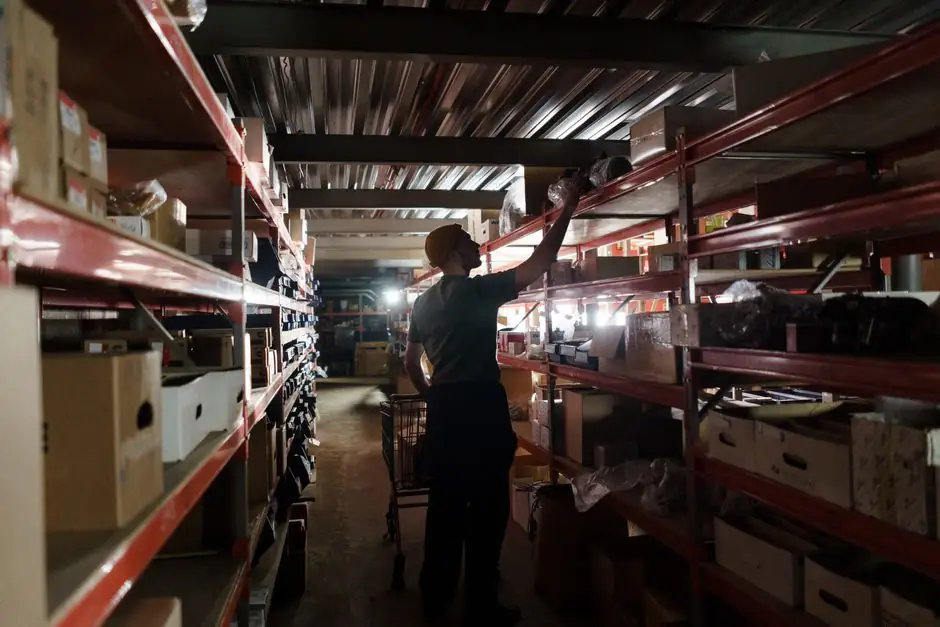
Retail distribution centers selecting an order picker in 2026 should anchor the decision on three numbers: lift height class, pick-rate benchmark, and operator labor cost, all of which move together when SKU mix shifts [S3][S5].
Order pickers lift the operator (and in some classes a small load) to the shelf face for item-level or case-level selection, distinct from a sit-down counterbalanced forklift that moves full pallets at ground level [S3]. A retail DC with mixed-SKU pallets and frequent replenishment typically needs both machines in parallel, the forklift for bulk put-away and the order picker for split-case fulfillment [S3].
Pick-Height Classes and What Each One Actually Solves
Low-level (ground or slightly elevated) order pickers operate at 2.5–2.8 m lift height, run in walk-behind or ride-on formats, and are sized for retail warehouses, grocery distribution, spare parts storage, and fast-moving pick faces [S3].
Mid-level order pickers cover 3–6 m lift height, add harness points and platform safety rails, and fit medium-density storage in 3PL warehouses, small-to-medium warehouses, manufacturing stores, and distribution hubs handling bulky items [S3]. High-level (vertical) order pickers for 6–12 m work exist but are typically specified for full-pallet reserve racking, not retail pick slots.
Throughput Benchmarks: Retail vs Grocery vs E-Commerce
Retail distribution centers typically achieve 80–150 cases per hour, with performance driven by SKU velocity and warehouse layout rather than raw operator speed [S5].
Grocery and foodservice distribution runs 120–200 cases/hour under case-picking and pallet-build workflows, while beverage distribution can hit 150–250 cases/hour because order profiles are predictable and SKUs are heavy [S5]. E-commerce piece picking sits at 60–120 order lines per hour, the lowest of the four because every stop is a single item, and pick-to-light, zone picking, or voice systems are what close the gap [S5].
Comparison: Low-Level vs Mid-Level vs High-Level Picker
For retail DC buyers, the decision pivots on lift height, typical pick rate, aisle footprint, and operator safety gear. Low-level units (2.5–2.8 m) suit case picking on the first rack level with 80–150 cases/hour retail benchmarks and no harness required [S3][S5]. Mid-level units (3–6 m) reach the second and third rack levels, require harness points and platform rails, and add cost but double the usable pick face per square foot [S3]. High-level (6–12 m) units move into very-narrow-aisle territory, demand a guided wire or rail floor, and are usually overkill for a retail DC unless the building is a true VNA design.
Labor and Ergonomics: The Cost Side of the Equation
A 2026 U.S. retail DC order selector position pays $21.50/hr base plus productivity incentives, with a published wage band of $18.00-$33.66/hr and shift conditions of 34-46 degrees general warehouse or down to -10 degrees in freezer zones [S2].
The physical envelope is non-trivial: standing or walking at least 10 hours, frequent push/pull/squat/bend/reach, 50 lb routine lifts, and occasional 70 lb lifts flagged for team lift, all of which feed directly into the case-per-hour benchmark above [S2]. A powered ride-on standing pallet jack, voice-based order system, and PPE compliance are the standard tool stack listed for perishable distribution work, so any power distribution upgrade on the truck should preserve 12V/24V accessory headroom for the voice terminal and scanner [S2].
Workflow Integration: Voice, Pick-to-Light, and Slotting
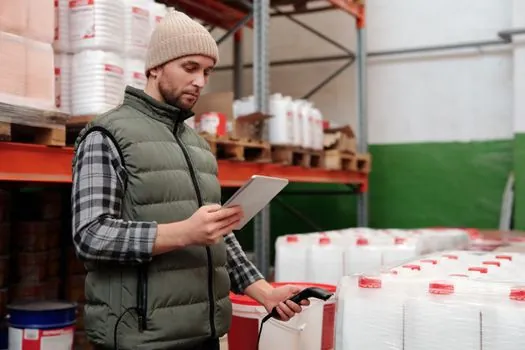
Voice picking is the most cited productivity lever in 2026 retail DC writing, with high-performing grocery and retail operations exceeding the 120–200 cases/hour range when voice is paired with optimized slotting [S5].
Pick-to-light and zone picking show measurable lifts in e-commerce piece picking, where the 60–120 lines/hour floor is set by stop frequency and travel time, not by operator skill [S5]. In mixed retail DCs, WMS-driven slotting that places A-movers on ergonomic pick faces typically drives the largest single jump in cases/hour, larger than the gain from switching picker class. Operators using electric ride-on pallet jacks, single or double, see less fatigue over a 10-hour shift, which directly protects the productivity curve at hour 8 when unassisted walk-behind workers slow down [S2].
Where the Order Picker is the Wrong Tool
Order pickers are not the right machine for full-pallet put-away, truck loading, or any horizontal-only movement: a sit-down counterbalanced forklift or reach truck outperforms them on those tasks by a wide margin, and the power distribution box on a picker-class truck is not sized for sustained high-current lift motors [S3].
Specifying a high-level (6–12 m) order picker in a building without a guided floor system is also a known failure mode: platform sway at height creates operator discomfort, and any explosion-proof distribution requirement in a -10 degree freezer with ripening-room transitions adds a certification layer that standard picker trucks do not carry [S2]. For purely ground-level case picking under 2.5 m, a walk-behind low-level picker is usually enough, and a mid-level truck is wasted capex.
Selection Checklist for a 2026 Retail DC Buyer

Confirm pick height against the tallest active pick face, not the building clear height: 2.5–2.8 m = low-level, 3–6 m = mid-level, 6–12 m = high-level [S3].
Set a productivity target inside the retail benchmark band of 80–150 cases/hour, with stretch toward 150 only after slotting and voice systems are in place [S5]. Budget labor at the $21.50/hr base / $18.00-$33.66/hr band seen in 2026 U.S. postings, and account for 8-10 hour shifts with rotating 4-day/10-hour weeks at perishable DCs [S2]. Demand harness points, platform rails, and a documented cold-rated distribution cabinet on any truck specified for freezer work, and a 50 lb routine / 70 lb occasional lift envelope in the operator job design [S2].
Two signals to track next: whether 2026 retail DC postings standardize on lithium-ion picker batteries (which cut recharge downtime versus lead-acid and shift the breakeven toward two-shift operation), and whether pick-rate benchmarks tighten above 150 cases/hour as voice-plus-slotting deployments mature [S3][S5]. For a deeper drill on aisle width and workflow matching, the order picker selection spec map walks through the same decision tree at the truck-build level.