An aluminum iron alloy is a wrought aluminum alloy in which iron is either the main alloying addition or the impurity that is held within close limits. Both cases rest on one physical fact: iron dissolves hardly at all in solid aluminum, so every fraction of a percent beyond that solubility freezes as an iron-aluminum intermetallic, and the size and shape of that phase decide what the metal can do. Dilute grades, the 1xxx and 8xxx series with roughly 0.4 to 2.0 % iron, are the foil, sheet and conductor stock of everyday use. Deliberately iron-rich grades made by rapid solidification or powder metallurgy, with 7 to 9 % iron and additions such as vanadium, silicon, molybdenum or cerium, carry strength into the range in which conventional age-hardening alloys have softened.
The buying decision concentrates on a few statements that have to be written into the order. The grade fixes the composition limits; the temper fixes the strength and ductility; the product form fixes the tolerances and the test methods; and the mill certificate proves that the lot meets all 3. That order is short for a foil coil of 8079 or a wire rod of 1350, where iron is controlled so that conductivity, formability and surface quality survive. It becomes an engineering task for a rapidly solidified alloy, where the powder route, the vacuum degassing, the consolidation and every later heating step decide whether the fine dispersoid that gives strength at temperature is still fine when the part is finished.
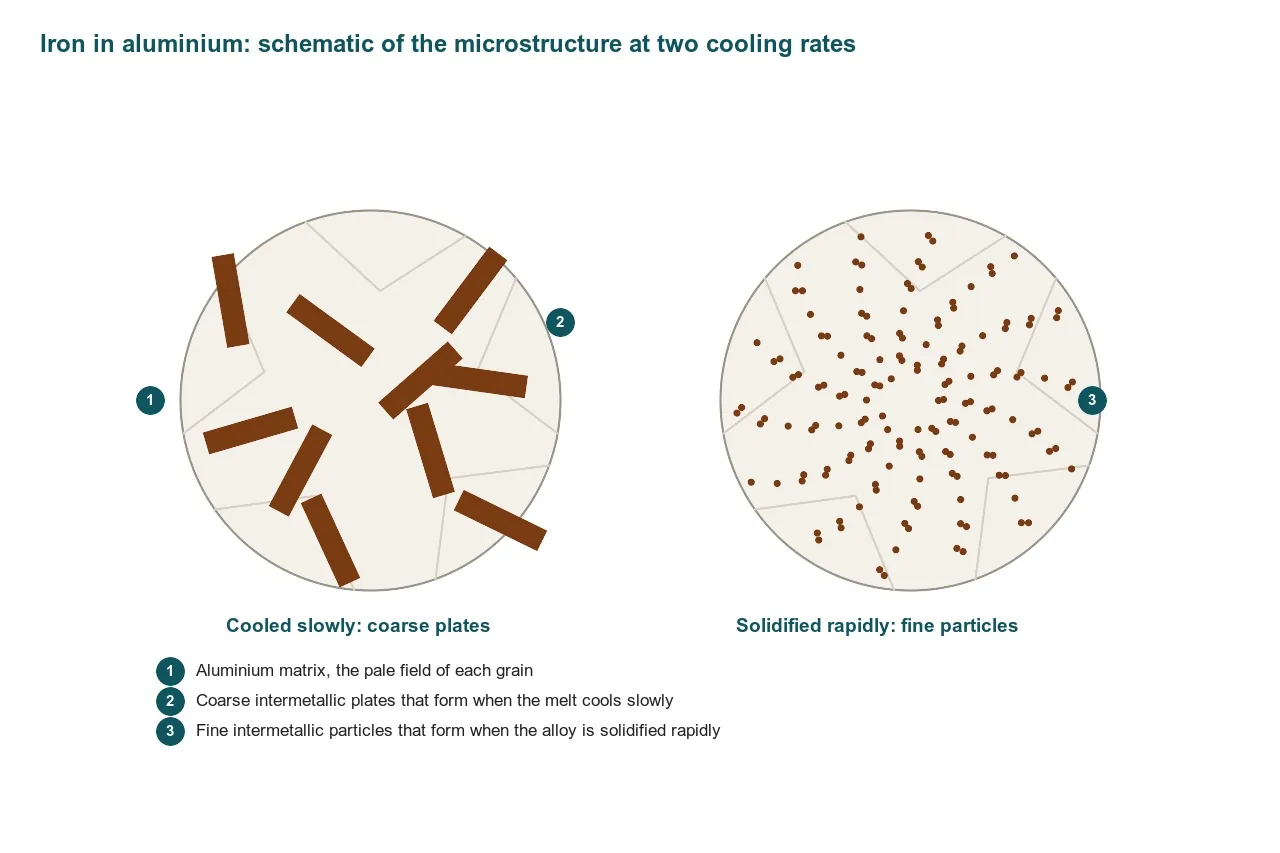
Diagram: SpecForge original drawing of the microstructure of an iron-bearing aluminium alloy at two cooling rates, made for this page.
The purchase of an aluminum iron alloy concentrates at 4 points. The first is the iron route: a dilute grade with iron as a controlled impurity, or a rapidly solidified grade with iron as the strengthening addition. The second is the phase condition, set by cooling rate and homogenization, because metastable Al6Fe and stable Al13Fe4 roll and anneal differently. The third is the temper, which writes strength and elongation. The fourth is the temperature the part must hold, since the dispersion-strengthened grades stay stable only to approximately 400 degrees Celsius (752 degrees Fahrenheit). A registered grade and an agreed temper close the order.
Chapter 1 / 06
What an Aluminum Iron Alloy Is and How It Works
An aluminum iron alloy is any wrought aluminum alloy whose registered composition makes iron the largest addition or the controlled impurity. The designation system places such alloys in 2 groups. The 1xxx group is unalloyed metal of 99.00 % minimum aluminum, where iron is limited as an impurity: 1050 allows 0.25 % silicon and 0.40 % iron, and 1100 allows 0.95 % silicon plus iron together. The 8xxx group holds alloys whose largest mean percentage falls on an element outside the 2xxx to 7xxx groups, which is where the iron-bearing foil alloys 8011, 8006 and 8079 sit. Iron is also the most common impurity of aluminum: it enters from a variety of sources and is very difficult to remove during recycling.
The working principle follows from the phase diagram. Iron has very little equilibrium solubility in solid aluminum, and the 2 metals form the equilibrium intermetallic Al13Fe4. Solidification in a real caster is never at equilibrium, so the iron that the growing aluminum grains reject forms metastable phases instead: Al6Fe, AlmFe or AlxFe, selected by the aluminum to iron ratio, the cooling rate and the other alloying or trace elements present. Al6Fe is the best characterized of them. It contains 25.6 % iron by mass, has an orthorhombic lattice of the Al6Mn type and a density of 3.45 g/cm3 against roughly 2.7 g/cm3 for the aluminum matrix.
Cooling rate selects the phase. One published sequence for binary aluminum-iron alloys puts only Al13Fe4 in castings cooled at up to 0.5 K/s, Al13Fe4 together with AlxFe between 0.5 and 0.9 K/s, AlxFe alone between 0.9 and 3 K/s, AlxFe with Al6Fe between 3 and 6 K/s, and Al6Fe above 6 K/s. AlmFe and Al9Fe2 appear only at very high cooling rates, and the limit above which they form is not known. A laboratory melt of Al-1.1 % Fe cast into a steel mold preheated to 450 degrees Celsius (842 degrees Fahrenheit) cooled at a measured 34.2 K/s and solidified metastable Al6Fe.
Size and form of the iron phase are what the rolling and annealing shop has to manage. In the as-cast Al-1.1 % Fe alloy the metastable constituent appears as very fine spherical particles and rods. Homogenization converts it to stable Al13Fe4 by diffusion of iron atoms through the aluminum matrix: at 600 degrees Celsius (1,112 degrees Fahrenheit) the change begins at the boundary between dendrites and eutectic areas, is mostly complete after 12 hours and complete only after 24 hours, with Al6Fe still detectable by X-ray diffraction at 4 hours. That is the mechanism behind one shop rule. Homogenize before heavy reduction, because non-equilibrium eutectics that are not removed can make the material rupture during further deformation.
When iron is added on purpose and the melt is solidified rapidly, the same insolubility becomes the strengthening mechanism. In the Al-Fe-V-Si family the alloy holds about 8 % iron with vanadium and silicon, and rapid solidification forms a ternary or quaternary intermetallic dispersoid with a symmetrical lattice that is thermally stable up to approximately 400 degrees Celsius (752 degrees Fahrenheit). The dispersoids measure under 50 nm as extruded and stay below roughly 100 nm after hot rolling, and they pin grain boundaries so effectively that grain size lies between 1.25 micron and about 0.3 micron according to dispersoid volume fraction. Strength comes from the interaction of dislocations with these insoluble particles.
The 2 routes give materials with different numbers. Dilute foil grades have nominal densities from 2.71 to 2.74 g/cm3 (0.098 to 0.099 lb/in3) and a melting range just below that of pure aluminum. The iron-rich dispersion-strengthened grades reach 2.92 g/cm3 (0.106 lb/in3) for the Al-Fe-Ce alloy 8019 and a modulus of 85 GPa (12,300 ksi) for the Al-Fe-V-Si alloy, and they conduct electricity less well, 25.8 % IACS against 31.8 % IACS for a conventional 2024 sheet. Neither group is an iron-rich iron aluminide: the ordered FeAl and Fe3Al phases, with Fe2Al5 and AlFe3 between them, are brittle intermetallics at the iron-rich end of the diagram and belong to a different family.
Chapter 2 / 06
Aluminum Iron Alloy Types and Boundaries
The first type is commercially pure aluminum, where iron is held as an impurity. The 1xxx grades are 99.00 % aluminum or purer and are bought for excellent corrosion resistance, excellent workability and high thermal and electrical conductivity, which is why they serve as transmission line conductors. 1350, with iron limited to 0.40 %, is the electrical grade; 1100, with copper 0.05 to 0.20 % and 0.95 % silicon plus iron, goes into food packaging trays. The last 2 digits of a 1xxx designation give the minimum aluminum content. These grades are not heat treatable: they are strengthened by cold work, as when rolling to thinner gauge, and softened by annealing.
The second type adds iron and silicon, and it is the foil family. 8011 carries 0.50 to 0.9 % silicon and 0.6 to 1.0 % iron. 8079 carries 0.05 to 0.30 % silicon and 0.7 to 1.3 % iron; 8005 0.20 to 0.50 % silicon and 0.40 to 0.8 % iron; and 8176 0.03 to 0.15 % silicon and 0.40 to 1.0 % iron. In 8011, 8079, 8005 and 8176 the elements not listed are limited to 0.05 % each and 0.15 % total. Iron is used here as an alloying element on purpose: at the cooling rates of thin cast stock metastable aluminum-iron eutectics solidify, and a proper homogenization anneal transforms them, which prepares the stock for the thermomechanical processing that follows.
The third type pairs iron with manganese. 8006 limits silicon to 0.40 %, copper to 0.30 % and magnesium to 0.10 %, and specifies iron 1.2 to 2.0 % with manganese 0.30 to 1.0 %. 8008 carries iron 0.9 to 1.6 % with manganese 0.50 to 1.0 %. The nominal density of 8006, 2.74 g/cm3 (0.099 lb/in3), is the highest among the dilute grades named here. Both elements are specified as ranges, not maxima, so they are deliberate additions, and a melt analysis below either lower limit is out of specification. And manganese belongs with the other alloying elements that decide which iron-bearing intermetallic forms, so the phase condition of these grades should be confirmed metallographically.
The fourth type is the rapidly solidified and powder-metallurgy family with transition-metal additions. The Al-Fe-V-Si alloy registered as 8009 specifies 8.4 to 8.9 % iron, 1.1 to 1.5 % vanadium and 1.7 to 1.9 % silicon, and its dispersoid takes 27 % by volume; compositions of the system run from 8 % to 36 % dispersoid. The Aluminum Association now lists 8009 among its inactive original alloys, so it is bought to a drawing or a material specification rather than as a live registered grade. The Al-Fe-Ce alloy 8019, with 7.3 to 9.3 % iron and 3.5 to 4.5 % cerium, is registered and active. An Al-8Fe-2Mo sheet exists as well and can be welded by electron beam when its hydrogen content is below 1 wppm.
The same compositions arrive in different forms, and the form says how they were made. Dilute grades come as sheet, as foil, one stocked gauge being 0.012 mm, and as wire rod drawn into wire for conductors and cables. The dispersion-strengthened alloys come as metal powder, as consolidated billet, as extrusion, as hot-rolled sheet nominally 1.6 mm thick and as forgings, each made by canning the powder, vacuum hot degassing it, extruding it and then rolling or forging. A cold forged heat treated aluminum forging of a conventional alloy belongs to the wrought family that iron merely contaminates. The powder-metallurgy iron-rich grades go into stiff panels, riveted or spot welded, and into angles, zees and channels hot formed above 370 degrees Celsius (about 700 degrees Fahrenheit).
The boundary with neighboring materials is best drawn by what iron is doing. In an aluminum alloy of the 2xxx to 7xxx series iron is only an impurity with a maximum limit; aluminum alloy 7178 is a zinc-based aircraft alloy. Titanium alloy is the metal against which the dispersion-strengthened aluminum-iron grades were proposed for duties up to 150 to 300 degrees Celsius (300 to 600 degrees Fahrenheit). Alloy steel and nickel alloy are the other heat-resisting neighbors, and all 3 remain the choice for hotter duty. Iron-rich iron aluminides stand on the far side: ordered FeAl and Fe3Al, brittle intermetallics that form on the steel side when steel and aluminum are joined. Alloys made for an aluminum die casting machine are cast products, not the wrought products of this page.
Chapter 3 / 06
Key Specification Parameters and Standards
Four standard documents govern what a specification for these alloys may say. ASTM B209/B209M covers aluminum and aluminum-alloy flat sheet, coiled sheet and plate; it applies to those forms only, in the alloys and tempers listed in its tables, and it requires the alloy and temper designations of ANSI H35.1/H35.1(M), with Unified Numbering System numbers formed by adding A9, as A98079 is for 8079. ISO 209 gives the chemical composition limits of wrought products and ingots and takes the Aluminum Association registration record as the normative reference for the designations. ISO 2107 establishes the temper designations for all product forms of wrought aluminum. Foil, wire, powder and forgings are covered by separate product-form standards to be named in the order.
Composition limits come first because everything else follows them. For the dilute grades the iron content lies between 0.40 % and 2.0 %, and for the Al-Fe-Ce and Al-Fe-V-Si grades between 7.3 % and 9.3 %. Nominal density is computed from the composition and rounded: 2.705 g/cm3 (0.0975 lb/in3) for 1050 and 1350, 2.71 g/cm3 (0.098 lb/in3) for 1100, 8011 and 8176, 2.72 g/cm3 for 8079, 2.74 g/cm3 (0.099 lb/in3) for 8006 and 2.92 g/cm3 (0.106 lb/in3) for 8019. These are nominal values for calculating weight per unit area or length, not engineering requirements to be written into an order.
Mechanical and physical values depend on temper and form. Soft annealed 8079 foil 0.012 mm thick has a tensile strength of 150 MPa (21.8 ksi), elongation at break of 2.2 %, Brinell hardness of 45 to 55 HBW, modulus of 69 GPa (10,000 ksi), electrical resistivity of 2.97 microhm cm, thermal conductivity of 230 W per m per K (133 Btu per hour per foot per degree Fahrenheit) and a coefficient of thermal expansion of 23 ppm per K (12.8 ppm per degree Fahrenheit). Rapidly solidified Al-Fe-V-Si sheet hot rolled at 300 degrees Celsius (572 degrees Fahrenheit) reached 430 MPa (62.4 ksi) yield strength, 454 MPa (65.8 ksi) tensile strength and 13.3 % elongation, and its modulus was 85 GPa (12,300 ksi).
Parameter
Typical value or range
What it decides
Iron content, dilute grades
0.40 to 2.0 %
Strength of foil and sheet
Iron content, dispersion-strengthened grades
7.3 to 9.3 %
Volume fraction of dispersoid
Nominal density
2.71 to 2.92 g/cm3 (0.098 to 0.106 lb/in3)
Mass of coil or part
Melting range, Al-1.1 % Fe
645.6 to 656.8 degrees Celsius (1,194 to 1,214 degrees Fahrenheit)
Solidus and liquidus
Elastic modulus
69 to 85 GPa (10,000 to 12,300 ksi)
Deflection and buckling
Tensile strength
150 to 530 MPa (21.8 to 76.9 ksi)
Allowable stress
Yield strength, Al-Fe-V-Si sheet
172 to 500 MPa (25.0 to 72.5 ksi)
Design stress
Elongation
2.2 to 30.7 %
Formability
Hardness, soft 8079 foil
45 to 55 HBW
Temper check
Electrical resistivity
2.97 microhm cm
Conductor duty
Thermal conductivity, 8079 foil
230 W per m per K (133 Btu per h per ft per degree Fahrenheit)
Heat transfer through foil
Thermal expansion, 8079 foil
23 ppm per K (12.8 ppm per degree Fahrenheit)
Mismatch with steel and copper
Strength retention, Al-Fe-V-Si
stable to approximately 400 degrees Celsius (752 degrees Fahrenheit)
Service temperature ceiling
Chapter 4 / 06
Selection and Duty Calculations
Selection starts with one question: is iron in this alloy an impurity to be limited, or a strengthening phase to be created? The answer fixes the grade list, the temper logic and the temperature the part can hold, and each of them has a calculation attached.
For a foil coil, a tray blank or a conductor, iron is the impurity or the modest addition, and the choice runs through the dilute grades: 1xxx where conductivity and corrosion resistance lead, an iron-silicon grade such as 8011 or 8079 where foil strength and annealing behavior lead, or 8006 where the iron content goes to 2.0 % with manganese beside it. For a stiff panel, a bracket or a fitting that must hold load at 150 to 300 degrees Celsius (300 to 600 degrees Fahrenheit) and beyond, the choice moves to the rapidly solidified grades, in which strength does not depend on precipitates that soften on reheating.
With the grade chosen, gauge and temper set the strength. Dilute grades are not heat treatable: rolling to thinner gauge raises strength by cold work, and annealing returns ductility, so the buyer orders the temper that the forming step needs. Soft annealed 8079 foil 0.012 mm thick and 200 mm wide has a cross-section of 2.4 mm2, and at 150 MPa (21.8 ksi) tensile strength it breaks at about 360 N (81 lbf). The same foil carries a mass of only 32.6 g per square meter at its nominal density of 2.72 g/cm3, so foil is specified by thickness tolerance and temper, never by a load rating borrowed from sheet data.
Mass and stiffness calculations use the nominal density and the modulus. A 1.6 mm sheet at the 2.92 g/cm3 of 8019 weighs 4.7 kg per square meter, against 4.3 kg per square meter for 1100 at 2.71 g/cm3, so the dispersion-strengthened part buys its temperature capability with about 8 % more mass per unit area. The modulus measured on the Al-Fe-V-Si alloy, 85 GPa (12,300 ksi), is about 23 % above the 69 GPa (10,000 ksi) of the dilute grades, so a panel of equal thickness deflects less under the same load. The gain is real but modest, and the engineer should take both numbers from the certificate of the actual lot.
Temperature duty is where the rapidly solidified grades justify their cost. Sheet of Al-Fe-V-Si showed insignificant change in tensile properties, in tests reported in 1991, after 120 hours or 504 hours at 400 degrees Celsius (752 degrees Fahrenheit) and after 120 hours at 455 degrees Celsius (851 degrees Fahrenheit). After 120 hours at 510 degrees Celsius (950 degrees Fahrenheit) yield and tensile strength had fallen by almost 10 % and elongation by nearly 50 %. Above 600 degrees Celsius (1,112 degrees Fahrenheit) the dispersoid coarsens rapidly and transforms to needle-like Al3Fe. They are creep resistant, so very high temperatures are needed to reduce their flow stress. The design rule follows: keep the long service temperature below 400 degrees Celsius (752 degrees Fahrenheit), and keep every process step, welding and hot forming included, as far below 500 degrees Celsius (932 degrees Fahrenheit) as the schedule allows.
Electrical and thermal duties follow from 2 numbers in the table. With a resistivity of 2.97 microhm cm, equal to 0.0297 ohm mm2 per m, the 0.012 mm by 200 mm foil strip has a resistance of about 0.012 ohm per meter. Thermal expansion of 23 ppm per K (12.8 ppm per degree Fahrenheit) lengthens a 1 m strip by 2.3 mm over a 100 K (180 degrees Fahrenheit) rise, which sets the wrinkle allowance when foil is laminated to a material that expands less. The dispersion-strengthened grades conduct at 25.8 % IACS, below the 31.8 % IACS of 2024 sheet, which reduces the current that shunts between adjacent resistance spot welds.
Decision factor
Options or value
Why it decides
Iron route
Dilute, 0.40 to 2.0 % Fe; or dispersion strengthened, 7.3 to 9.3 % Fe
Strength at temperature
Alloying partners
Si in 8011 and 8079; Fe and Mn in 8006; Fe, V and Si in 8009; Fe and Ce in 8019
The grade and its phase mixture
Temper
Soft annealed, or strain hardened and partly annealed
Above 6 K/s gives Al6Fe; 600 degrees Celsius (1,112 degrees Fahrenheit) for 12 to 24 hours converts it
Formability of cast stock
Registration status
8011, 8079 and 8019 active; 8009 inactive
Ordering by designation
Chapter 5 / 06
Processing, Heat Treatment, and Typical Failure Modes
Processing is where an aluminum iron alloy is won or lost, because every thermal step moves iron between phases. Melting and casting set the phase, homogenization and rolling set its shape, and consolidation, forming and welding decide whether the fine dispersoid survives to the finished part.
Melting and casting come first. The melt is prepared in a gas aluminum melting furnace or an induction furnace, held and refined in a holding furnace and transferred in a casting ladle. The iron level is set by the raw materials and the scrap mix, because iron enters aluminum from a variety of sources and is very difficult to remove in recycling. Casting into a steel mold can give cooling rates near 30 to 40 K/s: laboratory rods 160 mm long and 15 mm in diameter were cast into a mold preheated to 450 degrees Celsius (842 degrees Fahrenheit) at a measured 34.2 K/s and solidified metastable Al6Fe. The phase that forms depends on the cooling rate and the trace elements, so heavy and thin sections of one grade leave the caster in different conditions.
The dispersion-strengthened grades take the powder route. The melt is broken into powder that solidifies rapidly, the powder is canned and vacuum hot degassed, the consolidated billet is extruded, and the extrusion is hot rolled into sheet. Sheet 1.6 mm thick was made this way in a standard and in an extended degassing condition, the longer 20 hour treatment being chosen to lower the hydrogen content and improve weldability. Degassing is not a formality: porosity in fusion welds was clearly lower in the 20 hour material than in material degassed for 2 hours. Incoming billet is therefore inspected for internal voids on an ultrasonic flaw detector, and a densitometer reading on a machined sample shows whether it reached full density.
Homogenization, rolling and annealing then shape the phase. Dilute cast stock is homogenized so that metastable Al6Fe converts to stable Al13Fe4 before heavy reduction, which takes 12 to 24 hours at 600 degrees Celsius (1,112 degrees Fahrenheit), and a thermocouple at the load, not only at the heat treatment furnace, confirms the temperature. In the dispersion-strengthened alloys rolling temperature is the controlling variable. Hot rolled at 300 degrees Celsius (572 degrees Fahrenheit), 400 degrees Celsius (752 degrees Fahrenheit) and 500 degrees Celsius (932 degrees Fahrenheit), Al-Fe-V-Si sheet fell from 454 MPa (65.8 ksi) to 416 MPa (60.3 ksi) and then to 342 MPa (49.6 ksi) in tensile strength, while elongation rose from 13.3 % to 17.4 % and 18.0 %. Superplastic forming fails because the dispersoids pin the grain boundaries.
Joining is the step that most often fails. Gas tungsten arc welding, the work of a TIG welder, produced smooth continuous autogenous welds in both degassing conditions. Electron beam welding is a poor match for the Al-Fe-V-Si sheet: porosity persisted even with hydrogen at about 4 wppm, although an Al-8Fe-2Mo sheet 0.65 mm thick welded soundly by the same method with hydrogen below 1 wppm. Resistance spot welding was readily done, at about 80 % of the shear strength specified for conventional aluminum alloys of similar strength, and it benefited from the low conductivity of 25.8 % IACS. Where steel and aluminum are joined with an arc welder, embrittling ordered intermetallics form on the steel-rich side, so a direct fusion joint to stainless steel or carbon steel should be avoided.
Testing closes the loop. Chemical analysis is made by inductively coupled plasma spectroscopy, on a mass spectrometer or a spectrophotometer that reads each element against the registered limits. Metallography on a polished section shows the size, shape and identity of the iron phase: optical microscopy and scanning electron microscopy resolve the fine spherical particles attributed to Al6Fe and the darker, sharper particles attributed to Al13Fe4, X-ray diffraction tells the 2 apart by their peak positions, and differential scanning calorimetry finds the metastable phase by its melting peak at 645.6 degrees Celsius (1,194 degrees Fahrenheit). Mechanical acceptance runs on a tensile testing machine, on a hardness tester for the Brinell value, and on a conductivity meter for the electrical grades.
Failure mode
Where it shows
Cause and remedy
Residual metastable Al6Fe
Cast or under-homogenized stock; rupture in heavy reduction
Hold 600 degrees Celsius (1,112 degrees Fahrenheit) for up to 24 hours
Dispersoid coarsening
Parts or welds heated above 500 degrees Celsius (932 degrees Fahrenheit)
Extend vacuum degassing to 20 hours; prefer gas tungsten arc welding
Strength lost in hot rolling
Sheet rolled at 500 degrees Celsius (932 degrees Fahrenheit)
454 MPa (65.8 ksi) at 300 degrees Celsius (572 degrees Fahrenheit) fell to 342 MPa (49.6 ksi)
Brittle intermetallic layer
Joints between aluminum and steel
Avoid direct fusion; use a filler or a barrier layer
Low elongation in thin foil
Soft foil 0.012 mm thick, 2.2 % elongation at break
Order the temper for the forming step
Chapter 6 / 06
Industry Applications and Procurement Checks
Packaging foil is the everyday use of iron-bearing aluminum. Iron is used as an alloying element mainly in aluminum foil production, and the iron-silicon grades 8011, 8079, 8005 and 8176 and the iron-manganese grades 8006 and 8008 are the registered compositions of that family. Conductors are the second family: 1350 wire rod is drawn and stranded for the transmission lines that connect national grids, chosen for high electrical conductivity together with corrosion resistance and workability. The dispersion-strengthened grades were developed for aircraft structure that must hold load at 150 to 300 degrees Celsius (300 to 600 degrees Fahrenheit), where they could double the useful temperature range of conventional aluminum alloys: zee-stiffened compression panels and hot formed angles, zees and channels.
Conductor and heat-transfer duties follow from the physical values. 1350, with iron limited to 0.40 %, is rolled to wire rod, drawn to wire and stranded into overhead lines; a steel strand may carry the core of a long span while the aluminum layers carry the current, and a power cable of similar metal is sold on conductivity. 8079 foil, at 230 W per m per K (133 Btu per hour per foot per degree Fahrenheit), conducts heat well for its mass, and its expansion of 23 ppm per K (12.8 ppm per degree Fahrenheit) sets how it behaves when it is laminated to a material that expands less.
Cost and lead time follow from the number of steps. A dilute foil grade is a high-volume mill product: the order is filled from standard coils, and the variables are thickness tolerance, width, temper and surface finish. A dispersion-strengthened alloy is a small-tonnage product with powder making, canning, vacuum degassing and consolidation before any forming, so its lead time is set by powder and billet capacity rather than by coil inventory, and cost rises with each thermal step rather than with the metal content. The inactive registration of 8009 adds a further step, because buyer and supplier must agree a material specification and a test plan in place of a standard designation.
An order for an aluminum iron alloy must state 6 things and ask for 3 more. State the registered grade, and where the grade gives ranges rather than maxima, the aim within the range for iron, silicon and manganese. State the temper in the designation form of ANSI H35.1/H35.1(M) or ISO 2107. State the product form, thickness or diameter, width, and the dimensional standard the form is ordered to. State the mechanical properties to be certified, with tensile and elongation minima for the temper. State the resistivity or conductivity requirement for electrical grades. State the service temperature and the joining method for dispersion-strengthened parts. Ask for the mill certificate with the full chemical analysis. Ask for the test reports for tensile, hardness and conductivity. For foil and for every powder-metallurgy product, ask in addition for a metallographic report on the iron-bearing phase and for the homogenization or degassing cycle, with the hydrogen limit of the powder. For an inactive grade such as 8009, agree the material specification before the price is discussed.
FAQ
What is an aluminum iron alloy?
It is a wrought aluminum alloy in which iron is either the main alloying addition or the impurity held within close limits. Iron dissolves hardly at all in solid aluminum, so it freezes as iron-aluminum intermetallics, and the size and shape of those phases decide strength, ductility and recrystallization behavior. Dilute 1xxx and 8xxx grades with 0.4 to 2.0 % iron (8011, 8079, 1350) are the foil, sheet and conductor stock of daily use. Rapidly solidified grades with 7 to 9 % iron and additions of vanadium, silicon or cerium keep their strength up to approximately 400 degrees Celsius (752 degrees Fahrenheit).
How does iron strengthen aluminum?
Iron strengthens aluminum in 2 ways. In dilute grades the iron-bearing intermetallics, above all stable Al13Fe4, set how the sheet rolls and recrystallizes, and which metastable phase the caster produces depends on cooling rate: only Al13Fe4 up to 0.5 K/s, Al6Fe above 6 K/s. Homogenization at 600 degrees Celsius (1,112 degrees Fahrenheit) for 12 to 24 hours converts metastable Al6Fe to the stable phase. In rapidly solidified grades, 8 to 9 % iron with vanadium and silicon forms a silicide dispersoid under 50 nm that pins grain boundaries and is stable to approximately 400 degrees Celsius (752 degrees Fahrenheit). Above 500 degrees Celsius (932 degrees Fahrenheit) the dispersoid coarsens and strength falls.
What types of aluminum iron alloy exist?
Four types cover the field. The 1xxx grades are 99.00 % aluminum or purer with iron limited as an impurity, and serve as conductors and packaging stock. The iron-silicon grades 8011, 8079, 8005, 8176 and 8017 are foil alloys with iron 0.4 to 1.3 %. The iron-manganese grades 8006 and 8008 carry iron 0.9 to 2.0 % with manganese 0.30 to 1.0 %. The rapidly solidified grades carry far more iron: 8009 (Al-Fe-V-Si, now listed as inactive), 8019 (Al-Fe-Ce, with 7.3 to 9.3 % iron and 3.5 to 4.5 % cerium) and an Al-8Fe-2Mo sheet. Forms run from foil, sheet and wire rod to powder, consolidated billet, extrusion and forgings.
Which specifications matter most for an aluminum iron alloy?
Composition limits come first: the registered limits for each grade, with iron between 0.40 % and 2.0 % in the dilute grades and 7.3 to 9.3 % in the dispersion-strengthened ones. Then the temper, which sets tensile strength and elongation: 150 MPa (21.8 ksi) and 2.2 % elongation for soft annealed 8079 foil 0.012 mm thick. Nominal density runs from 2.71 to 2.92 g/cm3 (0.098 to 0.106 lb/in3) and the modulus from 69 to 85 GPa (10,000 to 12,300 ksi). The applicable standards are ASTM B209/B209M, ISO 209 for composition, and ISO 2107 and ANSI H35.1/H35.1(M) for tempers and designations.
How do I choose between a dilute and a rapidly solidified grade?
Decide by duty. Choose a dilute grade for foil, packaging, conductors and sheet that work at ordinary temperatures: 1350 where conductivity leads, 8011 or 8079 for foil, 8006 for the highest iron content. Choose a rapidly solidified grade only when the part must hold load at 150 to 300 degrees Celsius (300 to 600 degrees Fahrenheit) or beyond. The gain is tensile strength up to 530 MPa (76.9 ksi) with a modulus of 85 GPa (12,300 ksi); the price is a powder route, limited cold formability and difficult welding. Check the registration: 8019 is active, while 8009 is listed as inactive and has to be bought to an agreed material specification.
Can aluminum iron alloys be heat treated and welded?
The dilute grades are not heat treatable: they are strengthened by cold work and softened by annealing, and cast stock is homogenized, 12 to 24 hours at 600 degrees Celsius (1,112 degrees Fahrenheit), to convert metastable Al6Fe to stable Al13Fe4 before rolling. The dispersion-strengthened grades are shaped by hot working: brake forming above 370 degrees Celsius (about 700 degrees Fahrenheit) gave a 0.79 mm (1/32 in.) bend radius on 1.6 mm sheet, while superplastic forming fails and cold forming is limited. Gas tungsten arc welding gave sound welds; electron beam welding left porosity even after extended vacuum degassing. Keep heating above 500 degrees Celsius (932 degrees Fahrenheit) to a minimum, because there the dispersoid coarsens.
What standards apply, and what drives cost and lead time?
ASTM B209/B209M covers aluminum and aluminum-alloy flat sheet, coiled sheet and plate in the alloys and tempers listed in its tables, and refers alloy and temper designations to ANSI H35.1/H35.1(M). ISO 209 specifies the chemical composition limits of wrought products and ingots, and ISO 2107 establishes the temper designations for all product forms. Cost and lead time follow from the process route. A dilute foil or conductor grade is a high-volume mill product filled from coil inventory; a dispersion-strengthened alloy needs powder making, canning, vacuum degassing and consolidation before forming. An inactive designation such as 8009 adds the work of an agreed material specification and test plan.